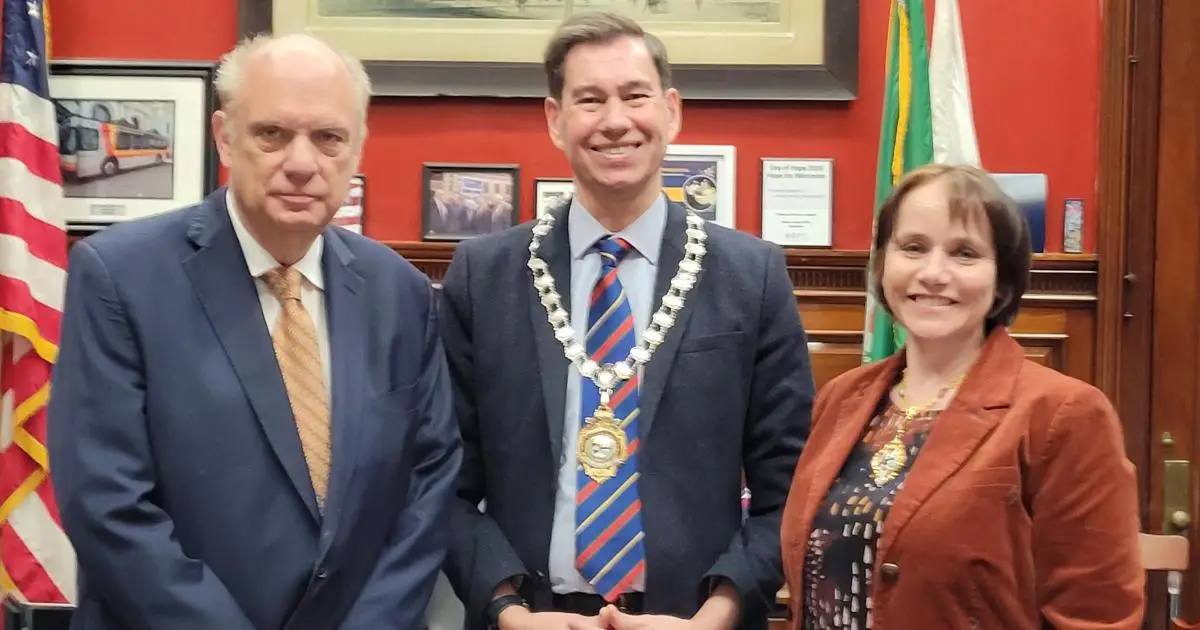

IT was a great honour to represent Worcester on a recent mayoral visit to our twin city of Worcester, Massachusetts, in the United States.
The occasion highlighted not only the warmth of our transatlantic friendship but also the deep historical ties that connect our two communities. From the outset the visit was marked by extraordinary hospitality.
Worcester mayoress Councillor Dr Zoe Cookson and I were warmly welcomed by the mayor Joe Petty, council members and residents whose kindness and generosity made a lasting impression.
Worcester mayor and mayoress Matt Lamb and Zoe Cookson with Worcester, Massachusetts, mayor Joe Petty (Image: Worcester City Council)
Matt Lamb and Zoe Cookson with members of the council (Image: Worcester City Council)

The visit included a number of memorable engagements that brought to life the vibrancy and civic pride of Worcester, Massachusetts.
At Doherty Memorial High School we were delighted to meet principal John Staley and spend time with students and staff.
Matt Lamb and Zoe Cookson with principal John Staley of Doherty Memorial High School (Image: Worcester City Council)
A particularly moving moment came when members of the school choir sang both The Star-Spangled Banner and God Save the King.
It was a thoughtful and generous gesture that captured perfectly the spirit of friendship between our two nations.
We were also privileged to visit the Worcester Art Museum where we were given a personal tour by its director Dr Matthias Waschek.
Matt Lamb and Zoe Cookson with Dr Matthias Waschek, director of Worcester Art Museum (Image: Worcester City Council)
Although the museum is usually closed on a Tuesday, it was specially opened for our visit — an act of great generosity for which we are most grateful.
Among the many treasures we were shown was a Royal Worcester porcelain vase, a striking and symbolic reminder of the craftsmanship for which our own city is renowned and a tangible link between the two Worcesters.
At Worcester State University we met president Barry Maloney and discussed the strong and growing links with our own University of Worcester.
More: 9 photos from pubs in and around Worcester in the 2000s
More: Do you remember these skittles champions from 1983?
More: All your photos celebrating National Pet Day
It was encouraging to hear about the collaboration already taking place and the potential for further academic and cultural exchange in the future.
Education is clearly at the heart of Worcester, Massachusetts, just as it is in our own city, and this shared focus offers real opportunities for partnership.
Speaking in the council chamber at City Hall at the end of our day I reflected on the shared story of our two cities and the wider relationship between Britain and the United States, particularly in this year marking the 250th anniversary of American independence.
Worcester City Hall in Massachusetts (Image: Worcester City Council)
During the council meeting staff from the British Consulate in Boston added a thoughtful and symbolic touch by bringing a selection of Union Flags, one of which was displayed in the chamber alongside the Stars and Stripes — an understated but meaningful reminder of the connection between our countries.
It is always special to visit a place that shares Worcester’s name but this connection goes far beyond that.
Our cities have been formally twinned since 1999 yet the links between us stretch back centuries, rooted in shared traditions, language and history.
There are, of course, differences.
Worcester, Massachusetts, with a population of over 200,000, is more than twice the size of what we affectionately call the Faithful City.
While Worcester in the US only became a town in 1722 and a city in 1848, Worcester in England can trace its origins back nearly 2,000 years to a Roman settlement on the banks of the River Severn.
Yet, despite these differences in scale and age, the parallels are striking.
Both cities were shaped by industry and craftsmanship.
Worcester in England became renowned for its porcelain, glove-making and Worcestershire sauce while Worcester, Massachusetts, built its reputation on steel, wire, shoes and clothing manufacturing.
Today both cities have successfully adapted to the challenges of economic change. Like many industrial centres Worcester, Massachusetts, experienced significant transition in the late 20th century.
What is so impressive is the way the city has reinvented itself as a hub for education, healthcare, biotechnology and research.
Worcester in England has followed a similar path with our own economy increasingly centred on education, culture and health services.
In that sense we share not only a past but a story of resilience and renewal.
Our shared heritage also extends into the political and constitutional history that underpins both our nations.
Worcester in England played a key role in the English Civil War with the first battle fought nearby at Powick Bridge in 1642 and the final, decisive Battle of Worcester in 1651.
These events formed part of a longer journey towards the principle that power must be limited and accountable — ideas that would later inspire and shape the American Revolution 250 years ago.
In the years since men and women from our two countries have served alongside each other in conflicts like World War I, World War II, Korea, Iraq and Afghanistan in the defence of freedom.
Ultimately, what this visit reinforced is the connection between our two Worcesters is about more than history.
It is about people, ideas and a shared commitment to the values of democracy, liberty and community.
Two cities with one shared name united by centuries of history and friendship across an ocean.
I am deeply grateful to the mayor and people of Worcester, Massachusetts, for their outstanding hospitality and I look forward to our Worcester continuing to build on this special relationship in the years ahead.