

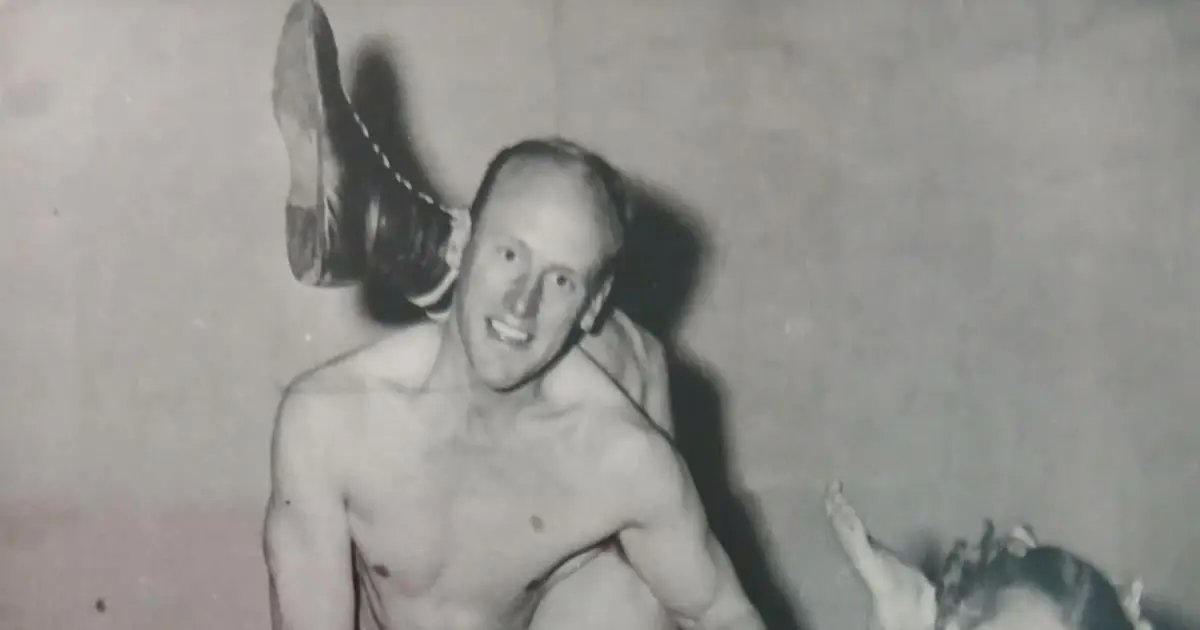

OF all the characters who walked Worcester’s streets in the decades either side of the Second World War, few shaped up to Marcel Callow, literally.
Because the contortionist known as The Rubber Man was one on his own. A boxer, circus and variety hall star, too, Marcel retained his flexibility well into later life.
When he was 74, surgeons fitted him with an artificial kneecap and steel leg plate because of arthritis, but within a fortnight he was able to bend himself double again.
His wife Nellie said at the time, “When people ask how he’s doing, I tell them he’s back on his head again.”
Marcel was born in St. John’s, Worcester and discovered his contortionist talent by accident.
As a schoolboy in the 1920s, he cut such a weedy-looking figure, his friends called him The Human Hairpin. So his father, a keen runner, introduced him to boxing to toughen him up.
It was to change his life, because through boxing young Marcel discovered the limelight he had begun to crave.
By the time he turned professional aged only 15, he was already establishing a reputation as a bit of a dandy – fancy dresser and smart with the chat, especially to the girls. The sort of chap people loved to see hammered in the ring.
Except he didn’t get hammered that often because Marcel discovered another way to grab the spotlight.
Working on his exercises in the gym, he found he could contort himself way beyond the limits of most of his friends.
“I started bending to keep supple,” he said. “My manager would find me lying in the gym with my legs under my armpits.”
One day, after a bout at Malvern Winter Gardens, Marcel slipped in a few contortions for the crowd.
They went better than the boxing and soon he was appearing on bills not to fight, but as a fill-in attraction with his contortions between matches.
In the years leading up to WW2, the Rubber Man was a highlight on boxing bills across the country.
Marcel limped out of the war after a fellow soldier accidentally stuck a bayonet through his foot, but his unique talent found a home in the ranks of ENSA and his act was a high spot of the wartime variety shows that toured searchlight stations and other military bases.
On demob, Marcel began work as a steel fixer in Cheltenham, but when it was found the second Callow daughter Antionette had inherited her father’s talent for contortion, a family act took to the stage.
As a highlight, Marcel would juggle the Child Wonder – as five-year-old Antoinette was known – on the soles of his feet with her knotted into a ball.
They turned professional and toured all over the country, people flocking to see the diminutive girl and her muscular bronze father twist themselves into identical, unbelievable shapes. The act ran for 15 years and ended when Antoinette left to get married.
“People ask us if we were double jointed,” said her father. “But you show me what a double joint is. No, we were not freaks, we just practised and practised. We became very supple. That was all. I suppose anyone could have done it if they had tried.”
Marcel and Nellie lived for many years in the Diglis area of Worcester in Portland Street. Later they moved to accommodation across the city at St Oswald’s Hospital in The Tything.
Marcel Callow died in Worcestershire Royal Hospital in 2005 following a stroke and The Rubber Man was still at last.