

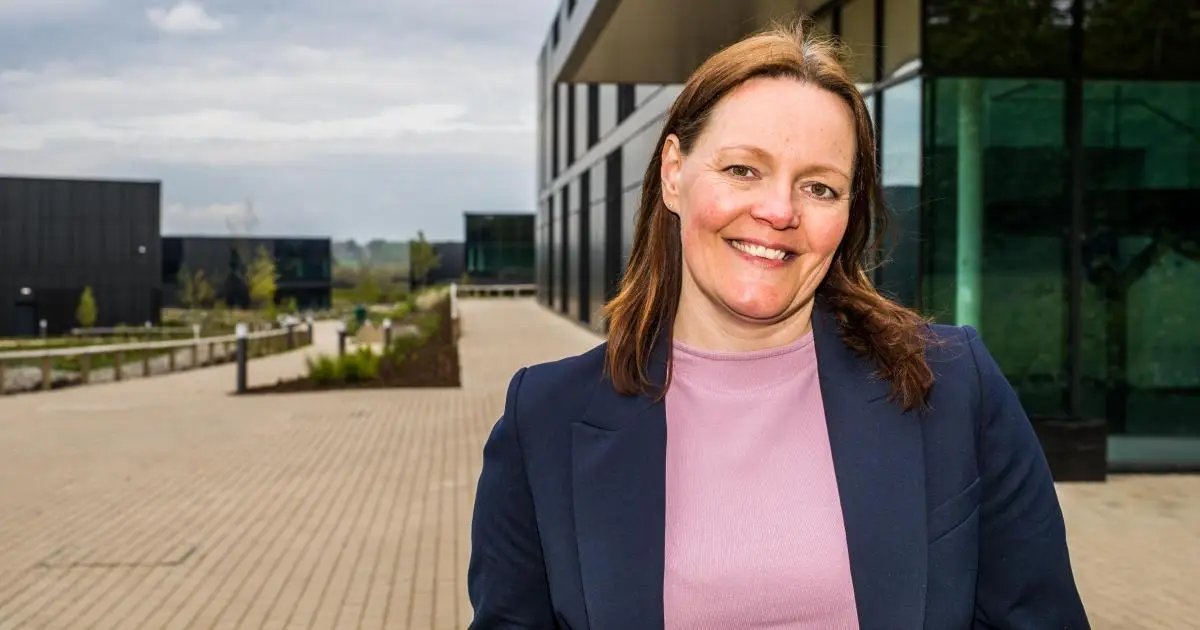

Business Durham’s new managing director, Kerry Walker, tells Mike Hughes that stepping into the top job feels like ‘more than anything, an honour’.
Sitting in the boardroom at the North East Technology Park (NETPark), County Durham’s flagship science and technology park, Kerry Walker is relishing the pace and ambition that comes with her new role.
Kerry has recently been appointed managing director at Durham County Council’s business support service, Business Durham.
The team she leads works with companies to help them start, grow and invest in County Durham, while also managing a diverse portfolio of business premises across the county to support companies at every stage of growth.
‘It’s really exciting,’ she says. ‘I often say that, more than anything, it’s an honour.
‘The team and the reputation that Business Durham has is phenomenal, so I am truly honoured to be able to have the chance to take us forward.’
What makes that responsibility feel real is the sense that Durham is on the verge of something transformational. There is a journey underway here, with a remarkable past and a future that promises so much more.
‘We’re not doing this for us. We’re doing it for the next generation, and then the one after that and the one after that,’ she says.
‘We’re certainly not coming from a standing start. There’s a legacy that’s already been built by my predecessors which puts us in a strong position coupled with continued investment from the council in sites and wider infrastructure. The county is poised for success.’
A nationally leading science and technology park
‘NETPark is a great example because it was a commitment 20 years ago by Durham County Council, which was pretty bold and ambitious at the time and look where we are today. We offer support for companies of every shape and size and that’s fundamentally at the heart of what we do in Business Durham – it’s about supporting all of our business communities so that everyone can share in the collective success.’
Home to businesses ranging from early-stage start-ups to leading technology giants operating on a global scale, NETPark is one of the UK’s leading science and technology parks, with Durham University and The Centre for Process Innovation based on site to help firms innovate, commercialise and grow.
‘The council’s recent £100 million expansion of the park has doubled our floorspace, to make sure that we can support our expanding businesses that are here already, but also to provide an opportunity to attract new companies into the area, to join our thriving community.
‘It’s a tremendous development of exceptional quality – an amazing environment for people that we hope will help inspire them to greater heights.’
Crucially, the new buildings are not just about supplying square footage. They are about giving high‑growth companies somewhere to start, somewhere to scale and somewhere to stay.
‘What it does is it allows us to support businesses through each stage of their journey,’ she says. ‘We’ve got incubation space here in Plexus, we have scale‑up spaces and now we have large‑scale capacity and production capabilities.
‘People might think NETPark is only for the huge tech giants, but it is clear when you come here that alongside them, we have remarkable smaller operations that are thriving in such global company.’
She says companies such as high-performance RF and communications technology company Filtronic are a perfect example.
‘They had very humble beginnings and operated in a sector that’s very different to where they are now. Incrementally, they’ve grown over the years, with the support of Business Durham and the wider council, and now they’re standing on their own two feet, winning multi‑million‑pound contracts with SpaceX, putting Durham on the global map. And we have been there to help them from day one.’
As we walk around the newly expanded NETPark campus, it is clear that design has been a key consideration. These are buildings designed for people working at the edge of science and technology, but they also have to be places where those teams want to spend their days, so footpaths, open spaces and places to sit and reflect are built in.
Kerry says: ‘Science and technology is at the heart of NETPark, but we know businesses here are operating in intensive environments, so you need a wider infrastructure and ecosystem that is supportive of that. It’s important to the business and, more importantly, to the people that work in every office and lab.
‘Talent attraction and retention is key to the success of any business, among many other things, so we’ve aimed to create an environment that is welcoming, inviting and a place where people want to work alongside like-minded individuals.
‘That also means that the mix of companies is itself a strategic asset.
‘We’re very lucky because we’ve got a wide range of sectors that operate here, from space, satellite technologies, semiconductors, graphene, health or life sciences, we’ve got a place for businesses of every shape and size which have research and innovation at their core.
‘This is where they develop, revolutionise, commercialise and they scale – and NETPark creates the right environment to enable them to flourish.’
NETPark aerial shot (Image: Business Durham)
Home to exciting sectors
That innovation story is not an accident or a recent invention. It is the modern expression of a much older identity born from its industrial heritage.
‘If we think about the modern railways, for example, Durham has been very much at the forefront of that innovation and technology,’ says Kerry.
‘It’s no different to where we are now. We’ve simply evolved the technology and increased the level of innovation to transform traditional industries for the modern age. We’re still leading the way. We are, and always will be, pioneers.
‘But it’s not just NETPark, we have some other sector strengths in innovative green technology – whether that’s PowerRoll with its flexible solar film down at Jade Business Park at Murton, or lithium extraction in Weardale – we’ve got cutting‑edge businesses developing really exciting technologies throughout the county.
‘That makes us stand head and shoulders above others because of the level of success that our companies are achieving.
‘We expect there to be some really exciting opportunities in the future in sectors such as AI and digital, advanced materials, manufacturing technologies and advanced manufacturing, electronics, photonics, pharmaceutical and life sciences, and space. It is really important when opportunities in new sectors arise for us in County Durham, that we are primed with the business community and our partners to be able to capitalise on them.’
If one sector symbolises how far Durham has come, it is space. For over a decade, the North East – led by Business Durham on behalf of the region – has built a growing reputation in satellite space-enabled technologies, with more than 80 organisations across the region now involved in the sector.
Recognising the opportunity early, Business Durham worked with the Satellite Applications Catapult to help establish a regional centre of excellence, which has since evolved into Space North East England – the region’s space cluster supporting collaboration between industry, universities and government.
Today, globally recognised companies including Filtronic, Pragmatic Semiconductor, Raytheon UK and Lockheed Martin all form part of the wider innovation ecosystem connected to the North East’s growing space economy.
‘Durham is really at the forefront of space technologies,’ says Kerry.
‘We’re not talking about astronauts, we’re talking about components, satellites and sheer ingenuity and vision building here in Durham.
‘We want to see our existing companies continue to grow, while also using that momentum and the fantastic facilities that we have as a basis to attract new businesses into the county.
‘As part of this, we are working on some exciting collaborations with organisations such as Space Florida in the US.
‘They recognise that we’ve got something truly unique in the North East and are keen to work with us and open up opportunities for businesses overseas – making this a particularly exciting development for us.’
She is equally animated when discussing the anticipated arrival of Lockheed Martin, which set out its plans for a proposed satellite manufacturing facility at NETPark.
This would be aligned with the development of the North East Space Skills and Technology Centre (NESST), in partnership with Northumbria University; helping to ensure that the region has both the facilities and the skilled workforce needed to support the future growth of the UK space sector.
Kerry says: ‘That’s really going to be transformational, not only for Durham, but for the whole of the UK.
‘The opportunities that they will bring with their investment in skills, workforce, technology and innovation are going to be absolutely tremendous – and the supply‑chain opportunities that it potentially brings are so exciting. It’s great to be part of something that will open new markets and opportunities in the global market, for our local businesses.’
Support for future workforce
Yet, as with so many game-changing projects in the North East, Kerry believes the true value is only realised when local people feel the benefit. And for her, that starts with raising aspiration, ambition and skills, and continues through creating clear pathways into careers and opportunities through Business Durham’s work with industry and education. ‘Skills is a huge agenda for me,’ she says.
‘We are already making headway through our annual programme of school engagement activity – Future Business Magnates – which actively engages and supports younger generations.
‘It’s about school engagement and, more importantly, student engagement with existing industry. We do that to raise entrepreneurial spirit, aspirations and to get young people to think about a career right here on their doorstep – not taking that elsewhere – actually developing businesses or working in innovative, cutting‑edge companies within their own communities.
‘That’s been running for 20 years and we are still transforming the lives of individuals to get them to think about where they see themselves. It’s not just about the here and now, it’s having the vision and the forethought to think about what we’re going to need in the future.’
She says FBM is only part of a much wider effort to build a pipeline of talent at every level: ‘We have the advantage of having four fantastic colleges on our doorstep, providing a pipeline of talent, alongside a world‑class university.
‘It’s important that we work together in partnership to address the skill levels and the skill needs of businesses in the future, to make sure that they can be productive, can grow and scale at the same pace as the technology they are developing.’
An innovation corridor
Although NETPark is the most visible symbol of Business Durham’s activity, Kerry’s remit is countywide and extends well beyond a single site.
‘For Business Durham, our focus is, of course, to grow the economy from a business perspective. But being part of the wider council, we also play an important role in supporting broader priorities,’ she explains.
‘We want to create a county where people chose to live, work and visit, and where they stay and continue to invest, supported by the wider package of opportunities and backing that Durham provides to its communities.’
Some of the most striking changes are set to happen in the heart of Durham City, at Aykley Heads. The council is working with its joint venture partner Muse Development and Durham University on an exciting vision for development at Aykley Heads, as the beating heart of a new Durham Innovation District. Including the site of the council’s soon to be demolished County Hall headquarters, the plans for Aykley Heads have the potential to create thousands of jobs, while the ‘triple helix’ approach will give businesses access to talent, research, networks, and resources.
The Durham City Incubator is located at Aykley Heads, supporting university spin outs and high growth potential start-ups, and the experience of developing and growing clusters at NETPark will play a big part in the innovation district’s success, delivering a step change in economic growth.
‘It’s about creating a truly welcoming environment across the whole county, for businesses and business leaders, but also for people that want to come and work for these cutting‑edge technology companies,’ says Kerry.
‘NETPark and Aykley Heads together create an innovation corridor, with business, professional and financial services at the heart of the city and innovation-led production at NETPark. You need both to achieve balance and to offer the strongest possible proposition for Durham.
‘These significant strategic assets will be transformational, not only for Durham but for the wider region. At the same time, our employment sites across our towns and villages remain vitally important from a local perspective.
‘They support local jobs and provide essential services – and that’s just as important as our larger strategic sites. Ultimately, it’s about creating opportunities for everyone.’
Vital financial support
To sustain that growth, Business Durham also needs to ensure that local firms can access the capital and support they require, and that public and private investment are pulling in the same direction.
To help ambitious businesses scale, Business Durham also plays a key role in improving access to investment through Finance Durham. This £30 million fund was established by Durham County Council and is overseen by Business Durham to support innovative and high-growth companies.
‘We recognise that, in order to unlock growth potential for businesses, access to funding and finance can sometimes be a barrier, which is why the council invested in the Finance Durham fund. It was a bold move and a calculated risk, but by working with Maven Capital and partners, it became a reality.
‘The fund invests in businesses with strong growth or high growth potential, and it is already delivering tangible benefits. It’s an evergreen fund, so we don’t need to keep injecting new money in. The council made the initial investment, we generate returns and those returns are reinvested to support more businesses.
‘It’s an amazing tool that enables anyone to explore opportunities within the county and consider moving here. We can’t afford to be complacent, we know we’ve only scratched the surface so we must keep thinking about how we can work with the private sector to unlock further development.
‘We want to ensure that people know that Durham is open for business and committed to supporting its business community, whether that’s an entrepreneur, a multinational, a local service provider or a developer looking to bring forward new opportunities.’
Power of partnerships
At many points, Durham University is referenced as a source of ideas, people, research and credibility. It is a strategic partner at NETPark and at the Durham Innovation District, producing world‑class research, innovation and graduates.
Tangible examples of the council and university’s effective collaboration come at the Orbit hub for science and technology companies at NETPark and at the Durham City Incubator business growth hub at Aykley Heads. These two vast organisations also team up in the cultural sector, with their partnership vital when County Durham made the national shortlist for UK City of Culture.
‘It’s really important that we continue to work in partnership because we are collectively invested in the area,’ Kerry says.
‘From a Business Durham perspective, we want to ensure firms fully understand the value of the university and how it can support their growth – whether it’s through Knowledge Transfer Partnerships, interns or access to research and innovation.’
Looking to the future
With so much happening – from Lockheed Martin to international space collaborations, finance funds, new buildings and skills programmes – it seems timely to ask whether Kerry ever gets the chance to step back and take stock. ‘I absolutely love my job,’ she says.
‘I joined economic development to make a difference and we genuinely do make a difference to people’s lives, and that in itself is incredibly rewarding. It is fast‑paced, with so much exciting activity, but it is important to take a step back and reflect on what we’ve achieved.
‘We’ve done exactly that, looking at the breadth of activity we’ve delivered over the past year, we need to take time to celebrate those successes. But we can’t rest on our laurels. It’s about asking: ‘great job last year – what next? How do we build on that? How do we build upon those strong foundations and carry them forward into the next phase?’
That next phase will be measured less by one announcement than by the way the whole county moves forward together – campuses and villages, satellites and small firms, students and founders.
To see this interview in the latest BUSINESSiQ magazine, you can get a free copy delivered to your office or home each quarter by subscribing HERE, or you can read all of our magazines online HERE.
Kerry is so firmly focused on Business Durham’s role to keep the county on the front foot, so that when the next opportunity appears, Durham is ready.
‘It really is a one thousand‑miles‑an‑hour environment,’ she admits with a smile.
‘But when you see the difference it makes – when a business grows, or a young person realises they can build a career here – you know we’re shaping the future of the county for generations to come and it’s absolutely worth it.’