

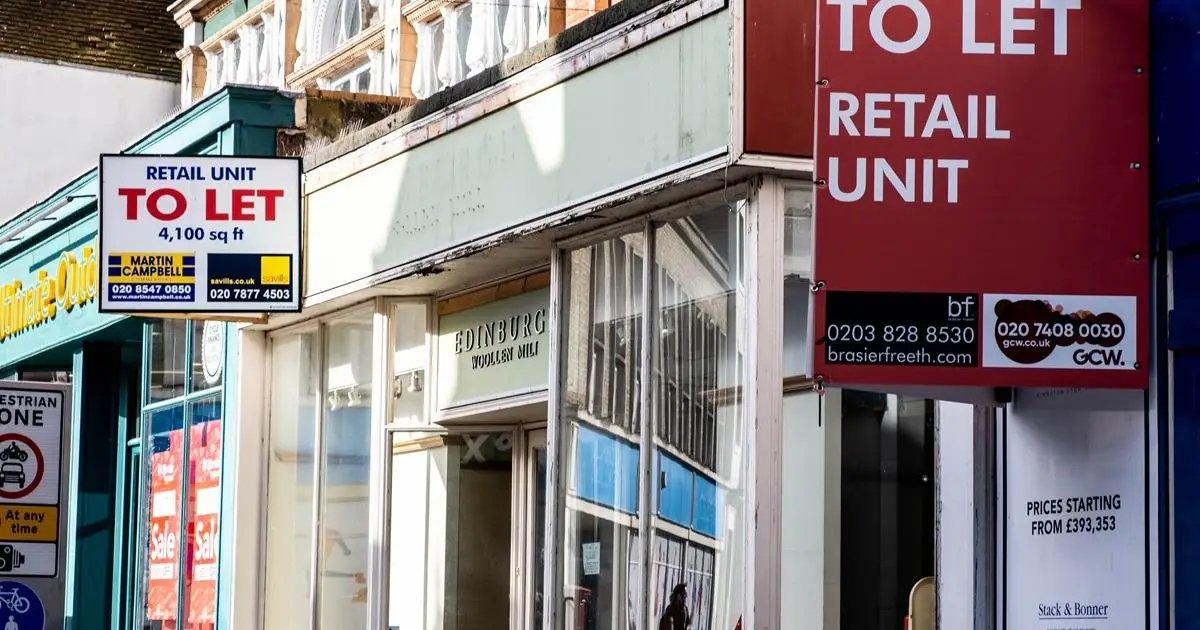

The British high street was once a place that you could rely on; no matter where you are in the UK, you knew if you headed to the centre of town, you would have all you needed in one place.
Now, high streets have never looked so different and sparse, as dozens of businesses shut their doors for good every year.
I grew up hearing stories of how the local town high street would host daily markets and how local businesses would be king of the streets, and it was a rare sight to see a chain store.
Even as a teenager, when I would spend every Saturday morning in town with my friends, there was lots to enjoy despite the change to a larger chain-business offering.
How do you think the high street can be saved? (Image: Getty Images)

But now when I head back to my small home town, the high street has little to desire, with boarded-up storefronts and more vape shops than any town could need.
This is something that many towns and cities across the UK can relate to.
How Britain’s high streets became a shadow of their former selves
Between 2024 and 2025, England and Wales lost 2,985 high street units according to Money.co.uk, while Scotland lost more than 900 retailers in the same span.
Towns are now feeling the effect of the closures, with a decline in footfall having a second-hand impact on other local businesses.
“These closures don’t just affect individual businesses; they will inevitably reduce overall footfall and can weaken town centres over time, making recovery more difficult for local economies”, Money.co.uk business savings expert Joe Phelan says.
Breaking the domino effect of closures is not an easy task for trading businesses to face, as Joe adds that it is a “difficult cycle to break out of, where declines in footfall can make it harder to attract new investment, which in turn can further suppress activity in the town centre.”
UK High Street Shops That No Longer Exist
Much of the drop in footfall has been driven by the loss of once-major high street chains that failed to withstand changing times.
In October 2023, discount retailer Wilko closed all its 400 stores, ending its more than 90 years in business and, for many shoppers, marking a sad day in British retail history.
Now the only reminiscence of the once iconic store is found within The Range after it brought the Wilko brand, website, and intellectual property in 2023.
Wilko is not the only historic brand now lost from the high street; more recently, the likes of Russell & Bromley, Quiz, Claire’s and Radley have all entered administration.
Many have wondered how such historic and once thriving brands could suddenly take such a tragic end.
Molly Monks, insolvency practitioner and founder of Parker Walsh, suggests that closures were long coming and are just a part of the evolution of high streets.
“The transformation of retail was already underway, but the cost-of-living crisis has dramatically accelerated the closure of stores that might otherwise have survived another few years”, Molly explains.
COVID-19 increased store closures. (Image: Getty Images)
Others believe the decline in retail is linked to the financial strain British households are feeling more than ever before.
As personal finance expert and co-founder of Raisin UK, Kevin Mountford shares, “The challenges facing the British high street cannot be separated from the financial pressure households have experienced over the past five years.
“Rising prices, higher energy bills and increased borrowing costs have made consumers more cautious and selective about where they spend.”
There is, however, no doubt that part of the high street decline is the huge rise and reliance on online shopping.
The online shopping boom that changed everything
The Covid-19 pandemic forced a change in action; no longer could we head into town for a browse; we had no choice but to shop online.
During 2020, online retail sales grew by 47%, compared to the previous year, according to Statista.
By 2022, internet sales accounted for 26.6% of all retail sales, showing a decline, but it remained higher than pre-2020.
Jump to 2024 to 2025, when the world had recovered from the pandemic, the UK retail scene was still heavily online.
What Happens When a Company Goes Into Administration?
Between 2024 and 2025, online retail remained high and continued to grow at a steady pace, accounting for 28% of all retail sales and amounting to £127.4 billion, according to the Office for National Statistics.
For many brick-and-mortar businesses, despite government support, the Covid-19 pandemic forced them to close as they struggled to face business and property rates.
The hidden property problem behind empty shops
Much of the British high street is made up of rented units, which are often left empty when businesses close, and landlords hold onto vacant shops.
But the big question is why would a landlord want to keep them empty?
Property expert and ValuQ founder Evern Ergin believes he may have the answer: “The high street’s deeper problem is a property problem, and it’s been hiding in plain sight.
“Rents and business rates were set in a world before the internet, and they never really came down.
“Worse, a lot of landlords would rather sit on an empty unit than accept a lower rent, because the moment they cut the rent, the value of their whole building gets revalued downwards.
“So, you get boarded-up shops on streets where a smaller independent would happily trade, if only the rent made sense.
“The empty unit is often the rational choice for the owner and a disaster for the street.”
The brands fighting for a second chance
Although some brands have lost the battle against the high street, some are willing to put up a fight to help save iconic British brands.
The 200-year-old pottery business Denby launched the #SaveDenby campaign following its administration news in March, with the aim that the government will provide more support to the British ceramics industry
Denby is not the only brand looking for a comeback, as budget-friendly beauty chain Bodycare recently confirmed its high street return.
Bodycare collapsed into administration in 2025, forcing 150 store closures and the loss of more than 1,000 jobs.
However, in the last few weeks, the chain has been slowly returning to the high street with the aim of reopening 25 stores in the UK by the end of 2026.
The success of Bodycare’s return and Denby’s fight has made some believe that the high street still has a fighting chance.
View this post on Instagram
A post shared by Bodycare (@bodycare.stores)
A post shared by Bodycare (@bodycare.stores)
Could independents be the high street’s saviours?
Steph Briggs, marketing and retail consultant and once the owner of a high street business, has firsthand experience with the realities of owning an independent business.
Before moving to consultancy, Steph grew her own brick-and-mortar independent high street shop, La Di Da Interiors, which she ran for 10 years.
Throughout her time as a high street shop owner, Steph learnt the harsh realities of running a business, from staffing, managing stock, e-commerce and the constant need to adapt.
Despite suggestions that British town centres cannot be saved, Steph believes they are not yet dead; instead, they are “evolving” and that they will be saved not by a superhero in a red cape, but by independent businesses.
“The high street isn’t dead, it’s evolving, it always has and always will,” she shared.
“The role of independent shops, hospitality, and mixed-use development in reviving town centres
“Indie shops make a place; if every town just had chain stores it would be very dull. Independent retailers add character, personality and genuine care for where they’re based.”
View this post on Instagram
A post shared by Denby Pottery (@denbypottery)
A post shared by Denby Pottery (@denbypottery)
Steph is not alone in believing independent businesses could be the saviours of the high street.
The key to survival is evolution
Co-Founder of OBJKTS Jewellery, Shirlene Tsang believes that the British high street has always been more than shopping; rather, it is a place where friends meet, discover new brands and enjoy their local community.
As part of that belief, Shirlene thinks that the key to saving high streets is for them to change with the times.
“The future is about giving people a reason to leave their homes,” she said.
“A physical shop can offer something a website cannot.
“Customers can touch a product, try it on, talk to someone who understands it, and discover something they may never have found online.”
Shirlene also suggests that retail units can survive while battling online sales by connecting the two: “The strongest retailers will be those that connect online and offline shopping.
“Someone might discover a brand on social media, research a product online, visit a shop to see it in person, and later buy it from their phone.
“It is all part of the same customer journey.”
So, can the British high street be saved?
It seems that the only way to save the British high street is to sacrifice some comforts in chain brands.
Sure, with big, branded names we know what we are getting, but they do not offer the personal touch that independent smaller businesses do.
At independent retailers, you can sense the love and care that has gone into every detail in every corner of the unit and every item that is on sale.
Recommended Reading
Knowing that everything you see and touch in that store has been picked by someone who truly cares and loves what they do adds a touch that chains cannot replicate.
So, what if we must lose some big brand names along the way?
Like everything in life, some things must be left in the past to make way for the future.
I just hope that one day, not too far down the line, the British high street will transform into the bustling and welcoming place it once was.
How do you think the British high street can be saved? Let us know your thoughts in the comments.