

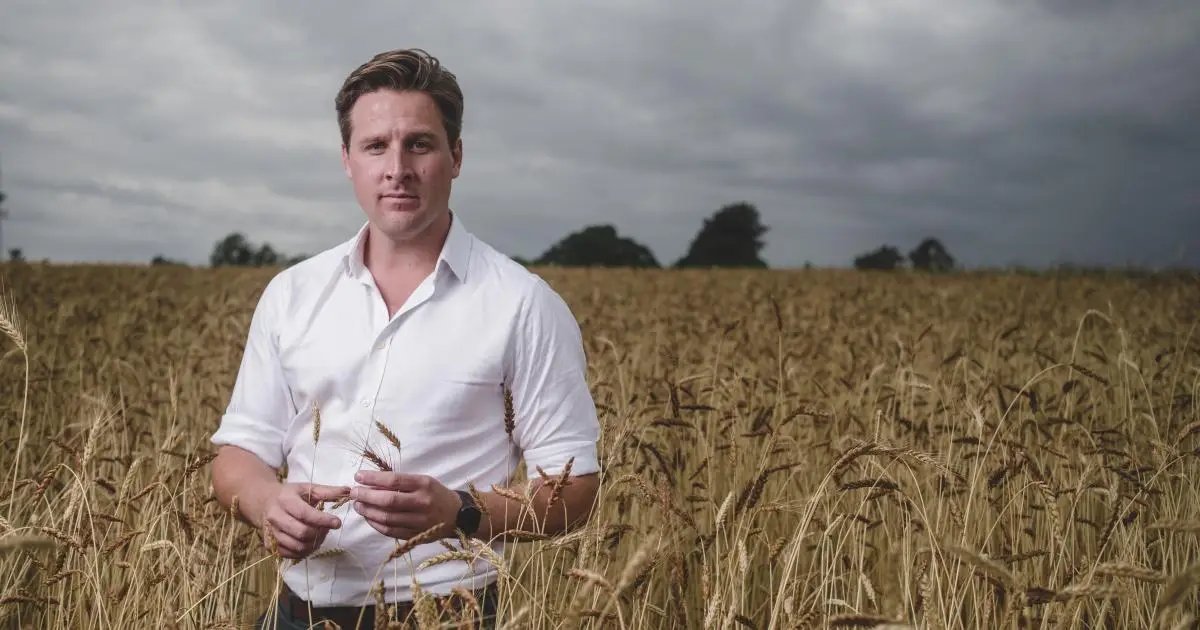

The first thing you notice about Bertie Matthews is that he speaks less like the managing director of one of Britain’s oldest flour mills and more like someone who genuinely cannot believe his luck.
He talks enthusiastically about wheat varieties, soils, artisan bakers and family life with the same infectious energy, drifting effortlessly from the science of regenerative agriculture to the smell of a freshly baked loaf emerging from the oven. It is an enthusiasm born not simply from business, but from stewardship.
As the eighth generation of the Matthews family to lead the Cotswolds flour mill founded more than two centuries ago, Bertie is responsible for carrying forward a legacy that stretches back to the early nineteenth century. Yet it is a role he never expected would become his.
“I am the third son and fifth child of my father’s eight children,” he says. “I do not think I was on the first team to take over.”
Bertie Matthews, Managing Director, Matthews Cotswold Flour (Image: Supplied)

Life, as it turned out, had other plans. Before returning to the family business, Bertie built a life away from Gloucestershire. He served with the Honourable Artillery Company, Britain’s oldest regiment and part of the Army Reserve, before working in both New York and London. Those years away proved invaluable.
“They were good experiences,” he reflects. “At least I managed to escape for a few years before coming back.”
His return came not through careful succession planning but during one of the company’s most difficult periods.
In 2017, the business faced significant challenges. Bertie found himself at a point in life where, as he jokingly puts it, he was “old enough to have experience, but young enough not to have a mortgage or children.”
It made him the right person at precisely the right time.
Bertie Matthews (Image: Supplied)
Then, in 2020, as the Covid pandemic swept across the world, he formally took over the business from his father, who had begun dividing his time between Britain and New Zealand.
“It was a baptism of fire,” Bertie says. “But it has been really rewarding.”
Running a flour mill might sound like preserving history, yet Bertie insists the business is anything but stuck in the past. His working day rarely resembles the romantic image of sacks of flour and turning millstones. A typical morning can begin with production meetings before moving on to conversations with farmers about harvest conditions, reviewing grain quality, agreeing future contracts and overseeing product development.
“We have production meetings, organise orders, speak to farmers, arrange contracts, have quality meetings and quite often new product development sessions where we are trying new things on our stone mill or roller mill,” he says. “It is very varied.”
The variety is one of the reasons he enjoys the role so much.
“I love the whole farming aspect and actually producing something that people eat from amazing farms.”
Bertie Matthews in the mill (Image: Supplied)
For Bertie, however, the real business is not the mill itself. It is the relationships behind it. Unlike many larger operations that buy grain through merchants, Matthews continues to work directly with farming families, in many cases across multiple generations. That approach, he believes, has remained one of the company’s defining strengths throughout its history.
“The importance of working directly with farmers resonates across all the generations,” he explains. “You have that close connection and that trust.”
Trust, patience and long-term thinking are recurring themes whenever Bertie speaks about the family business. Unlike start-up companies driven by rapid growth, he believes multi-generational businesses succeed by making decisions that may not fully bear fruit until decades later.
“Everybody is working almost for the next generation rather than themselves.”
It is a philosophy that feels increasingly unusual in modern business. Perhaps that perspective comes naturally when your family has occupied the same site for more than 200 years. The mill has never moved. Many of the farming families supplying grain today have worked alongside Matthews for generations. The business continues to employ a significant proportion of people from the surrounding village.
Looking around today, Bertie believes his ancestors would recognise much of what they created. “I hope they would be quite proud,” he says. “It is still going on. We are still on the same site. We are still growing. We are still working with many of the same farming families from generation to generation.” He pauses before laughing. “I have not got a direct line to them, so I do not know.”
Family remains central to everything he does. Away from the mill, Bertie’s happiest moments are often the simplest. He enjoys baking at home, particularly making fresh pasta with his children, describing the process of rolling, cutting and hanging it to dry as something everyone can enjoy together.
“I love baking,” he says. “My favourite thing is pasta making because it is something you can do with the kids and it is fun.”
Bertie Matthews, MD of Matthews Cotswold Flour (Image: Supplied)
Even holidays rarely take him too far from flour. Asked how he relaxes when he is not thinking about farming or food, his answer quickly turns to family trips to Devon, where surfing has become his ideal escape.
“We are going down to the south-west next week to do some surfing,” he says. “That is my idea of heaven.”
Yet even on the beach, it seems difficult to escape thoughts of grain. Britain’s warming climate, he believes, could transform the country’s ability to grow durum wheat, opening new possibilities for British-made pasta in years to come. It is typical of Bertie’s outlook. Where others see tradition, he sees opportunity. Where others inherit history, he sees responsibility. And where many businesses plan for the next financial year, Bertie Matthews is already thinking about the next generation.
The future is flour
If Bertie Matthews inherited a family business built on history, his ambitions are firmly rooted in the future. That future, he believes, begins not in the mill itself, but beneath every field of wheat.
Spend enough time talking to the eighth-generation miller and one word crops up time and again: soil.
It is the foundation upon which everything else depends, from the quality of a loaf of bread to the long-term security of Britain’s food supply.
“The real factory of all our food is the soil,” Bertie says. “The soil is alive and the healthier the soil is, the healthier the plants are. If you really want great wheat for great flour and great bread, it all starts with the health of the soil.”
For decades, conversations around farming have often centred on a choice between conventional or organic production. Bertie believes there is now a third path gaining momentum – regenerative agriculture.
Rather than replacing existing farming systems, regenerative farming focuses on improving what lies beneath the crop itself. Healthy soils, richer biodiversity, cleaner water and capturing more carbon all become measurable parts of how a farm performs.
“It is about improving the situation,” he explains. “Being able to measure it and being able to trace where it has come from.”
For Matthews, it is not simply an environmental aspiration. It is also a commercial necessity.
Working directly with farmers has always been central to the family’s business model, and today those relationships often begin years before a crop is harvested.
Through the company’s grain partnership, growers are encouraged to diversify beyond conventional wheat, producing grains including rye, spelt and durum wheat for specialist customers.
Rather than asking farmers to place all their faith in a single crop, the system spreads both opportunity and risk.
“We will work directly with farmers sometimes 15 to 24 months before harvest,” Bertie says. “We give them options for different grains to grow, and that helps make their businesses more financially sustainable.”
Bertie Matthews with the grain (Image: Supplied)
Those long-term partnerships have become increasingly valuable as farming faces unpredictable weather, rising costs and changing consumer expectations. The conversation about food has changed dramatically in recent years. Shoppers who once simply reached for a bag of flour are becoming increasingly interested in where it came from, how it was grown and what impact it has had on the environment. Major supermarkets have begun embedding regenerative agriculture into their long-term strategies, a signal Bertie believes reflects changing public attitudes as much as corporate ambition.
For him, however, the issue extends beyond sustainability.
“It is about food security,” he says. “We want to be able to grow food in this country in 30 or 40 years’ time.”
His optimism is grounded in practicality. Regenerative farming, he argues, can deliver yields close to conventional farming while reducing the reliance on expensive chemical inputs. For farmers, that means healthier margins as well as healthier fields.
“Lower inputs mean less money going towards chemicals and fuel and a better margin for the farmer,” he says. “That means farmers are more secure and therefore our food system is more secure.”
If farming is changing, so too is baking. The stereotypical image of a neighbourhood bakery has undergone a remarkable revival over the past decade, fuelled by social media, television programmes and a growing appetite for handcrafted food. For Bertie, the resurgence is impossible to ignore.
“Take one look on Instagram at baking or artisan bakers and you will see the immense creativity going on around the UK,” he says.
He reels off examples of award-winning independent bakeries Matthews has worked alongside over the years, each producing everything from naturally fermented sourdough to laminated pastries that would not look out of place in Paris.
What excites him most is not simply the quality of the products, but the confidence with which Britain’s independent bakers now tell their stories.
“They are improving the way they communicate what they do, and that inspires more bakers.”
The queues forming outside local bakeries across the country, he believes, are evidence enough. The same curiosity is filtering into people’s kitchens. During the pandemic, many rediscovered baking through a simple loaf of bread. Now, Bertie has noticed home bakers becoming increasingly adventurous. Fresh pasta, viennoiserie, enriched doughs and ancient grains are all finding their way into domestic ovens. One grain in particular has enjoyed a renaissance. Spelt, prized for its nutty flavour and high soluble fibre, has become one of Matthews’ fastest-growing products.
Bertie Matthews (Image: Supplied)
“It is a beautiful flour to use,” Bertie says. “People are always looking for new mixes and blends so that when they pull a loaf out of the oven they can smell something unique.” He smiles. “There is no better smell than a freshly baked loaf of bread in your home.”
Despite leading one of Britain’s oldest milling businesses, Bertie’s own recipe for great bread is refreshingly uncomplicated.
“Flour, water, salt and long fermentation,” he says. “You stick to those simple principles and you will make a fantastic loaf.”
It was a philosophy he shared recently during a visit to Exeter, where Matthews hosted an event bringing together independent bakers from across Devon and the wider South West. For Bertie, the region has always felt familiar. His mother is from Devon and the company has supplied customers across the South West for generations.
“We have been coming down here for a very long time,” he says. “The South West is a key region for us.”
The gathering was less about selling flour than bringing together a community of people united by a shared craft. Whether supplying a high-volume bakery or a small artisan operation producing hand-shaped loaves, Bertie says the aim is the same: to help businesses create the best products possible.
“It does not matter your size or what you are making,” he says. “We are happy to support you with whatever you are looking for.”
As Britain’s appetite for artisan baking continues to grow, so too does Matthews’ ambition. He wants the company to become the country’s leading speciality flour mill and the first choice for independent bakers, while continuing to demonstrate the measurable benefits of regenerative agriculture. He knows neither goal will be achieved overnight.
“I think in 10 to 20 years’ time regenerative farming will just be farming,” he says. “It will simply be the way we farm.”
Bertie Matthews, MD of Matthews Cotswold Flour (Image: Supplied)
For a business entering its third century, that timescale feels entirely appropriate. After all, the Matthews family has never measured success in months or even years. Its story has always been written in generations. And if Bertie Matthews has his way, the next chapter will begin with healthier soil, stronger farms and better bread.
