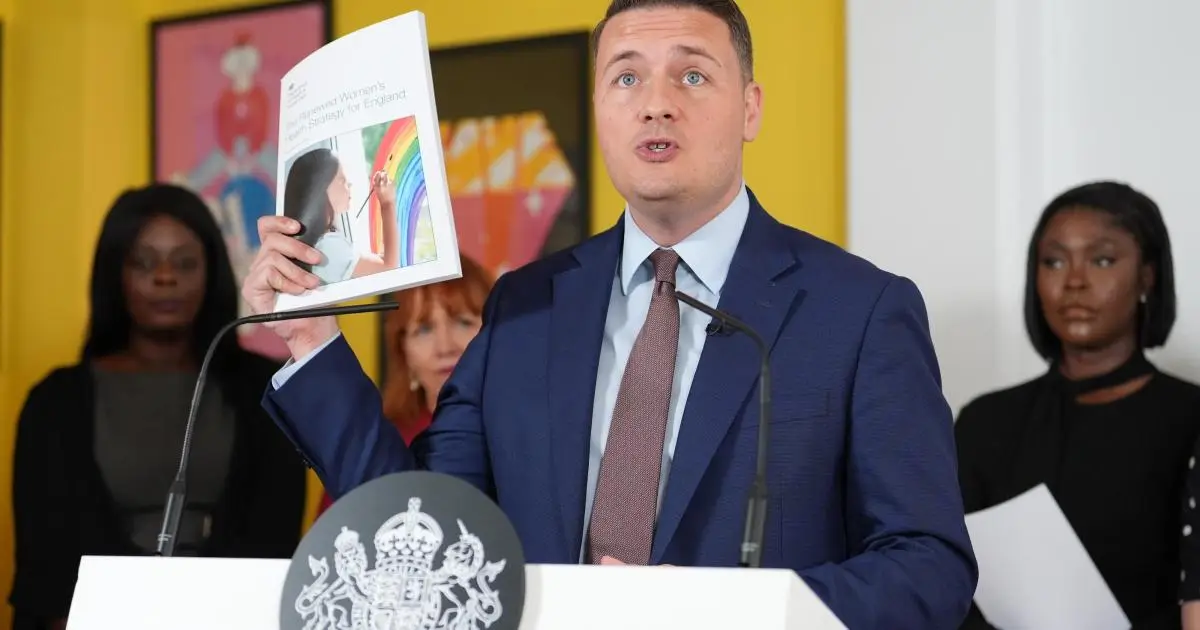

Waiting lists for women using gynaecology services will fall faster than the overall NHS waiting list, the Health Secretary has pledged.
Wes Streeting said women had been made to feel like “second-class citizens whose voices don’t matter” as he launched sweeping reforms for women’s health care.
Mr Streeting said the NHS had a “problem with basic, everyday sexism” and an “appalling culture of medical misogyny” as he launched a renewed Women’s Health Strategy in a bid to stop women from being “ignored, gaslit, humiliated and disrespected”.
But a number of organisations have said the strategy does not go far enough.
The Royal College of Midwives (RCM) said the Government had “missed an opportunity” on maternity care, while Sling the Mesh, a campaign group for women harmed by pelvic mesh, said it was “deeply disappointed” with the document.

And the Royal Osteoporosis Society said the strategy failed to implement fracture prevention clinics.
The strategy document states that NHS performance data “shows that the NHS fails women badly”, with “major challenges” in gynaecology care where average waits are 15 weeks, up from an average of 6.4 weeks in 2018.
There are currently 565,000 women waiting for gynaecology care.
Speaking at a launch event for the strategy in south London, Mr Streeting said: “When I look at the rise in waiting lists overall, it doesn’t explain the disproportionate rise in the gynaecology waiting list, and that’s why it’s my intention that, as well as bringing down NHS waiting lists and waiting times overall, we will cut the gynaecology waiting list faster than the overall waiting list.”
He said: “The blunt reality is this, though founded on principles of equality, the NHS does not treat all patients equally.”
An estimated 7.25 million treatments were waiting to be carried out at the end of January, relating to 6.13 million patients, according to the latest NHS figures, with new data to be published on Thursday.
The new strategy document sets out 117 action points and makes several pledges on how care will improve, including reforms to tackle “outdated and misogynistic practices” around pain relief for invasive procedures, and women will be given powers to contribute to the withholding of payments for services if they have a poor experience.
It pledges to “eliminate the diagnostic odyssey facing women” with conditions such as endometriosis and fibroids and promises that women will be “listened to and taken seriously at the first time of asking”.
Ministers also pledged to improve healthy life expectancy for women in the poorest parts of the country to at least 61 years from 50.5 years.
The report also vows to improve safety in maternity services after a number of failings have been highlighted in hospitals across the country.
An independent review of maternity care was launched in June last year and is expected to report within the next couple of months.
The new strategy document says it is “important that this work continues without restriction” but does not go too deeply into the issue other than pledging to “improve safety in maternity services”.
Reacting to the document, RCM chief executive Gill Walton said: “We are deeply disappointed that maternity services do not feature as a headline priority in today’s renewed Women’s Health Strategy.
“This is a significant missed opportunity and one that is very difficult to understand.”
Kath Sansom, from Sling the Mesh, said she was “deeply disappointed” with the review and called for ministers to include specialist pelvic floor physiotherapy education for girls in schools in the new period education programme announced in the strategy.
Craig Jones, chief executive of the Royal Osteoporosis Society, said: “Patients need the fracture prevention clinics promised by Wes Streeting. Delays to the implementation of this policy are costing lives.”
Writing the foreword to the report, Mr Streeting said: “The NHS has a problem with basic, everyday sexism and an appalling culture of medical misogyny.
“Being ignored, gaslit, humiliated and disrespected are all-too-common experiences for far too many women.
“The NHS is failing women and girls on even the most basic measures of health care.
“Our mission is to dismantle the culture and ingrained behaviours that allow medical misogyny to fester and grow.”
Dr Sue Mann, NHS England’s clinical director for women’s health, said: “The renewed Women’s Health Strategy will build significantly on the work the NHS has been doing to ensure women are heard and get the specialist care they need.”