


Europe’s wildfire emergency eased across much of western Europe on Saturday, with major fires in France and Spain no longer advancing and Portugal’s main blaze under control.
However, the crisis worsened in Greece, where gale-force winds drove flames through a seaside resort and triggered fresh evacuations.
In south-western France, firefighters held a vast wildfire within its perimeter, with about 198,000 people now allowed home after what may have been the country’s largest peacetime evacuation.
A second French fire that raced across four square miles in six hours on Friday — “faster than a horse at full gallop”, according to the prefecture — also stopped expanding overnight. But it remained active on Saturday and 2,500 people were still unable to return home.
The progress marked a sharp turn from the height of the crisis, when fires in France and Spain alone drove a third of a million people from homes and holiday sites, emptied towns during the summer tourism season and stretched firefighters, aircraft and emergency services across simultaneous emergencies.

Portugal’s major wildfire was declared under control, while Spain’s largest fires were no longer making sustained advances and most evacuation orders had been lifted.
But Europe’s emergency is not over as its most dangerous front has shifted towards Greece. New fires erupted on Saturday as powerful winds whipped up flames, carried embers across dry landscapes and prevented some aircraft from collecting water or approaching closely enough to make drops.
The danger carried grim resonance in Attica, where the 2018 wildfire at the seaside community of Mati killed 104 people, making it the world’s second deadliest wildfire of the 21st century.
Europe is Earth’s fastest-warming continent, heating at more than twice the global average since the 1980s, according to the European Union’s Copernicus climate service. Rising temperatures and prolonged drought leave vegetation drier and more combustible, allowing fires to spread faster and burn more intensely.
The Gironde fire has burned 162 square miles of pine forest west of Bordeaux, an area four times the size of Paris.
Firefighters said it remained contained within that perimeter on Saturday. But it had not been declared “fixed” — the point at which crews determine that a fire is no longer advancing — and active sectors and buried hot spots persisted.
Several communities remained largely deserted. Authorities kept much of the affluent, forested Cap Ferret peninsula evacuated because a nearby hot spot could flare again.
“Today, the fire is still not fixed. It is contained,” Lt Col Eric Pitault told reporters.
Crews used tactical burns overnight, deliberately consuming vegetation ahead of active sectors. They still faced about 149 miles of fire edges where heat can remain buried underground and erupt again.
The fire’s toll extended beyond people and property. Allain Bougrain-Dubourg, president of France’s League for the Protection of Birds, told RMC radio that animals affected already numbered in the millions.
In the Var, defensive lines around the Gros Bessillon fire held overnight and no additional ground burned, Var prefect Simon Babre told French media on Saturday.
But the fire remained active. About 2,500 people were still unable to return home, and 1,300 firefighters were deployed.
The blaze’s sudden return “defies understanding”, Mr Babre said.
Twenty French departments were under an orange heat warning on Saturday, mostly in the east and south-east. Temperatures of 35C to 39C were forecast around the Mediterranean, while eight departments faced a high forest-fire risk.
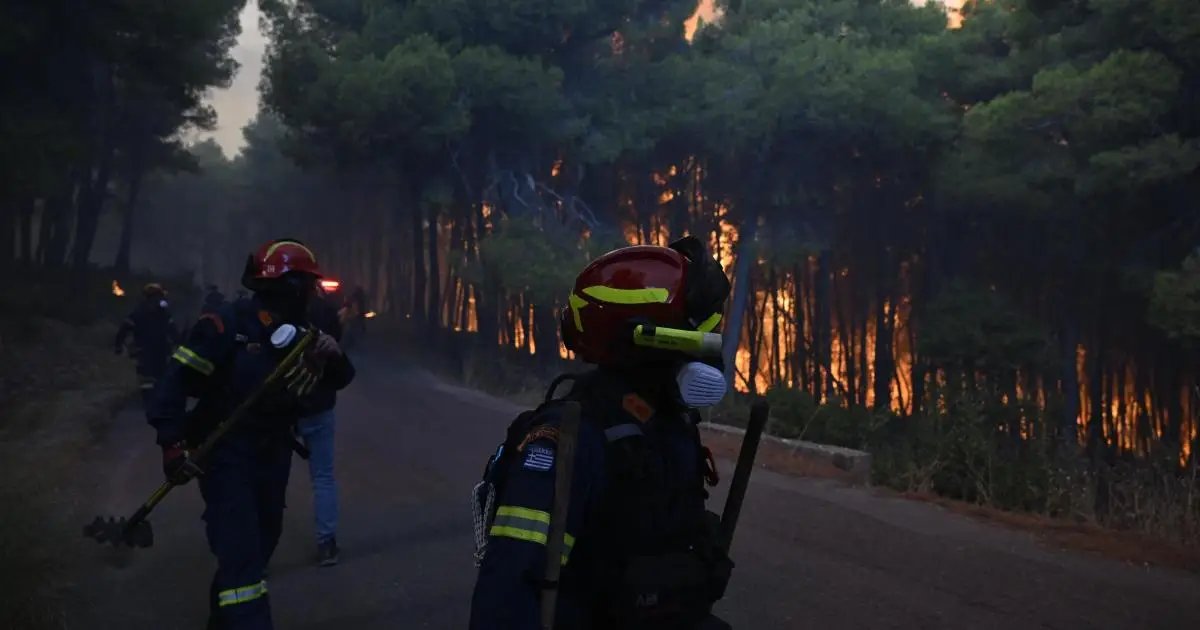
In Greece, hundreds of firefighters fought on Saturday to protect Porto Germeno, a popular resort on the Gulf of Corinth, as gale-force winds drove flames through the coastal area west of Athens.
The fire broke out on Friday near the neighbouring village of Agios Vasileios. About 300 people were evacuated by sea, and authorities issued further evacuation orders on Saturday.
Towering flames devoured thick pine forest around Porto Germeno as smoke blocked out the sun.
“A pristine forest, a paradise, was surrendered to the hands of the fire,” said Minas Tzortzanis, a 60-year-old farmer and local resident. “There are no words to explain what has happened. Destruction. Total destruction.”
Theodore Giannaros, a wildfire meteorologist at the National Observatory of Athens, estimated that 15 to 19 square miles had been affected, although authorities had not issued an official burned-area figure.
Nearly 500 firefighters, along with specialised forest-fire teams and crews temporarily deployed from France and Romania, were backed by 19 water-dropping planes and 11 helicopters. Local authorities said homes had been destroyed, but a complete count was not immediately available.
New fires broke out elsewhere in Greece on Saturday. A blaze east of Nafpaktos prompted evacuation alerts for at least four villages.
“The very strong to gale-force winds continue to create exceptionally difficult conditions,” climate crisis and civil protection minister Evangelos Tournas said. He said extreme turbulence was preventing some aircraft from collecting water or approaching the fires closely enough to make drops.