


WERE it still alive today it would be a rail route as cherished as the Severn Valley, the heritage railway that runs from Kidderminster to Bridgnorth and attracts around 250,000 visitors each year.
It even had a catchy nickname, the Hopfield, Plum and Cherry Orchard Railway, but that didn’t stop Dr Beeching chopping the last branch down in 1964.
Given the terrain it crossed and the paucity of the population, the Worcester to Leominster via Bromyard line was always an optimistic endeavour but even though it’s long gone now some magic memories remain.
Especially in a new book by Neil Parkhouse called Branch Lines to Leominster and Kington, a less-than-clickbait title which will surely only attract the attention of hardcore railway enthusiasts although in reality this needs a wider audience.
Author Neil Parkhouse with his book Branch Lines to Leominster and Kington, volume 10 of the British Railways in Colour series (Image: Branch Lines to Leominster and Kington)

More: What they did in Worcester on Sunday afternoons
Not least for some wonderful old photographs which show how railways have been a thread through society over the centuries.
On reflection it wasn’t the best place to build a railway.
The beautiful rolling countryside of the Worcestershire to Herefordshire border may inspire poets but for engineers it’s nightmare.
The landscape dips and climbs, includes rivers and forests and orchards and there aren’t many people out there anyway.
Nevertheless, it was decreed a railway line should be built from Worcester to Bromyard and on to Leominster.
The idea was to link the outback areas with the towns and provide a quick and comfortable transport system for people and produce at a time when both still went by horse and cart.
Sadly, in view of the monumental efforts that went into construction, it didn’t last long.
It opened on September 15, 1897 and the final train to Leominster ran on September 5, 1952.
The Worcester to Bromyard section survived another three years but felt the chop of the Beeching axe and fell silent on September 6, 1954.
The Worcester, Bromyard and Leominster Railway received its Act of Parliament in 1861 but right from the start money was tight.
Economically it was always on dodgy ground but the idea received enthusiastic support from many landowners and locals who tended to accentuate the positive but ignore the negative.
Because of the shortage of funds progress of any kind was slow and not much happened until the appointment of Mr EB Evans as company chairman in 1872.
He decided the first priority was to drive a single line westwards from Worcester towards the station at Bromyard.
Even this meant building two sizeable viaducts at Hayley Dingle and Broad Dingle.
Two viaducts were built to accommodate the line from Worcester to Bromyard. This one at Hayley Dingle, near Alfrick, had six wrought-iron girder spans. Only the brick pillars still stand today, almost lost in overgrown woodland (Image: Ray Jones)
The first would be 70-feet high with six spans and deep cuttings would be needed at Knightwick and Suckley.
Earth slips caused great trouble at Suckley and in January 1874 the contractor was changed for the third time to the Malvern Wells company of William Ridler.
Suckley station photographed in 1908 (Image: Branch Lines to Leominster and Kington)
However, money was still in short supply and in an attempt to obtain some revenue the railway’s directors decided to open the line as a ‘fruit special’ as far as Yearsett, a temporary wooden station near Suckley. The Great Western Railway agreed to run it.
But on the morning before the official opening tragedy struck.
A group of navvies at Yearsett got tired of waiting for the engine to arrive to take them to work and set off to meet it in a ballast wagon.
Coming down the decline at Bates Bush, near Knightwick, they saw the steam of the approaching engine through the trees but it was impossible to stop and in the collision one man was killed and 20 were injured.
Nevertheless, the official opening went ahead and despite its lack of passengers the line remained popular with farmers and growers right up until the end.
They used to queue at Knightwick, where Mrs Palmer was station mistress, to load up their produce and even just before closure the station was handling 1,500 boxes a day at the height of the fruit picking season.
Sadly, the hop and plum and cherry orchard line could never last.
Pretty it might have been, economical it never was.
Branch Lines to Leominster and Kington by Neil Parkhouse is published by Lightmore Press and costs £35.
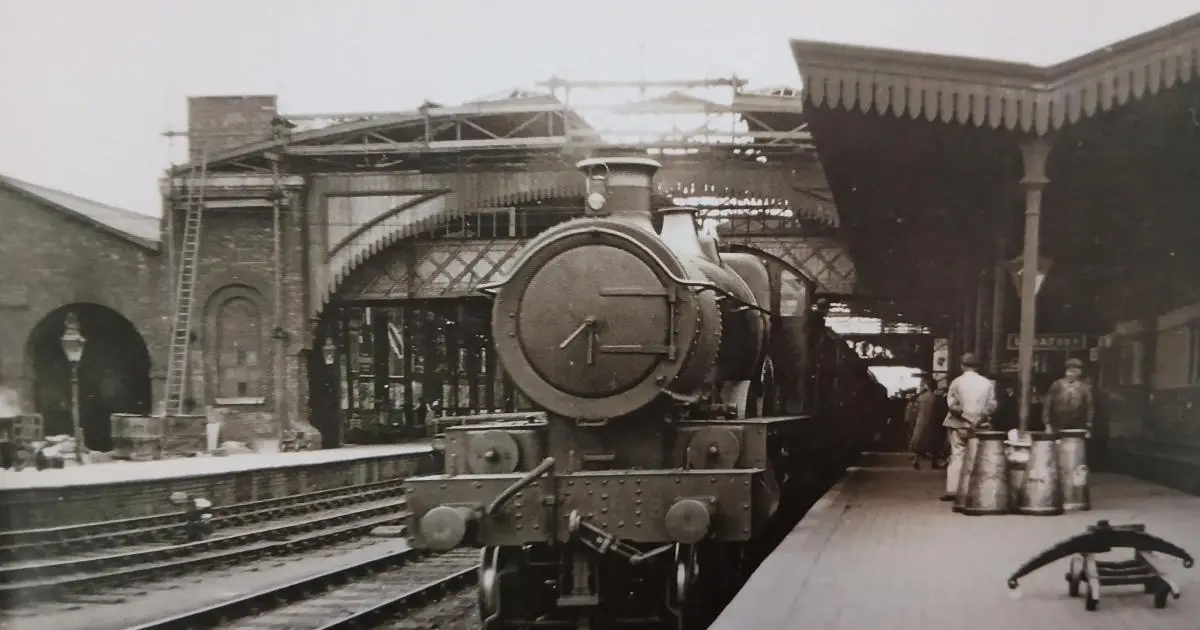
Worcester’s Shrub Hill station in 1927 with a Hereford-bound express pulled by the Saint Class locomotive Robins Bolitho waiting. Note the milk churns and sack barrow on the platform (Image: Ray Jones)
Foregate Street station Worcester in its 1920s heyday (Image: Ray Jones)
Foregate Street railway bridge being rebuilt in the centre of Worcester in 1907. The sign is to warn tram passengers to remain seated while passing underneath (Image: Ray Jones)
How Shrub Hill station looked in 1963 before the monstrosity of Elgar House was built (Image: Branch Lines to Leominster and Kington)
Henwick station in St John’s, Worcester, in 1910. Opened in 1859, it was closed in 1965 but there are repeated calls to reopen it today to act as a park and ride site for the city centre (Image: John Alsop Collection)