

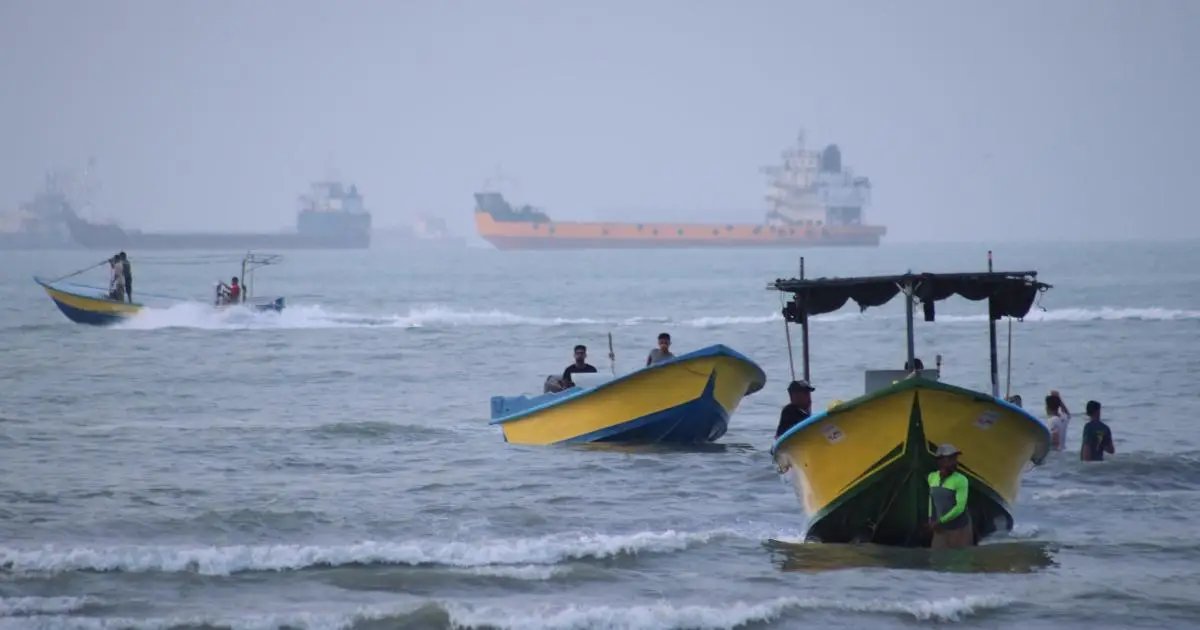

Iranian and Omani negotiators have finalised the draft deal to reopen the Strait of Hormuz and are awaiting a final approval from Iran’s supreme leader, two regional officials told The Associated Press on Wednesday.
The officials, who were briefed on the negotiations, portrayed the potential deal as a temporary solution to the US-Iranian dispute over vessels’ transit through the vital waterway.
They said it is tied to the agreement reached between the US and Iran in June that aimed at ending the fighting and reopening the strait, but which ultimately collapsed.
The officials, who spoke on condition of anonymity, said the potential deal will pave the way for the US and Iran to resume negotiations to reach a final deal on Tehran’s nuclear programme.
Earlier, the regional officials said the possible agreement between Iran and Oman calls for ships to enter the Persian Gulf through an Iranian-controlled route and exit through a route controlled by Oman. Service fees would be charged for providing security and preserving the maritime environment, the officials said.

Oman and Iran have not officially commented.
US President Donald Trump had said a deal on the Strait of Hormuz could come as early as Wednesday or Thursday.
Mr Trump was asked by reporters travelling with him in California about a report on the Axios news site that an announcement on the Strait of Hormuz could be made on Wednesday.
“It could happen. Tomorrow or the next day,” he said, speaking on Tuesday evening California time, which was already Wednesday morning in the Middle East.
“A lot of progress has been made.”
Oil prices eased on hopes of progress for a deal that would allow oil tankers to freely exit the Persian Gulf again and deliver crude around the world.
Brent crude, the international standard, slipped by 1.2% to 78.43 dollars per barrel early on Wednesday.
The Trump administration has previously ruled out any deal that would give Iran control over the strait, which was an open international waterway before the the US and Israel attacked Iran on February 28.
About one fifth of the world’s oil and natural gas passed through the strait, but shipping through the waterway has been reduced to a trickle at best by Iran’s attacks since the start of the war.
In an exchange with reporters on Monday, the US president reiterated his public opposition to tolls being charged in the strait.
“I’m not going to let them charge,” Mr Trump said.
“Anybody’s going to charge, we’ll charge.”
The regional officials said negotiations were still under way and that the final agreement could take a different form, with any deal linked to lifting the US blockade on Iran’s ports.
Iranian Foreign Ministry spokesman Esmail Baghaei said on Tuesday that Tehran’s talks with Oman were focused on “establishing safe inbound and outbound shipping lanes”, routes that “uphold sovereign rights while also addressing the national security considerations of both Iran and Oman”.
On Wednesday he said that the agreement with Oman is in the “final stage” of drafting, and that a joint statement will be issued “if certain parties do not obstruct this process,” apparently referring to the United States.
“The final results of these negotiations will be announced once concluded,” he added, according to Iran’s state-run IRNA news agency.
US secretary of state Marco Rubio confirmed progress had been made in those talks, “but not finality yet”.
Mr Rubio has previously ruled out any deal that would give Iran control over the strait, saying last month that would create a “very dangerous precedent” for other parts of the world.
US treasury secretary Scott Bessent told CNBC that “there is a chance we may have a deal today or tomorrow to open the strait and move towards a more normalised position in this conflict”.
Qatar’s emir, Sheikh Tamim bin Hamad Al Thani, said he also spoke to Mr Trump by phone on Tuesday as the Arab country tries to broker a resolution to the war.
Mr Al Thani’s office said the two discussed ways to bridge the divide “in a way that enhances the prospects of reaching a sustainable diplomatic settlement to the crisis”.
Mr Trump is under mounting pressure to end an unpopular war that has driven up gas prices ahead of mid-term elections and drawn down US supplies of some munitions.
The southern route through the Strait of Hormuz remains free and open for all commercial vessels seeking to transit the international waterway. Over the past three months, U.S. forces have assisted more than 1,000 vessels in successfully transiting the strait despite unwarranted… pic.twitter.com/TcszH0GimG
— U.S. Central Command (@CENTCOM) August 4, 2026
In recent days, he has again alternately threatened massive strikes and voiced support for diplomatic efforts.
Mr Trump said on Monday that the US was in talks with Iran, saying it was Tehran’s “last chance” to reach a deal and avoid another US military escalation.
“The first phase is the opening of the straits. The second phase will be the denuclearisation,” Mr Trump said. “And that will take a little while.”
Iran has denied it is negotiating with the US, saying the talks are only with Oman.
Even as hopes increased that a deal on the Strait of Hormuz could be imminent, attacks on shipping in the region continued.
The Iranian-backed Houthi rebels claimed on Wednesday they had fired ballistic missiles toward a Saudi oil tanker called the Wafa in the Red Sea.
Brig Gen Yahya Saree, a military spokesman for the Houthis, said in a pre-recorded statement that the vessel was targeted off the Saudi port city of Yanbu. He did not provide evidence and there was no immediate comment from Saudi Arabia.
Meanwhile, the already shaky ceasefire between Israel and Iran-backed Lebanese militant group Hezbollah grew more volatile on Wednesday, as the Israeli military issued an evacuation warning to residents of the southern Lebanese village of Mansouri — the first such warning in weeks.
Israel said that it was in response to Hezbollah’s violation of the ceasefire agreement between them, which had largely held since June 20.
Later, the Israeli military said it had begun conducting “precise strikes” in southern Lebanon in response to what it described as “a blatant violation of the ceasefire” by Hezbollah.
Separately, the United Nations’ human rights chief, Volker Turk, criticised what he said was an increase in executions and death sentences in Iran since March.
Mr Turk said capital punishment is being used to instil fear and suppress dissent.
At least 56 people have been executed since March 19, he said, including 27 who were convicted in cases linked to anti-government protests that occurred across the country at the start of the year. Mr Turk said more than 100 more were at risk of execution on similar charges.
“Persistent lack of fair trial and due process guarantees are deeply troubling,” he said, alleging that confessions have been obtained under torture and ill-treatment, while saying some executions have reportedly been carried out in public and some only weeks after the suspect was arrested.