

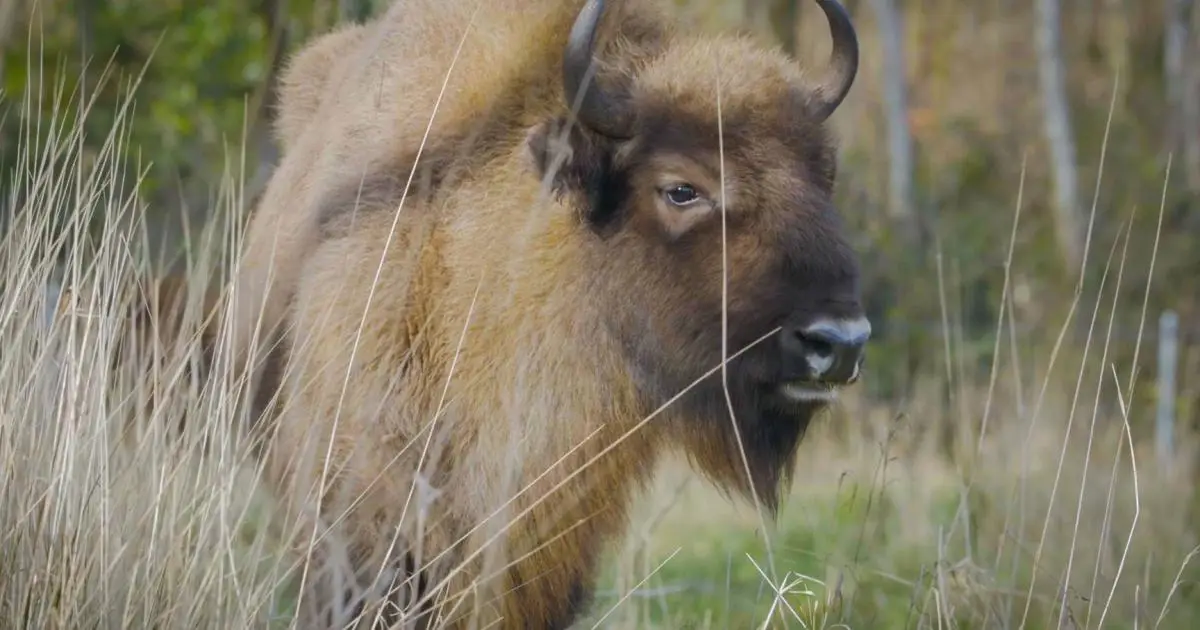

A group of bison from a UK-first conservation project in Kent is settling into its new home in Cumbria as part of a scheme to restore wildlife.
Land managers say the animals at Castletown Estate, between the Eden and Esk rivers north of Carlisle, are already starting to “bash through” woodland and open up habitat to create a much richer and more diverse landscape.
The new breeding herd, which moved north from Kent earlier in the year, is part of the “Solway Wild Lands” project which aims to restore wildlife by letting natural processes and species such as bison and beavers reshape parts of the landscape, alongside managing land for commercial farming.
The five-strong herd of European bison, the closest relative of ancient steppe bison that would have roamed Britain thousands of years ago, has come from a project to introduce the animals to West Blean and Thornden Woods, near Canterbury.
The pioneering scheme at Blean has been led by Wildwood Trust, which has been advising on the latest project in Cumbria and will continue to own the bison, and Kent Wildlife Trust, to boost wildlife and restore natural processes.

As bison are currently licensed in the UK under “dangerous wild animals” laws, in the same way as lions and tigers, the Cumbria scheme – as in Kent – has had to erect large-scale fencing, creating an enclosure of 700 acres which the bison will be able to roam in.
Toby Mounsey-Heysham, who runs the estate, said the bison, which have started out in a smaller “soft release” area since travelling north, had “behaved brilliantly” since their arrival.
He said: “What we wanted them to do, and what they are doing, is bash through woodland and open up woodland to create a multi-storey forest.
“We want them to drag seeds out into a broader area and create further woodland in what is currently grassland, we want them to wallow, we want them to produce dung for dung beetles.
“We want them to create a much more diverse, much more interesting, much richer habitat – which is what they’re already doing,” he told the Press Association.
The bull bison has pushed over “quite sizeable” trees and the impact of opening up woodland can already be seen with new grasses, flowers and “really diverse, really rich landscape”, he added.
It is thought at least one, and perhaps both, female bison are pregnant, so Mr Mounsey-Heysham said they would look forward to calves being born in the autumn.
He said the animals were part of efforts to manage the environment with natural means, such as large herbivores and beavers, which have already been on the estate for a year with dramatic effect in creating wetlands.
The Solway Wild Lands project aims to restore wildlife-rich habitat in the landscape, which it is hoped can then generate income from nature and carbon credit schemes.
At the same time, other areas of the 5,000 acres of land on the estate are being used for grazing and growing animal feed for thousands of cattle and sheep.
Mr Mounsey-Heysham said he wanted the scheme to be economically viable and ultimately subsidy-free, and he believed farming and natural habitat could live next to each other “quite happily”.
He added: “We are trying to occupy a place where you use the right land for the right thing.”
The Forestry Commission said it had worked with the estate to develop a management plan enabling the bison to be released into existing woodland to help it become more wildlife-rich while Natural England said bison were an innovative approach to habitat restoration with benefits for nature in Cumbria.
Paul Hadaway, director of conservation and engagement at Kent Wildlife Trust, said the project at Blean showed how keystone species such as bison could drive ecological change.
He said: “The bison have created habitat complexity through their natural behaviour – breaking up dense scrub, dust bathing and debarking, and generating the conditions for bio-abundance.
“The expansion to the north marks a critical step in establishing bison as part of the UK’s conservation toolkit.
“These animals restore natural processes that have been missing from our landscapes for millennia.”
Paul Whitfield, Wildwood Trust’s director general, said it was “incredibly encouraging” to see bison from the founding herd at Blean established and thriving in Cumbria.
He said: “It shows that this approach works and can be adapted and applied in very different landscapes.
“Our role is to support that journey by sharing the knowledge and experience we’ve built up working with the UK’s first free-roaming bison herd.”
The Wildlife Trusts federation, of which Kent Wildlife Trust is a member, also wants to see legal changes for species such as bison, currently subject to both dangerous wild animal and livestock regulations, with a “kept wild” regime for large herbivores to live more naturally in large landscape areas.