

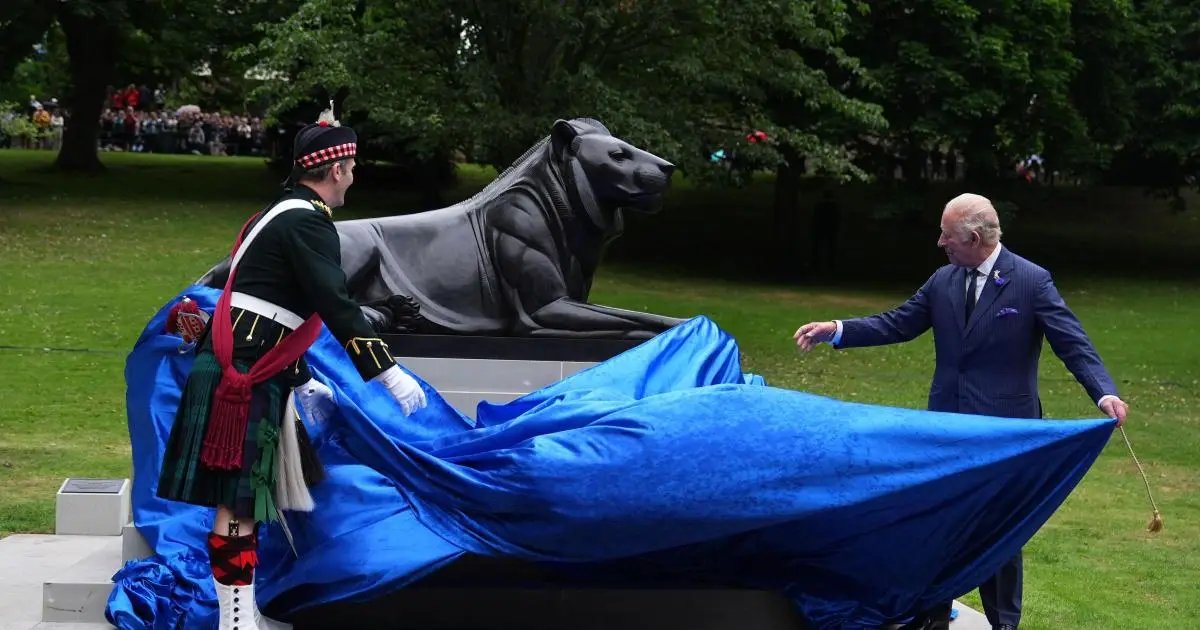

The King celebrated the achievements of The Royal Regiment of Scotland on its 20th anniversary by unveiling a statute representing the “service, sacrifice and enduring pride” of its soldiers.
Charles revealed the bronze reclining lion guarding the regiment’s cap badge in Edinburgh’s Princes Street Gardens in front of serving servicemen, their families and veterans.
The King, the regiment’s Colonel-in-Chief, said at the unveiling: “Your battalions have consistently ranked among the most operationally deployed in the British Army, demonstrating professionalism, adaptability, and courage in every theatre.
“It is right that we remember today that these high standards come at a cost.
“We remember therefore with solemn pride the 23 officers and soldiers who have been killed in action since 2006, their sacrifice is the foundation upon which your reputation stands, and their memory endures in the regiment’s spirit and purpose.”

Before the unveiling ceremony, the officers and their men exercised the Freedom of the City of Edinburgh – and in full ceremonial dress, paraded from the King’s official residence, the Palace of Holyroodhouse, past the City Chambers where the Lord Provost and Lord Lieutenant of Edinburgh Lord Lieutenant of the City of Edinburgh took the salute.
The Royal Regiment of Scotland is the senior line infantry regiment of the British Army and was formed on March 28, 2006, by amalgamating the six existing Scottish infantry units: The Royal Scots, the King’s Own Scottish Borderers, the Royal Highland Fusiliers, The Black Watch, The Highlanders and the Argyll and Sutherland Highlanders.
Charles added: “The distinction and reputation of the regiment is reinforced still further by the ceremonial duties you conduct, perhaps most notably three years ago now for our coronation, but also so movingly, following the death of the late Queen, your former colonel-in-chief.
“So in unveiling this statue, we reaffirm the trust placed in this regiment to uphold its gallant heritage to serve with distinction, and to honour those who have gone before.
“May this monument stand a generation as a symbol of service, sacrifice, and enduring pride.”
The statue was designed by Edinburgh artist Kenny Hunter, who received the commission after winning a competition.
He described how the not yet mature lion was symbolic of a young soldier ready for action.
The sculptor said: “It’s reclining and in a relaxed pose, but you get the sense it’s see something on the horizon that has piqued its interest.
“Everybody wants peace, but when things go awry you want people to be ready.”