


I SUPPOSE it was entirely appropriate that when workmen dug up part of The Butts, Worcester, in 2003 and revealed a cobbled Roman road, the site they were excavating had once been a garage.
There was no suggestion the business of Thorne’s (Worcester) Ltd , which specialised in Austin cars, had also supplied chariots to Caesar’s legions but it did have a history going back quite a way.
In fact, along with names like HA Saunders, Holloway’s, Barker’s and Tansell’s, it had once been a leading city motor house.
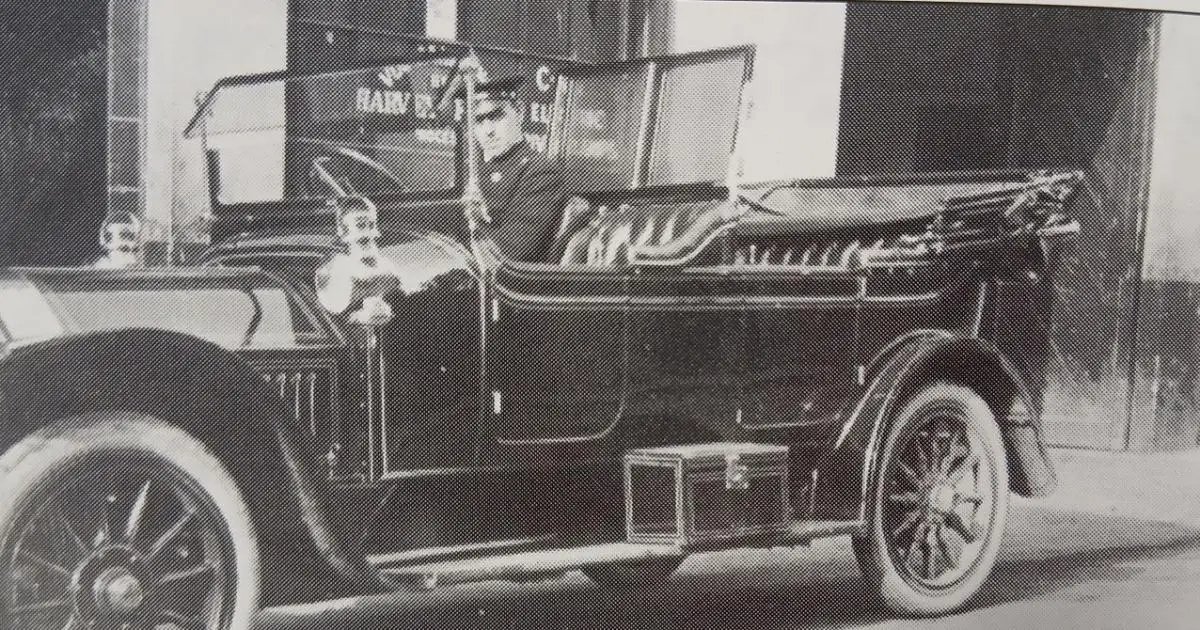
An impressive early automobile outside Thorne’s garage in The Butts in the 1920s (Image: The Changing Face of Worcester)
One where the proprietor usually wore breeches and knee length polished brown riding boots.

Not an image that conjures up the average garage boss today. Let alone the sales staff.
The interior of Thorne’s Garage with WT Thorne seen centre stage in his breeches and boots (Image: The Changing Face of Worcester)
More: 15 photos from the 1980s at this Worcester junior and infant school
At the time the cobbled road emerged a lady called Phyllis Smith gave a fascinating interview to my late colleague Mike Grundy.
She explained: “The family-run garage stood in The Butts for very many years.
“WT Thorne, the managing director, was my uncle and my grandfather, aunt and father all worked there in various capacities.
“Thorne’s also had showrooms at 34 Foregate Street, opposite the Shirehall, and were main agents in the district for Austin Cars.
“In fact, Thorne’s inaugurated the Austin Owners Club whose Sunday runs I remember with affection and not a little amusement.
“A trip to Bristol Zoo was a great achievement in those times. As were outings to Weston-super-Mare and other places then considered to involve ‘long’ distances.
“I also remember the occasion in 1922 when the driver of a tanker lorry and his daughter were drowned after the vehicle plunged off Bransford Old Bridge and into the River Teme.
The 1922 tragedy when Thorne’s lifted a tanker lorry from the River Teme at Powick. WT Thorne is at the front of the boat directing operations, this time in breeches and knee-length knitted socks (Image: The Changing Face of Worcester)
“WT Thorne and some of his workmen supplied the heavy lifting gear to pull the tanker from the water.”
In 1935 the family firm acquired part of the old County Prison site in Castle Street with a view to building a big, modern garage and showrooms.
However, before any development of the old jail took place, the citizens of Worcester were invited to look round the prison at a charge of 6d each.
The not inconsiderable proceeds were donated to the Royal Infirmary.
Phyllis continued: “Sadly, the tragic death of my uncle WT Thorne in 1936 changed everything.
“He was one of the victims when a car competing in the Newtownards Road Race in Ireland left the track and hurled into the spectators, killing four of them. He was only in his early 40s.”
Thorne’s family firm continued for only a comparatively short time afterwards.
Bill’s widow Dora, whose father named Dickinson had been a Worcester newspaper proprietor in past times, did not wish to take on the running of the garage.
His father, by then an old man, decided to retire, Ethel Thorne got married and Phyllis’ father decided he too had no wish to take on the burden of running the business.
George Thorne later went to work for a short time at the Star Hotel in Foregate Street before becoming licensee of the Shakespeare Hotel in Angel Street for 15 years from 1942 until his death in 1957.
His widow Edith took over the licence afterwards but retired from the Shakespeare in 1960.
Phyllis joined her parents at the Shakespeare during the Second World War after the death of her husband Robert Hall who was from the Worcester family firm of ironmongers J and F Hall.
He was killed in action with the RAOC in the Western Desert in 1941.
Phyllis helped her parents at the Shakespeare for some years but later re-married.
Another interesting snippet to come out of the interview was that WT Thorne’s plan for car showrooms on the old prison site in Castle Street was eventually undertaken by HA Saunders Ltd and became a city landmark known as Austin House with its distinctive tower clock.
The building was later taken over by Mann, Egerton, Rowe Carpets and then County Furnishings before being converted into the University of Worcester’s Art House.
Phyllis added a footnote to the interview: “I am now in my late 80s but the memories of the garage in The Butts are still clear, especially of the sweets the office ladies always seemed to have waiting for a small girl.”
Those were the days.
Worcester Corporation used to have a large yard in The Butts. In this image from 1905 some form of meeting appears to be taking place. Management or local dignitaries, looking at their dress, because no one here seems likely to lift a dustbin (Image: The Changing Face of Worcester)
The Ewe and Lamb pub used to stand at the bottom of The Butts facing the cattle market. Here it is on July 12, 1951 (Image: The Changing Face of Worcester)
Another favourite in The Butts, the Paul Pry public house in 1951 (Image: The Changing Face of Worcester)
Also at the bottom of The Butts was the business of agricultural feed, seed and fertiliser merchants F Golledge and Co Ltd, later to be transformed into Images nightclub (Image: The Changing Face of Worcester)