

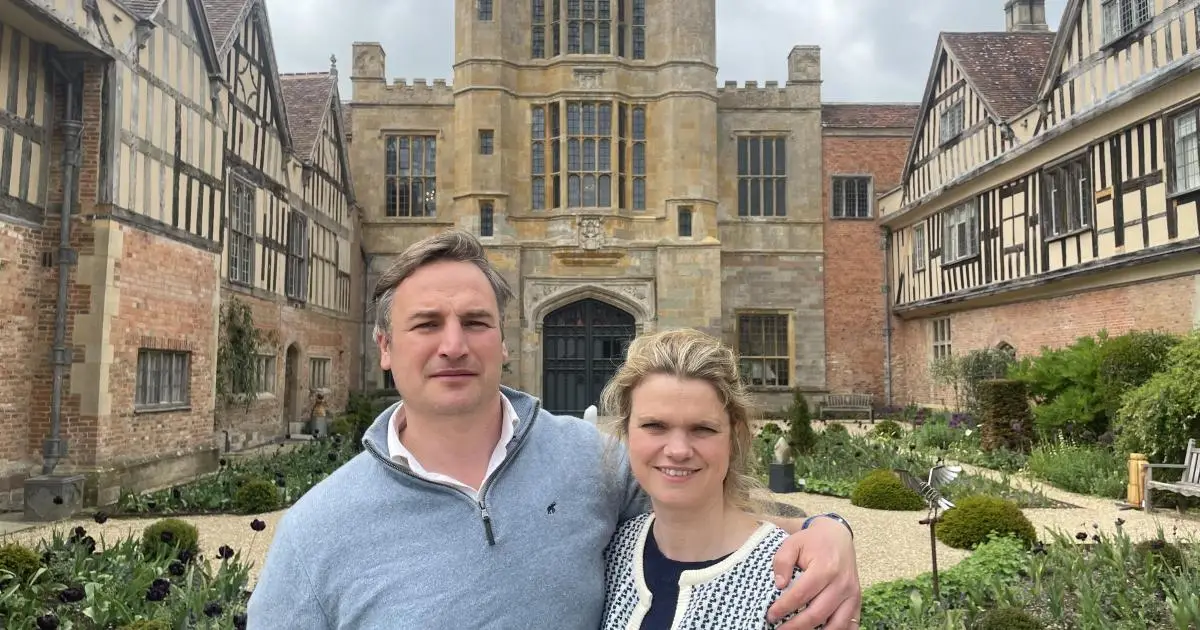

WHEN the Throckmorton family took over the running of their ancestral home, it lit a fuse among certain National Trust members, if you will pardon the crude Gunpowder Plot pun.
“Not everybody likes change”, says Magnus Birch Throckmorton, who, with wife Imogen, has taken on the day-to-day running of Coughton Court, the spectacular Tudor country house near Alcester.
Magnus is candid when asked about how National Trust members reacted to the Throckmortons taking over the stewardship from February of this year, admitting they were ‘not happy’. I’ll confess it. As a NT member, I wasn’t either.
How National Trust members reacted to change
However, it certainly appears that the family is winning over hearts and minds after NT members were stung when they learned they would lose their coveted free access.
Yet, in some ways, the family has thrown its arms wide open to people who may never have had a membership.

There is something very wholesome about that. The shrieks of laughter from the new play park (which is free for all) make it sound like they have already won over a new generation.
Even reactions from NT members have softened, lacking something of the incendiary quality which first greeted the announcement. Some, at least, are no longer biting their lips in frustration and have stopped well short of chewing up their National Trust cards.
VISIT: James Connell in front of one of the iconic views of Coughton Court, now managed directly by the Throckmorton family (Image: James Connell/Newsquest)
“They haven’t been happy with it. But we have had several National Trust members who have gone on Tripadvisor and said they have come here and had a wonderful time. People don’t like change,” he said.
He believes people reacted in that way because of the ‘outpouring of love’ members showed for Coughton Court which informed the decision to open the doors to them on designated days.
A thorny issue for members was the timing of transition which came shortly after the completion of a £3.3 million roof and restoration project, which was funded by National Trust donations.
CRAFTSMAN: Anthony Birch, one of three potters at Coughton Court with Chris Bell and Sally White (Image: James Connell/Newsquest)
It seems there are quite a few misconceptions about the Throckmorton’s longstanding arrangement with the National Trust – and clearing them up may be a good place to start.
The family, who have been at Coughton for 600 years, have made it their mission to be as accommodating as possible to NT members, including offering 10 days in the year when they can visit the property. Demand has been high, however. They are all fully booked.
Magnus, 38, the steward of the property, says the family is still working very closely with the National Trust and wants to continue to do so.
“The National Trust is phenomenal organisation. We are lifelong members of the National Trust. The Throckmortons and the National Trust have worked together since 1946 – and we will work together for the rest of the lease,” he said.
SCULPTURES: One of 67 sculptures dotted around Coughton Court (Image: James Connell/Newsquest)
But the new arrangement has allowed them to spread their wings – my words, not theirs, permitting them to move in new and interesting directions.
But the couple is quick to admit they are learning as they go and things are constantly ‘evolving and adapting’. One of the things they are exploring is closer links with Harvington Hall, another property once owned by the Throckmorton family. Like Coughton Call, Harvington Hall has a strong connection to the recusant Catholic families of England and has several secret priest holes or hides.
Catholic rebels and deadly plots
These holes date back to a time when all England was soaked to its beleaguered old bones with paranoia and intrigue. Catholic families like the Throckmortons had to be wary, keeping a watchful eye out for priest hunters or pursuivants, state-sanctioned agents whose job was to track down priests who faced execution for treason.
The Throckmorton family, even after 600 years, has kept the faith and there are Catholic and Anglican churches at Coughton.
SECRETS: The double priest hole at Coughton Court reminds visitors of a dark time in the chapter of English Catholics (Image: James Connell/Newsquest)
One famous family member is Thomas Throckmorton (1553-1614) who lived during the reigns of Elizabeth I and James I and was imprisoned three times, including when the Catholic Spanish Armada threatened to invade.
The Throckmorton family was involved in the Throckmorton plot of 1583 when a cousin, Sir Francis Throckmorton, planned to depose Queen Elizabeth and replace her with the Catholic Mary Queen of Scots. During the Gunpowder Plot of 1605, the wives of the conspirators, waited at Coughton to hear the news of the scheme’s success or failure.
DYNAMIC: The Throckmorton were front and centre in the turbulent world of Tudor politics (Image: James Connell/Newsquest)
One of the things you notice about Magnus and Imogen is just how hands-on they are – and how welcoming. There are no airs and graces – they are friendly and down-to-earth, picking up trays of empty coffee cups and taking them to the kitchen, greeting customers at the ticket hut.
They are not hidden away in a priest hole or looking down loftily from any tower, ivory or otherwise.
“We’re always around,” says Magnus. “We are in the early stages but it’s very exciting. The feedback from people has been lovely.”
Country house hosts first major event since leaving National Trust
Ex-National Trust site will be buzzing with family-friendly activities over half term
Worcestershire pub to throw open surprise £5,000 bar tab on this day
Their hands on attitude is something of a family tradition – Magnus’ mother, Christina Williams, helped create the garden with his grandmother, beginning in 1991. Imogen, with help from a team of gardeners, has continued this tradition. The rose labyrinth and the herbaceous borders are just beginning to come into their own.
Magnus says the Throckmortons have always had ‘strong female characters’ and it seems Imogen, 34, is in also made in this mould, helping to design a new children’s play area which has proved extremely popular. The couple, who live at Coughton Court, are working ‘flat out’ six days a week, an impressive feat when you consider they have two young children, Isabella, four, and Hector, 18 months. But growing up at Coughton Court will mean ‘an incredibly lovely childhood for them’, says Imogen who met Magnus through a mutual friend. They moved to Coughton Court just before they got married, nine years ago.
APPEAL: The Rose Labyrinth at Coughton Court (Image: James Connell/Newsquest)
One of the lovely touches they have introduced are the 67 sculptures dotted around the grounds, courtesy of the Oxford Sculptors Group, with birds being particularly prevalent. But there are real birds too – house martins dart about beneath the eaves.
In 1946, the Throckmorton family officially transferred ownership of Coughton Court to the National Trust.
As part of this historic 1946 agreement, a unique 300-year hereditary lease was introduced, giving the family the right to continue living in the house while retaining their right to manage the property as a visitor attraction.
Lady Lilian Throckmorton, the great-great grandmother of Magnus, gifted the home to the National Trust
When Magnus’ grandmother, Clare McLaren Throckmorton, inherited the property in 1991, there were about 500 visitors per year but by 2005 that had risen to 50,000. She was a great champion of Coughton Court’s restoration.
GRAND: The cafe at Coughton which has meat sourced from local butchers and Monsoon coffee from Stratford (Image: James Connell/Newsquest)
When she developed early onset Alzheimer’s, she asked the National Trust to run Coughton Court for a 15 year period. The National Trust ran Coughton Court between 2005 to 2026, when the Throckmortons once again resumed stewardship.
In some senses, the property is now more open than it was under the National Trust. For example, people can access the stableyard and cafe without having to pay a penny, something that would not have been possible before. This has enabled people, including families, to access Coughton, including the new play area. This can only entice a younger generation to take an interest in their history and conserve it for posterity, a passion shared by the National Trust and the Throckmortons.
