

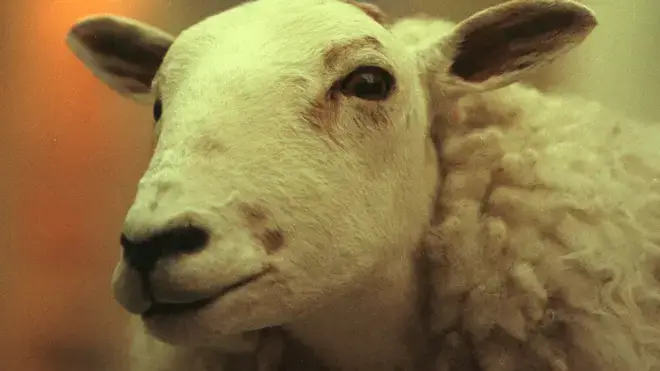

One of the first cloned mammals, this sheep paved the way for future discoveries.
Share
Want LBC stories before everyone else? Set us as your Preferred Source on Google
A cloned sheep who made possible the cloning of the famous Dolly the Sheep is now on display at a Scottish museum.
Morag the sheep made history in June 1995 when she was cloned at the Roslin Institute in Edinburgh.
Along with twin sister Megan, she was the first mammal to successfully be cloned from differentiated cells, a type of cell that is unique, having matured to fulfil a particular function.

Their cloning was an early breakthrough that paved the way for modern cloning, and helped scientists reprogram the DNA of an adult cell in order to clone Dolly the Sheep.
Experts said the births of Morag and Megan demonstrated that viable sheep could be produced by nuclear transfer from cells – the same technique used to create Dolly.
Morag has now gone on permanent display at the National Museum of Rural Life (NMS) in East Kilbride, in South Lanarkshire. She is the centrepiece of a new part of the museum that examines the connection between science and agriculture.
Morag died in 2000, and was initially on display at the National Museum of Scotland, in Edinburgh.
Professor Andrew Kitchener, principal curator of vertebrate biology at NMS, said: “The birth of Dolly the sheep is remembered as one of the great scientific breakthroughs of the late 20th century, but that historic moment wouldn’t have been possible without the arrival of Morag and her twin."
“Without them, there would not have been Dolly.“
"It’s very fitting that Morag forms the centrepiece of this fascinating new display at the National Museum of Rural Life, exploring the role that cutting-edge science can play in farming,” he added.