

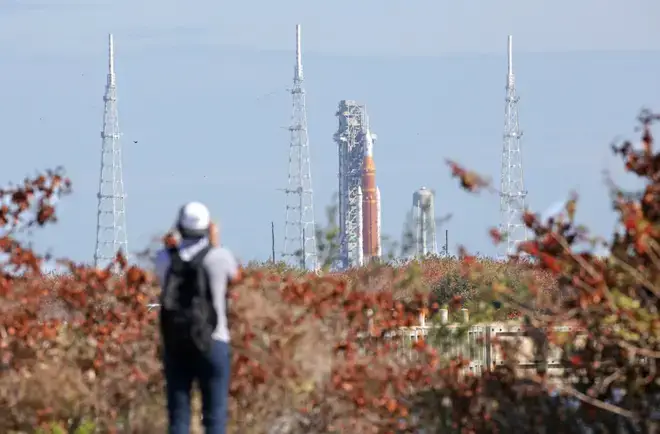

The Artemis II mission was set to blast off in early March from the Kennedy Space Centre in Florida.
Share
The first mission to the moon in over half a century has been delayed, after NASA discovered a fault in its rocket.
The Artemis II mission was set to blast off in early March from the Kennedy Space Centre in Florida.
On Friday night, NASA announced in a blog post that the flow of helium to the rocket was interrupted.
Helium flow is required for the rocket's launch.

A NASA spokesperson said: "This will almost assuredly impact the March launch window."
NASA also announced that it was taking steps to return the Artemis II rocket and Orion spacecraft back to the vehicle assembly building in the Kennedy Space Center in Florida.
Prior to this setback, the agency had pegged 6 March as the launch date.
The four astronauts would become the first to fly around the moon since Apollo 17 in 1972.
The mission would mark the farthest human flight ever into space.
The crew includes US Reid Wiseman, Victor Glover and Christina Koch, and Canadian Jeremy Hansen.
There are no plans for the mission to land on the surface of the Moon, with Artemis II acting as a precursor to Artemis III, scheduled for 2028.
The Artemis missions form part of NASA’s Lunar Gateway plans – long-term plans to build a space station, intended for astronauts to live, work, and prepare for Mars missions.
When the 10-day mission is able to go ahead, the crew will test life support, navigation, and communication systems.
These checks will confirm that everything is operational in deep space.
The crew will then enter Earth's high orbit, where the crew will pilot Orion manually before handing it back to controllers at NASA's Johnson Space Center in Houston, Texas.
The four astronauts will spend four days circling the moon, travelling a record breaking 4,600 miles beyond its far side, before returning to Earth, splashing down in the Pacific Ocean.