


Share
An astronaut has shared new details of NASA's first medical evacuation which brought an end to a space station mission last month.
Mike Fincke, 58, was one of the four members on board Crew-11 but suffered what officials described as a serious health issue, which prompted its early return.
Fincke has since praised his colleagues and medical team for their "professionalism and dedication," and said their efforts "ensured a positive outcome."
He claimed NASA determined that an "early, carefully coordinated return" was the safest option, rather than an emergency, which allowed the crew access to advanced medical imaging unavailable on the space station.
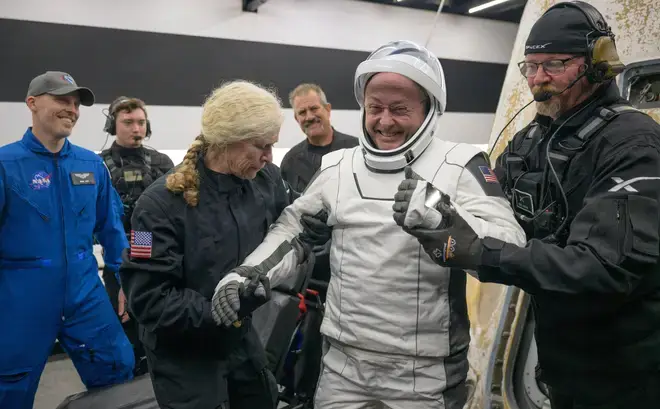
SpaceX guided its Dragon capsule to a middle-of-the-night splashdown in the Pacific near San Diego, less than 11 hours after the astronauts exited the International Space Station, in January.
NASA administrator Jared Isaacman previously said that the decision was made out of caution, noting that the Fincke's medical episode was considered "serious" and would require additional care on Earth.
Fincke declined to go into detail about his condition but told a press conference: "I'm doing very well and continuing standard post-flight reconditioning at NASA's Johnson Space Center in Houston.
"Spaceflight is an incredible privilege and a reminder of how human we are. Thank you all for your support."
He also told the press conference: "Having a portable ultrasound machine helped us in this situation, we were able to take a look at things that we didn't have."
This was the first time a crew on board the ISS had their mission ended early due to medical reasons.
Fincke added that the crew had lots of experience using the ultrasound machine to track changes in the human body, and said: "When we had this emergency, the ultrasound machine came in super handy.
"Of course, we didn't have other big machines that we have here on planet Earth."
Ultrasound can be used as a general diagnostic tool in multiple medical cases.
Crew-11 arrived at the ISS on August 1 last year and their return date had been scheduled for late February.
The four astronauts were set to leave after Crew-12 arrived on a new SpaceX Dragon capsule no earlier than February 15, but the Crew-12 mission launched to the ISS on February 13.