

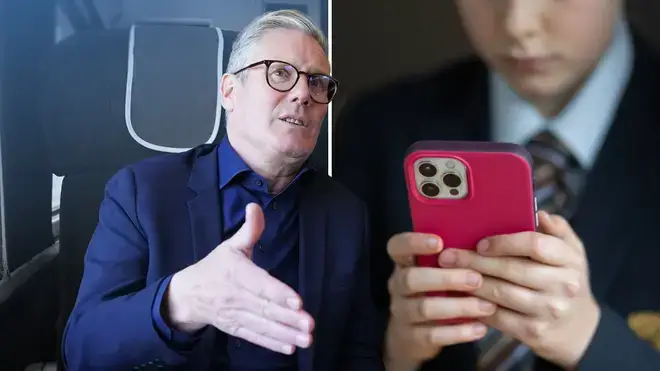

The Government's plans come after peers tabled an amendment to the Schools Bill intended to force through a ban
Share
An under-16s social media ban in Britain has moved a step closer – as the Government announces a consultation on new plans to restrict youngsters online.
After Australia banned under-16s from using social media in 2025, Downing Street has announced it is looking into copying the policy in Britain to protect children online.
Currently, the digital age of consent for social media platforms accessible in the UK is 13.
The measure has been supported by figures across the political divide in recent weeks, including Labour's Health Secretary Wes Streeting and Conservative leader Kemi Badenoch.

In a bid to crackdown on social media addiction among children, the review will also look into restricting potentially addictive app design features such as “streaks” and “infinite scrolling”.
Ministers will visit Australia as part of its consultation, after its Government implemented a ban in December.
The consultation will encourage submissions from parents and young people with a response expected as soon as the summer, according to the DSIT.
The announcement comes as the Government seeks to face down an amendment in the Lords over banning social media for children.
Later this week, peers will vote on an amendment to the Children's Wellbeing and Schools Bill which would require social media platforms to stop children aged under 16 from using their platforms within a year of the Bill's passing.
In an attempt to satiate the upper chamber, the Department for Science, Innovation and Technology (DSIT) said it will be taking immediate action on children’s social media use, including directing Ofsted to examine schools’ mobile phone policies and how effectively they are implemented during inspections.
As part of the review, the Government will also produce screen time guidance for parents of children aged five to 16. Guidance for parents of under-fives will be published in April, it said.
Despite the announcement, former schools minister Lord Nash said it represented only more delay.
“This announcement offers nothing for the hundreds of thousands of parents, teachers, medical professionals, senior police officers, national security experts and parliamentarians of all parties who have been calling for a raising of the age limit for social media,” the Conservative peer, who is tabling the Lords amendment, said.
“The Prime Minister must be in no doubt about the strength of feeling on this. The longer we delay, the more children we fail. I continue to urge all peers to back my amendment on Wednesday which would begin to end the catastrophic harm being done to a generation.”
Lord Nash’s amendment has already secured the support of the National Education Union (NEU), and 61 Labour MPs who have written to the Prime Minister calling for “urgent action”.
Esther Ghey, whose 16-year-old daughter Brianna was murdered by two other teenagers in 2023, said on Monday that a ban would be “a vital step in protecting children online”.
In a letter to party leaders, Sir Keir Starmer, Kemi Badenoch and Sir Ed Davey, Ms Ghey said her daughter had a “social media addiction” and “desperately wanted to be TikTok famous”, putting her “in constant fear about who Brianna might be speaking to online”.
Technology Secretary Liz Kendall said: “Technology has huge potential to create jobs, transform public services, and improve lives. But we will only seize on that potential if people know they and their children are safe online.
“We are determined to ensure technology enriches children’s lives, not harms them – and to give every child the childhood they deserve.”
Education Secretary Bridget Phillipson said: “We have been clear that mobile phones have no place in our schools but now we’re going further through tougher guidance and stronger enforcement. Mobile phones have no place in schools. No ifs, no buts.”
Paul Whiteman, general secretary at school leaders’ union the NAHT, said: “We welcome the news that the Government will take its time to properly consider a ban on social media for under-16s.
“It’s important that we learn from other countries and consider the unintended consequences as well as the advantages of such an approach.
“The vast majority of schools already have restrictions on the use of mobile phones on school sites.
“The Government’s suggestion that Ofsted should be ‘policing’ school policies is deeply unhelpful and misguided.
“School leaders need support from Government, not the threat of heavy-handed inspection.”
Pepe Di’Iasio, general secretary of the Association of School and College Leaders, said: “Ofsted’s involvement in policing these bans is all well and good but it would be more helpful for the Government to provide schools with resources to support the safe and secure storage of mobile phones.
“Most schools operate a policy in which students are asked to keep their phones in bags and out of sight – but this, of course, means that teachers constantly have to be alert to pupils breaking the rules.
“There are products on the market which can be used to safely store mobile phones so that they cannot be used.
“However, this costs money and many schools are, frankly, completely cash-strapped.”
Ian Russell, who set up the Molly Rose Foundation after his 14-year-old daughter Molly took her own life having viewed harmful content on social media, also spoke out about the ban.
Mr Russell said: “In the last few days, parents have been presented with a false choice between a toxic status quo and a social media ban that risks unintended consequences and a false sense of security for parents.
“The Prime Minister must now commit to strengthening the Online Safety Act to address the harmful and addictive design choices that are blighting a generation of children, and to make clear in law that protecting digital wellbeing is now the price of admission to the UK market.”
