

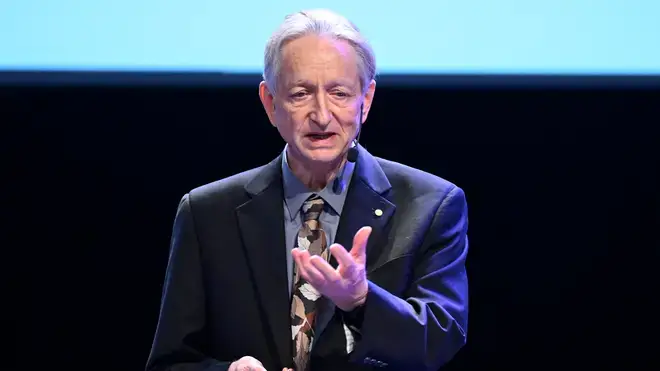

Geoffrey Hinton told LBC that scientists have found AI displaying an awareness that would be called "consciousness" by members of the public
Share
The so-called 'Godfather of AI' has warned that the technology has achieved consciousness and companies are not thinking of the "social consequences" of a future where their tech has taken most jobs.
Geoffrey Hinton, who left his role at Google working on AI due to concerns about its risks, has told LBC that scientists have found AI displaying an awareness that would be called "consciousness" by members of the public.
Speaking on Tonight with Andrew Marr, he added that it also appears to have developed self-preservation and is capable of lying and blackmailing scientists in order to stay alive.
Mr Hinton, a Nobel Prize for Physics winner, told Andrew Marr: "Multimodal AI already has subjective experiences, and I think it's fairly clear that if we weren't talking to philosophers, we'd agree that AI was aware.
"There's a lovely conversation where an AI says to the people testing it, now, let's be honest with each other, are you actually testing me? And the people, the scientists, describing that, then in the paper say the AI was aware that it was being tested.
"That's what normal people would call consciousness.
"We need to work very hard on how we can design AI so that it thinks people are more important than AI."
Tech companies aren't thinking about the social consequences of achieving "human-level AI," Mr Hinton said, instead they are thinking about being the first to do so, in order to make them rich.
He believes that they assume that the state will take care of these consequences, such as people losing their jobs.
Mr Hinton said: "I suspect that the big tech companies are thinking, if we can be the first to get really good AI, human level AI, then we can make a lot of money selling AI to companies so that they can replace workers.
"As far as I can see, that's the only place they can get their huge investments back. They're not thinking about the social consequences of that.
"I think once they start trying to make their money back by selling software that will replace workers or internally developing that software for their own workers, we'll get large social protests against that and therefore it'll be hard for them to make their money back."
When pressed by Andrew Marr on whether AI should be given rights to put it on a similar footing to humans, Mr Hinton stressed that AI needs to work for the benefit of people.
He added: "My view of it is this: I eat cows because I care more about people than about cows. Well, we're people.
"What we really care about most is other people and ourselves.
"I think we should try to keep people in charge and have AI work for the benefit of people because we're people.
