

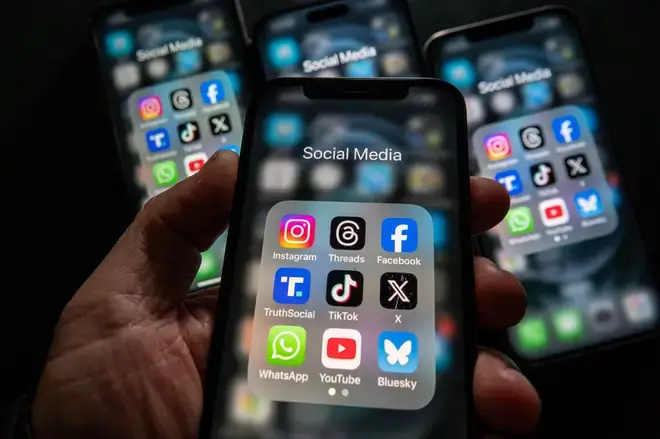

Google and Meta have today been found liable by a US jury for social media addiction in a landmark trial.
Share
Want LBC stories before everyone else? Set us as your Preferred Source on Google
Google and Meta have been found liable by a US jury for social media addiction in a landmark trial that could change the face of online regulation forever.
But why was the decision made, and what could the consequences be in the US and here in the UK?
What are Meta and Google accused of?
The social media companies are accused of "engineering addiction" in young people.
Mark Lanier, representing the plaintiff KGM, said the case is "as easy as ABC", which he said stands for "addicting the brains of children".
In all, lawyers pointed out three features that they say prove the addictive nature of social media:
The Case
A jury at the Los Angeles County Superior Court has delivered its verdict that the tech giants were negligent after a 20-year-old woman said her early use of social media made her addicted and her depression worse.
Snapchat and TikTok were also defendants in the trial – but both settled with the plaintiff before it began.
It is alleged by the plaintiffs that Meta's Instagram and Facebook, Google's YouTube, TikTok, and Snapchat "rewired how our kids think, feel, and behave".
The decision came after more than 40 hours of deliberation across nine days and more than a month since jurors heard opening statements in the trial.
The plaintiff, a 20-year-old woman identified as KGM in documents, or Kaley as her lawyers have called her during the trial, says her early use of social media addicted her to the technology and exacerbated her mental health struggles. She began using YouTube at the age of six and Instagram at nine, and told the jury she was on social media "all day long" as a child.
Meta and Google-owned YouTube were the two remaining defendants in the case after TikTok and Snap each settled before the trial began.
Jurors listened to about a month of lawyers' arguments and evidence, and they heard from Kaley herself, as well as Meta leaders Mark Zuckerberg and Adam Mosseri.
YouTube's chief executive, Neal Mohan, was not called to give evidence.
Lawyers representing Kaley, led by Mark Lanier, were tasked with proving that the respective defendants' negligence was a substantial factor in causing Kaley's harm.
They pointed to specific features they said were designed to "hook" young users, like the "infinite" nature of feeds that allowed for an endless supply of content, autoplay features, and even notifications.
The jurors were told not to take into account the content of the posts and videos that Kaley saw on the platforms, because tech companies are shielded from legal responsibility for content posted on their sites thanks to Section 230 of the 1996 Communications Decency Act.
Meta consistently argued that Kaley had struggled with her mental health separately from her social media use, often pointing to her turbulent home life.
Meta also said "not one of her therapists identified social media as the cause" of her mental health issues in a statement following closing arguments.
But the plaintiffs did not have to prove that social media caused Kaley's struggles, only that it was a "substantial factor" in causing her harm.
YouTube focused less on Kaley's medical records and mental health history and more on her use of YouTube and the nature of the platform.
They argued that YouTube is not a form of social media, but rather a video platform akin to television, and pointed to her declining YouTube use as she got older.
According to their data, she spent about one minute a day on average watching YouTube Shorts since its inception.
YouTube Shorts, which launched in 2020, is the platform's section of short-form, vertical videos that have the "infinite scroll" feature the plaintiffs argued was addictive. Lawyers representing both platforms also consistently pointed to the safety features and guardrails they each have available for people to monitor and customise their use.
The case, along with several others, has been randomly selected as a bellwether trial, meaning its outcome could affect the way thousands of similar lawsuits filed against social media companies play out.
Laura Marquez-Garrett, a lawyer with the Social Media Victims Law Centre and the counsel of record for Kaley, said this trial was "a vehicle, not an outcome" during deliberations.
"This case is historic no matter what happens because it was the first," Ms Marquez-Garrett said, emphasising the gravity of getting Meta and Google's internal documents into the public record.
She said social media companies are "not taking the cancerous talcum powder off the shelves", likely to be a reference to a past case that Mr Lanier and his firm worked on, securing a multi-billion-dollar verdict.
"And they're not going to because they're making too much money killing kids."
The Social Media Victims Law Centre and the parents who trace their children's deaths or harms back to social media will continue to keep fighting, Ms Marquez-Garrett said, wearing several rubber wristbands in honour of victims, that have not come off since the trial began.
The trial was one of several that social media companies face this year and beyond.
They are the culmination of years of scrutiny of the platforms over child safety, and whether the companies make them addictive and serve up content that leads to depression, eating disorders or suicide.
The consequences
Experts believe this case could be similar to those faced by tobacco and alcohol companies.
This means social media companies could face increased regulations in the US.
America could now see similar legislation to the UK’s Online Safety Act – which looks to curb the powers of social media companies.
Lawyers for the plaintiff say this case could bring justice for “thousands of children” impacted by social media.
"This verdict is bigger than one case," the lawyers said.
"For years, social media companies have profited from targeting children while concealing their addictive and dangerous design features.
"Today's verdict is a referendum – from a jury, to an entire industry – that accountability has arrived."
Technology expert Chris Stokel-Walker told LBC's Tonight With Andrew Marr: "A Meta spokesperson said they respectfully disagree with the verdict and they are evaluating their legal options.
"A Google spokesperson said we disagree with the verdict and plan to appeal, so they are one step ahead in terms of Meta, in terms of they're actually definitely going to appeal.
"If they weren't to do so, then it would mean big changes effectively for these platforms because they would have to try and fix the problems otherwise they, they might end up falling foul of similar cases in the months to come."
How have the tech companies responded?
Both Meta and Google have said they disagree with the ruling.
"We respectfully disagree with the verdict and are evaluating our legal options," a Meta spokesperson said in a statement this evening.
José Castañeda, a spokesperson for Google, added: "This case misunderstands YouTube, which is a responsibly built streaming platform, not a social media site."
