


These rare cosmic events blaze 10 to 100 times brighter than typical supernovae
Share
Astronomers have for the first time observed the birth of one of the most extreme objects in the universe: a magnetar packing the mass of about 500,000 Earths into a sphere only 12 miles wide.
A magnetar is a special type of neutron star. Neutron stars form when the core of a massive star collapses during a supernova explosion.
After the explosion, the remaining core is compressed so tightly that its matter is made almost entirely of neutrons.
What makes magnetars different from other neutron stars is their extraordinarily powerful magnetic fields – the strongest known in the universe.
For comparison, a typical fridge magnet has a magnetic strength of about 100 Gauss. A magnetar’s magnetic field is roughly a million billion Gauss.
The discovery provides the strongest evidence yet that magnetars may power some of the brightest explosions in the universe. It also shows how these objects can warp space-time, as predicted by Einstein’s general theory of relativity.
Scientists made the discovery while studying a superluminous supernova called SN 2024afav for more than 200 days.
Normally, the light from a supernova fades gradually after reaching peak brightness.
But SN 2024afav behaved differently. As it dimmed, its light flickered and produced small pulses.
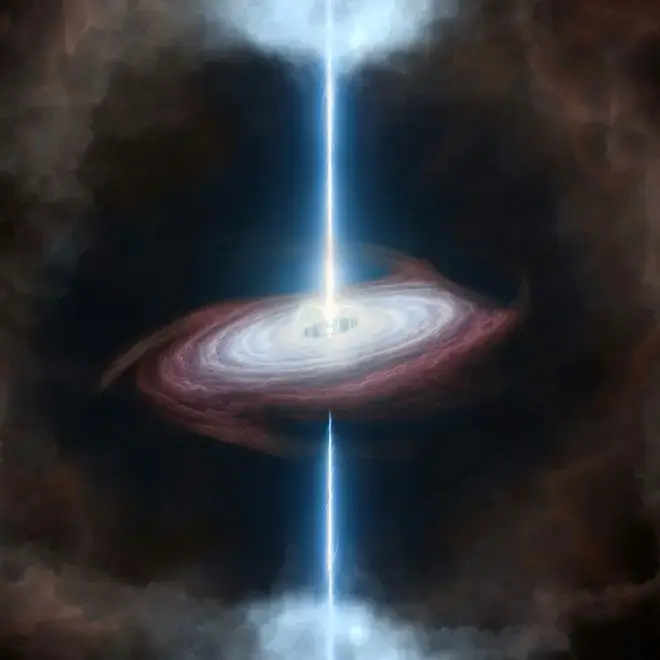
Researchers believe this happened because some of the exploded star’s debris fell back toward the newly formed magnetar, forming a swirling disk of gas around it.
According to their study, published in the journal Nature, the disk’s rotation was slightly tilted due to the effects of general relativity.
Alex Filippenko, a professor of astronomy at University of California, Berkeley and co-author of the study, said the observations provide “definitive evidence” of a magnetar.
"To see a clear effect of Einstein’s general theory of relativity is always exciting, but seeing it for the first time in a supernova is especially rewarding," he told The Times.
Superluminous supernovae like SN 2024afav are extremely rare.
They can shine 10 to 100 times brighter than typical supernovae, which themselves can outshine the Sun by about a billion times.
The explosion occurred in a galaxy roughly one billion light-years from Earth.
Joseph Farah of University of California, Santa Barbara described the discovery as a career highlight.
He said: “This is the most exciting thing I have ever had the privilege to be a part of. This is the science I dreamed of as a kid.
"It’s the universe telling us out loud and in our face that we don’t fully understand it yet, and challenging us to explain it.”
Researchers used the California-based Las Cumbres Observatory and Chile's ATLAS survey telescope to study the phenomenon.
