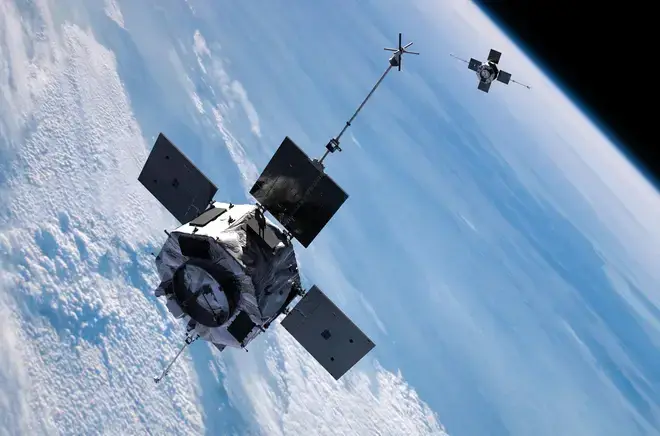

The satellite forms part of a pair of twin probes which were first launched into space in 2012
Share
A NASA spacecraft is set to crash back down to Earth on Tuesday, with the space debris' uncontrolled re-entry set to pose
According to the US military’s Space Force, the Van Allen probe is thought to weigh roughly around 1,323lb (600kg) and is expected to re-enter Earth’s atmosphere at about 11.45pm GMT on Tuesday.
The satellite forms part of a pair of twin probes which were first launched into space in 2012, with the craft joining the Van Allen Probe B on a mission to gather data on Earth's two permanent radiation belts.
Now, 14 years after launch, the spacecraft is expected to come crashing back down to Earth, with the debris classed as "low" risk to the public.
Parts of the aircraft are expected to survive re-entry, with Space Force calculating that there is a 1 in 4,200 chance that somebody on Earth could be harmed by the incoming debris.
Nasa has warned there is a 24-hour margin of "uncertainty" in regards to the timings.
As for the satellite's re-entry location, Nasa has said the geographical co-ordinates of the landing site are not immediately clear at this time.
Originally designed to partake in a two-year mission, the Van Allen Probes A and B — named after scientist James Van Allen — continued to function for almost seven years.
NASA eventually chose to end the mission after the two spacecraft ran out of fuel and were no longer able to orient themselves toward the Sun.
During the mission, both probes flew through the dual rings of charged particles trapped by Earth's magnetic field to discover how the particles were gained and lost, according to Nasa.
When the mission ended in 2019, initial analysis suggested that the spacecraft would re-enter Earth’s atmosphere in 2034.
However, that prediction was later changed to align with the current solar cycle, with updated calculations dating back to 2024 confirming that changing solar conditions meant an earlier-than-expected re-entry.
The mission provided a number of significant scientific breakthroughs, with initial data suggesting the existence of a transient third radiation belt, which can form during times of intense solar activity.