

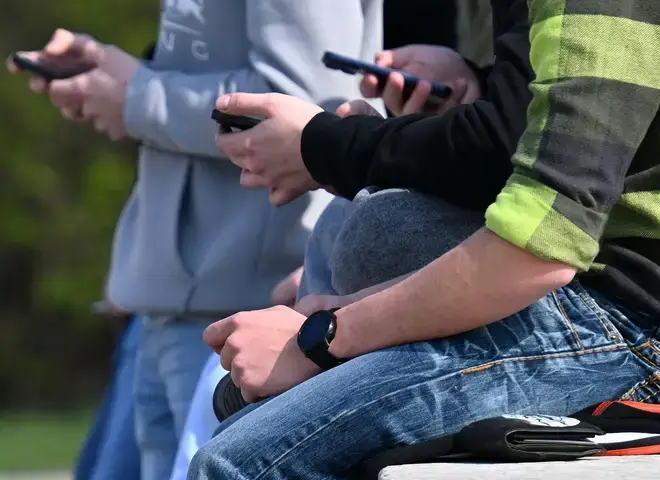

Australia introduced the ban in a world's first last year which could be followed by the UK
Share
Want LBC stories before everyone else? Set us as your Preferred Source on Google
Hundreds of teenagers are set to take part in a mock social media ban as the Government weighs up bringing it into law.
The six-week pilot will see 300 youngsters aged 13 to 17 be limited to restrictions on certain apps, as well as having time limits and curfews imposed.
The Department for Science, Innovation and Technology (DSIT) will test the different degrees of restriction in an attempt to study the impact on schoolwork, sleep and family life.

It comes as peers are set to vote again on whether to block under-16s from platforms deemed harmful, which could trigger a stand-off in Parliament.
The matter will return to House of Lords on Wednesday after the proposal to block under-16s had been written into the draft new law following a vote in the upper chamber, which won by a majority of 111.
But MPs voted to strip it out by a majority of 134, instead agreeing to give the Government a wider and more flexible power.
On Wednesday, peers will be asked whether they would like to insist on Lord Nash’s proposal or agree with MPs.
Lord Nash, who proposed the age limit as part of the Children’s Wellbeing and Schools Bill, warned that "when it comes to our children and social media, there can be no half measures and no wasted opportunities".
The peer said: "My colleagues in the Lords have the opportunity to again tell our elected colleagues that when it comes to our children and social media, there can be no half measures and no wasted opportunities.
"The damage that social media is doing to our children increases by the day. it is now clear that the Government’s consultation is a rushed job with no guaranteed outcome and worse, one skewed towards the so-called positive benefits of social media".
In the upcoming trial, participating young people and their parents will be split into four groups, with one set to be shown how to use parental controls to remove or prevent access to selected social media apps, replicating the effects of a social media ban.
Another group will have a one-hour-a-day cap on the most popular social media apps such as TikTok, Snapchat and Instagram.
Meanwhile the third will see parents block social media access for their child between 9pm and 7am, so they are still able to get online for a bit before and after school.
The final group will allow the teenagers the same access to social media as they currently have for comparison.
Families taking part will be interviewed at the start and the end of the trial to see how the ban or limits they piloted impacted them, and any difficulties they faced in implementing the limits.
The evidence from the pilot will inform Labour's decision on any policies aiming to improve children’s relationship with social media.
The Government's consultation on a potential Australia-style social media ban is set to conclude on May 26.
Technology secretary Liz Kendall said: "We are determined to give young people the childhood they deserve and to prepare them for the future.
"This is why we are listening to parents, children and experts with our consultation, as well as testing different options in the real world.
"These pilots will give us the evidence we need to take the next steps, informed by the experiences of families themselves."
Some 21 bereaved parents have already written to members of the Lords, urging them to "vote to raise the age".
Under the Commons-backed amendment put forward by ministers, children could be banned or restricted from accessing selected social media services.
The Secretary of State would also gain new powers to bring in social media curfews for young people, or limit the amount of time children can spend on social media.
A Government consultation on what action should be taken to address online harms is underway.
The 21 parents contributed to an open letter to "parliamentarians" in which they described the Commons vote as "devastating".
Its signatories included Ellen Roome and Matthew Sweeney, the parents of 14-year-old Jools Sweeney – and George and Areti Nicolaou, the parents of 15-year-old Christoforos.
They wrote: “We are writing as parents who wake up every day to a silence that should not exist, who go to bed knowing there will be no goodnight, no laughter, no future with the child we raised and loved."
They added: "The Government’s offer, a consultation with no binding commitment and no fixed end point, is not an answer to a problem that has already claimed too many young lives."