

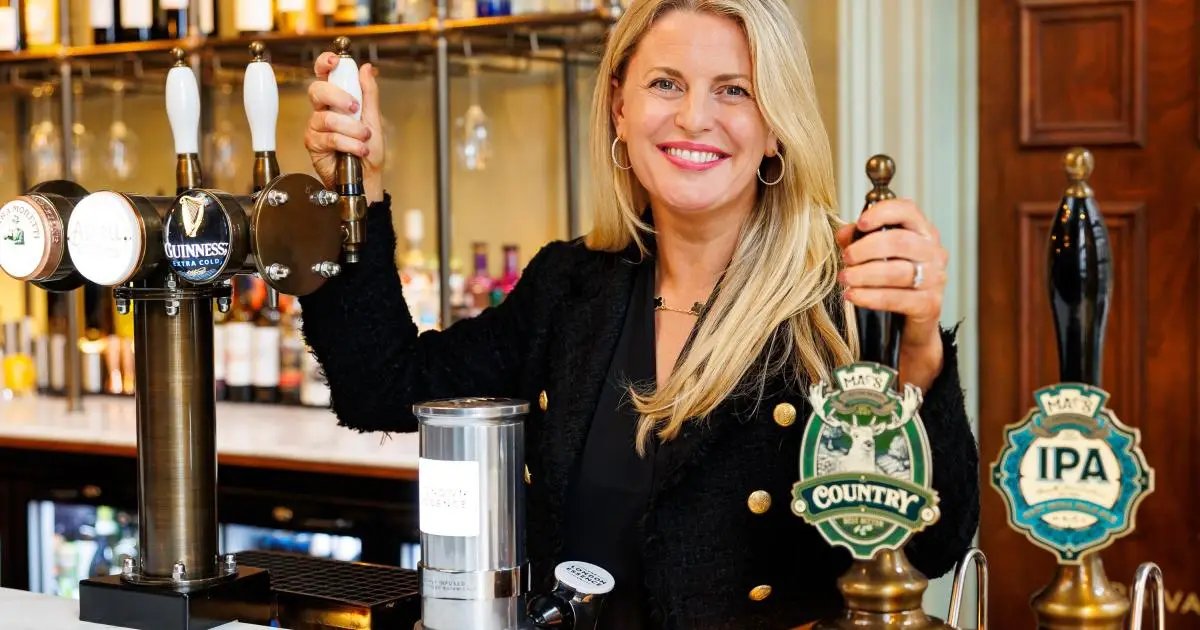

Former MEP, Emma McClarkin OBE, now heads up the British Beer and Pub Association. Katie Jarvis met her at a hostelry near Stroud to ask more about the Great British pub….
We’re looking at the view from Emma McClarkin’s window. A view true to itself over hundreds of years, hardly bothering even to glance up as the outside world twisted and twirled around it.
The greens – emerald, mossy, olive, teal – of wooded slopes, where apexes of old, old cottages barely make themselves known through a million leaves…
A manor on a nearby ledge, with dignified Georgian façade… ‘Dunkirk House,’ Emma says.
Really? Ha! I lived along the lane from that house for years; never seen it from this angle.

I’ve seen Emma’s house before, though; admired it as I passed on the narrow track to nearby Woodchester Lakes: a walkers’ paradise spread out in a hidden valley.
Admired its Arts & Crafts demeanour, where architects let the beauty of Cotswold stone speak for itself.
‘The same people who designed The Bear — Falconer, Baker & Campbell — designed ours. I think this is the last one they built.’
Yes, I can see that. The Bear, high on Rodborough Common, echoes these pure lines.
She shows me around the downstairs of this lovely house she and husband, Russell, bought in the midst of Covid, bringing it back to glowing life.
I love the paintings: some traditional; one, with a Ravilious feel, of a concentric, Neolithic mound…
(Image: Alex Rumford)
‘Wiltshire artist, where my husband is from.’
There are copies of modern classics lined up in rainbow-order on a bookcase. (‘My grandfather’s.) A lovely corner cabinet — walnut, maybe? (‘Russ’s grandmother’s’.)
A framed Country Life advert for the house in 1969. (‘Let’s cry over what you would have paid then… £16,750!’)
And the garden that cascades down in terraces, where four chickens (one named Elizabeth, after the Queen) have the time of their lives: ‘We had a resident buzzard that lived in the maple tree; he got a partner after a while and moved away.’
I think I’ve found the heart of the home when I notice a generous drinks’ trolley: ‘A lot of gin; a lot of whisky, rum and, of course, beer. We like to entertain.’
But, no. The real heart, I’m guessing, is at the end: a space of glass, light and vaulted ceiling: its jewel — a huge Gothic window, topped by arrow-slit — echoes Woodchester Priory church, a stone’s throw away.
Once a garden room, it’s now a semi-office.
‘I immediately saw it and said: “That’s a chapel”.’
Emma McClarkin pauses. ‘We just love it,’ she says, looking round with joy. ‘I am in London during the week; I get to come home and escape to here… I love it.’
Change of scene…
We’ve repaired to the aforementioned Bear, a hotel I know well. Ian and I had our wedding reception here, many, many (many) moons ago.
But here, with Emma — chief exec of the British Beer and Pub Association — I’m kind of looking at it with new eyes. Built in the 17th century as a coaching inn (dramatically changed by Mr Falconer’s enlargements), it nowadays doesn’t blink at a vegan decaf latte. Or the vegan scone with jam and cream that comes with it.
But it’s Emma’s comment that stops me in my tracks.
As we sit down, she exclaims: ‘Oh, I love your bag!’ (Patterned with a tree-house and squirrels, where I keep pens and notebook). ‘It reminds me of The Enchanted Wood.’ Really? I think, again.
Enid Blyton books were slated, in their ‘original’, for being (amongst other things) sexist. Books I adored too.
‘Hearing that you, a woman at the top of your game, grew up on books where the girls made sandwiches and the boys did men’s work…’ I quiz.
‘Yeah.’
‘Hasn’t affected you?’
‘Absolutely not.’
She laughs. ‘I remember somebody came into my office in Brussels when I was an MEP and said: “So you like being a woman in a man’s world”. I’ve never thought about it like that because I never see limitations to what I can do.’
Nor a necessity to change or compromise. She’s proud of her state-school education (the marvellous Stroud High); of her country childhood, growing up in Thrupp on the outskirts of Stroud.
(Image: Alex Rumford)
Of her long blonde hair that she wears in gentle waves.
Early on in her career, somebody said: ‘What are you going to do with your hair?’
‘Nothing.’
‘You need to tie it up or cut it.
‘And you need to wear glasses.’
‘But I don’t need to wear glasses!’
‘And she said: “Maybe you should get clear-lens ones. And don’t wear colourful nail polish”.’
Hang on, I interrupt. ‘This wasn’t a man?’
‘It was a woman.’
Emma doesn’t look as if she has the weight of the world upon her shoulders.
But she does bear the weight of the beer and pub world – or a hefty proportion of it.
Half the UK’s 44,000 pubs are represented by the BBPA, the trade association she heads up; and members brew 90 per cent of the country’s beer.
It’s tough time to be at the helm of a heavy-laden ship in choppy waters. Last year, one pub a week went under owing to the rising cost of doing business.
But Emma loves a challenge.
‘We’re very grateful that we managed to get a deal in February of £370m for the next three years to help pubs with business rates… but we need permanent rates reform. And we need beer duty to come down: we pay 12 times more than Germany and Spain – so it’s more expensive to go out.’
She took up her role – one could say – at the worst possible time: November 2019.
Except that’s not how she frames it.
Instead, Covid shone a blinding spotlight on exactly why we need our pubs – then, and now.
‘Listen,’ Emma says. ‘We’ve got great publicans in this country who have been through the wringer. They do it because, yes, they make a living. But so often it’s their home; they invite you into their home. And they do it because they love serving their community.
‘During Covid, what they missed the most was the ability to look after people.’
Which is why publicans would phone people they were concerned about; made sure vulnerable members of the community got hot meals.
(Image: Alex Rumford)
‘The Crown & Sceptre in Stroud was the only place locally you could get flour during the pandemic; Rodda [Thomas, one-time legendary landlord] opened it up as a shop. He’d put your Goram IPA in a flagon for you.’
The loneliness Covid threw into sharp relief has far from abated.
‘Human connection is absolutely vital to our mental health and wellbeing. And that’s what the pub does. It brings us together. You can walk in on your own – and it might be the only conversation you have during a day…
‘And it’s one of the few places where we can meet inter-generationally. There will be young people, old people; people having a cup of coffee and a cake; other people having a pint or a lovely meal. Some sitting in a corner, knitting or reading a newspaper.’
She’s bang on the money, of course.
A pub is the hub of the community; the heart of the high street.
The barometer of a town.
The place you go to ask about the best local builders. To find out gossip.
‘One of the top three things people in the UK look for when they’re buying a house is a good pub nearby. Because it’s an indicator of a really vibrant, close-knit community that you can fit immediately into.
‘We’ve got centuries of pubs in this country. And even when there isn’t a pub, we write it into books! The Green Dragon in Lord of the Rings. The Leaky Cauldron in Harry Potter. It’s so part of our culture.’
Funny, I say, isn’t it, that other countries haven’t dreamed them up…?
‘We’re actually exporting pubs now.
‘One of my members, Charles Wells, has got 19 in France. Village pubs.’
‘Who goes to them?’
‘They’re really popular.’
‘With ex-pats?’
(Image: Alex Rumford)
‘No, French people – students. They love it.’
Emma grew up in Stroud.
Went to good old Stroud High, the local grammar.
‘We didn’t go to school when it snowed – not because we couldn’t get there but because the pipes in the outdoor toilets froze. People think I’m joking when I say it. But, no! We had outdoor toilets and that was perfectly normal.’
Her dad, George, was a musician and photographer, who taught her that anything was in reach, providing you had passion and commitment.
Her mum, Maria, was at the heart of a happy, extended family life for Emma and her two younger siblings.
‘We are a Catholic family: we go to church and to the pub on Christmas Day. Christmas doesn’t feel like Christmas unless you’ve been to the pub, gathered together and celebrated together.
‘One of my earliest memories was St Patrick’s Day, where we’d go to the Queen Victoria [in Gloucester Street, Stroud] and eat cooked ham and cabbage.
‘All family celebrations were in the pub.’
Births, marriages, deaths, and the days in between: singing and dancing at the local.
Deaths. Indeed.
When Emma was 19, at uni studying law: ‘My mum got sick. She had chemo and went into remission. And we had about 18 months before it came back – and it came back very aggressively. She was 48; I’m now 47: the older I get, the more I understand. In your head, your parents are really old. But she was a young, vibrant woman.
‘My brother was 18, my sister 21. They had a joint party, and she was still well enough to enjoy it. Things changed very quickly.’
Why the Cotswolds are like a second home for Levi Roots
Fourth-generation baker who been in the business for more than 60 years
Meet the Indiana Jones of the chocolate world
Walk and talk with Gloucestershire’s new High Sheriff
Put those two parental elements together – a cheerleading dad; an amazing mum who died far too young – and you begin to understand some of the drive this woman has. Emma – always self-aware – certainly understands it. ‘It made me feel: “You’ve got to live fast; you just don’t know when your time is going to be up. You want to do something? You’ve got to find a way to do it. Make it count. Go for it”.’
And how. A love of rugby led to a job as a government relations executive for the Rugby Football Union.
When she decided she wanted to be on the other side of that dynamic, she stood as an MEP for East Midlands. Eight years – she was told – was the length of time it would take her to get elected: she did it in two.
The youngest elected member when she took up her seat in 2009.
Cyber-security; free-trade agreements; culture and education; chair of the Commonweath Forum… If she saw an issue she could contribute to, she was in on it.
How did she do it?
‘I’ve been very lucky that I work in areas of my genuine passion,’ she says.
Lucky?
‘I do feel lucky.’
But it’s not luck that took you there.
‘I have worked incredibly hard – there’s a lot of sacrifice that a lot of people don’t see. As a politician from the ages of 30 to 40, I could have been making babies but I was making law. Those are decisions you make.
‘It’s very difficult, if you’re not already married when you go into politics, to meet anybody.
‘I met my husband just before I left politics and was really grateful I found somebody with shared values.’
So hard work, dedication, following her passions.
‘And I feel very strongly that I’ve also been successful because I’ve had this guardian angel with me. I used some of that grief to fire me on. I was living for my mum; living the dreams that she had.’
There are still plenty of battles to be fought for pubs and breweries.
But there’s tons of good news too.
Over half of pub employees are women. Man’s world? Not anymore!
And pubs are continuing to reinvent, evolve, adapt in the best of ways.
In this geographical area?
‘If you go to The Stroud today by the town’s station, that is a really good version of a modern classic pub.
‘What Country Creatures [Sam and Georgie Pearman] have done with the Wild Duck at Ewen is amazing. Russ and I went for our anniversary. They’ve done such a super job of renovation. After the roast, they had a pianist who sang. Nobody wanted to leave!
‘Or Jodie and Mike at the Ram at Woodchester – they’ve brought it back to life.
‘If you want to grow the economy; if you want to create more jobs for young people; improve areas of deprivation: we’re the network you can literally switch on.
‘Incentivise us and we’ll just grow, hopefully in every town, every village, every city up and down this country.’
Politicians head to the pub for photo opportunities every election-time. Now’s the moment to put their money where their mouths are.
Cheers!.