
The Board of Deputies of British Jews and the Jewish Leadership Council released a joint statement expressing their deep concern about the High Court ruling
Share
The Metropolitan Police will stop arresting protesters who hold up signs declaring “I support Palestine Action” in the wake of the High Court ruling that the Government’s terrorism ban is unlawful.
Scotland Yard said it would only gather evidence on the protesters after the controversial unelected judges's ruling which overturned the Home Secretary's ban which came after the group attacked RAF Brize Norton last summer.
Fury erupted after the High Court's 'appalling' decision which has already cost taxpayers £700,000. Home Secretary Shabana Mahmood instantly announced plans to appeal.
The three judges, Dame Victoria Sharp, Mr Justice Swift and Mrs Justice Steyn ruled in favour of the case brought by Palestine Action's co-founder Huda Ammori saying the ban was "disproportionate" even though it had "organised and undertaken actions amounting to terrorism."

Palestine Action had not suggested these actions were a mistake or aberration but had “lauded” those who took part. Their picture of “an ordinary protest group engaged in activities that fall within the well-established tradition of peaceful protest” was “not accurate.”
While they concluded that the government's decision should be quashed, the judges warned that the group would remain a banned terror group pending an appeal by the Government.
“The High Court has found that the decision to proscribe Palestine Action was unlawful,” the Met said in its statement.
“However, the group remains proscribed pending the outcome of any Government appeal, which means expressing support is still a criminal offence.
“We recognise these are unusual circumstances and there will likely be some confusion among the public as to what happens next.
“From a Metropolitan Police perspective, officers will continue to identify offences where support for Palestine Action is being expressed, but they will focus on gathering evidence of those offences and the people involved to provide opportunities for enforcement at a later date, rather than making arrests at the time.
“This is the most proportionate approach we can take, acknowledging the decision reached by the court while recognising that proceedings are not yet fully concluded.
“This approach relates solely to the expression of support for Palestine Action.
“We will continue to intervene and make arrests where we see people crossing the line from lawful protest to intimidate, to damage property, to use violence, to stir up racial hatred or to commit other offences.
“We are mindful that this decision comes at a time when the impact of a prolonged period of significant protest continues to be felt by communities across London, in particular Jewish communities.
“We will continue to take an assertive and determined approach to dealing with antisemitism and other hate crime, acting decisively against anyone who tries to use the cover of protest to cause fear and distress to Londoners.”
The Board of Deputies of British Jews and the Jewish Leadership Council released a joint statement expressing their deep concern about the High Court ruling.
It has said that the impact of Palestine Action's activities on the Jewish community has been "significant and deeply upsetting," adding that the safety of the British public including Jews "must be a priority".
The statement reads: "We recognise the vital importance of judicial oversight in matters of national security and civil liberties. However, the practical impact of Palestine Action’s activities on Jewish communal life has been significant and deeply unsettling.
“Palestine Action has repeatedly targeted buildings hosting Jewish communal institutions, Jewish-owned businesses, or sites associated with Israel, in ways that cause fear and disruption far beyond the immediate protest sites.
“We welcome the response of the Home Secretary and note her intention to fight the judgement in the court of appeal. We will seek urgent clarity from the Government, police forces and the CPS regarding the implications of this ruling and the steps they intend to take to ensure that communities are protected from intimidation and criminality. This includes ensuring appropriate legal tools are available.
“The safety of the British public including Jews must remain a priority.”
Analysis of court data shows that at least 87 hours of court sitting time has been taken up at Westminster Magistrates’ Court since October with preliminary hearings for Palestine Action supporters.
A courtroom usually dedicated to handling serious crime extradition requests has been used for the hearings, with cases being overseen by senior judges in the magistrates’ court and occasionally the Chief Magistrate himself.
The High Court ruling has placed significant doubt over the future of the live criminal cases already in the system.
Thirty-two activists are due to make their first appearance at Westminster Magistrates’ Court on Monday next week, having been charged with a terror-related offence for holding placards supporting Palestine Action at a demonstration last August.
An Old Bailey judge on Friday delayed the plea hearing of four alleged pro-Palestine protesters who are accused of causing more than £1 million of damage after smashing into a defence manufacturer’s factory.
The defendants, who are currently in custody, asked for a delay, which was agreed to by Mrs Justice Cheema-Grubb, with a trial currently set for June 8.
Defendants facing magistrates’ court cases over placards and signs have been put on bail, while hundreds of days of court time has been allocated to hear their trials in the latter half of this year.
The Crown Prosecution Service has not said it will be dropping cases, but the courts are likely to now be asked to deal with legal applications to have the charges dismissed.
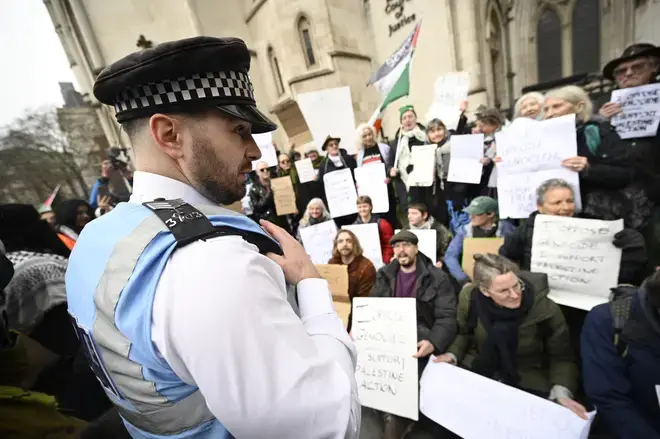
Activists with signs declaring “I oppose genocide, I support Palestine Action” gathered outside the High Court for Friday’s ruling.
Two Met Police liaison officers approached one of the group, Grace Lally, and advised her not to carry the sign as Palestine Action remains technically a proscribed organisation under the Terrorism Act.
One officer told her: “Potentially we’re looking at evidence of offences or anything like that, prosecution at any given point really – I can’t advise as to whether you will be arrested today, that’s not my decision.”
Another officer asked: “Are you waiting to get arrested, is that your intention?”
She replied: “I don’t want to be arrested. I want to know if it’s illegal to hold this sign.”
The officers replied: “We can ask.”