

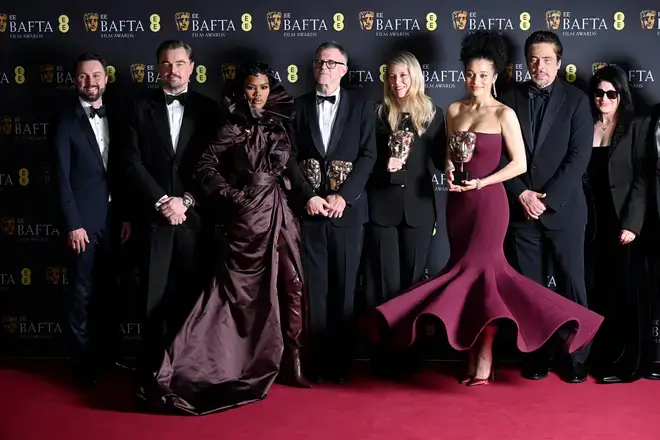

Actress Jessie Buckley and screenwriter-director Ryan Coogler both made history at this year’s Bafta film awards
Share
Paul Thomas Anderson’s film about a washed-up revolutionary searching for his missing teenage daughter won six categories from 14 nominations, including best film, best director, best adapted screenplay and best supporting actor for Sean Penn.
Collecting the biggest award of the night, Anderson said it was a “tremendous honour”, adding: “Anybody who says that movies aren’t good any more can piss right off because this is great f****** year.”
“We have a line from Nina Simone that we used in our film, ‘I know what freedom is, it’s no fear’.“
Let’s keep making things without fear, it’s a good idea. See you at the bar.”

Breaking Bafta records with 11 nominations, Hamnet was named best British film, with Jessie Buckley taking Leading Actress, making history as the first Irish actress to do so.
Accepting the award, Buckley said: “As a little girl, I never in a million years thought I would get to make a film.”
Recalling her early days as an actress, she said: “I had nuclear bad fake tan on, white hoop earrings, a polka-dot red skirt and had the audacity to say one day I wanted to be like Judi Dench.“
This is nuts, this really does belong to the women past, present and future who taught me and continue to teach me how to do it differently.”
Addressing her fellow nominees, Buckley said: “You are all just radical and you are doing it for the naughty girls, and I’m in awe of all your incredible performances.”
She added: “I love films and I believe in storytelling. I believe in women’s voices to tell those stories.”
Buckley, who had her first child last year, continued: “I share this with my daughter, who has been with me since she was six weeks old on the road with this.“
It’s the best role of my life being your mum and I promise to continue to be disobedient so you can belong to a world in all your complete wildness as a young woman. I am very grateful for this.”
Sinners took three awards, winning best original screenplay and the award for the original score.
Wunmi Mosaku, who has joint British-Nigerian nationality, landed best supporting actress, becoming the first black British winner of best supporting actress.
Referencing her role in the highly acclaimed vampire film, Mosaku said: “I found a part of myself in Annie, a part of my hopes, my ancestral power and connection, parts I thought I had lost or tried to dim as an immigrant trying to fit in.”
Addressing director Ryan Coogler, she told him: “I felt the presence of the ancestors’ pride and joy daily on your set.”
Robert Aramayo won best actor for his lead role in I Swear, a biographical drama based on the true story of John Davidson, a Scottish man with Tourette syndrome.
He defeated Hollywood heavyweights including Leonardo DiCaprio, Timothee Chalamet and Ethan Hawke for the best actor prize and gave Hawke a special mention as he accepted his trophy.
He said: “When I was in school, Ethan Hawke came in to speak to us at Juilliard and he gave an amazing talk on longevity as an actor, about protecting your instrument and avoiding self-destructive behaviours, and it had a great impact on everyone in the room.“
So to be in this category with you tonight is incredible. Thank you Ethan.”
In addition to bagging best actor, Aramayo also picked up the rising star award, the only category of the night decided by a public vote.
Lauren Evans picked up the award for best casting for I Swear.
Aramayo and Mosaku spared the UK the embarrassment of a fourth consecutive year without wins in any of the main Bafta acting categories, on a night that overall saw a modest amount of British success.
Aramayo and Mosaku’s awards mark the first time since 2022 that British performers have landed any of the big trophies.
British sound engineer Gareth John was one of the joint winners of the Bafta for best sound, for the sporting drama F1.
Frankenstein won three awards, production design, makeup and hair, and best costume design.
Akinola Davies Jr and his brother Wale Davies picked up the award for outstanding debut by a British writer, director or producer, for their family drama My Father’s Shadow; This Is Endometriosis took the prize for best British short film; Two Black Boys in Paradise was named best British short animation; and Clare Binns, creative director of Picturehouse Cinemas, won the award for outstanding British contribution to cinema.
Sentimental Value won the award for film not in the English language; Avatar: Fire And Ash picked up the award for special visual effects; best documentary was awarded to Mr Nobody against Putin; Zootropolis 2 won for best animated film; and Boong won for children’s and family film.
The in memoriam section of the Bafta ceremony featured tributes to late stars Diane Keaton, Terence Stamp, Catherine O’Hara, Rob Reiner and Robert Duvall.
Universal Pictures chief Dame Donna Langley was presented with the Fellowship – Bafta’s highest honour – by the academy’s president, the Prince of Wales, who was seated in the front row of the audience with the Princess of Wales.
