


Why 1998 game was so heated, as Iran make preparations to play in USA this summer – as Middle East conflict continues
Share
Iran is set to play in the 2026 World Cup on American soil, despite their war with the US, in what might be the competition’s most heated games for almost 30 years.
Fifa president Gianni Infantino has said that Iran is welcome to play in the North American-hosted competition this summer, even as the Middle Eastern conflict develops.
The US has been on an offensive in the country since February 28 which has seen Supreme Leader Ayatollah Khamenei killed and much of the region dragged into a war.
Iran will not likely play the US as they are in different groups, but their participation has echoes of the 1998 World Cup, when the team played America in Lyon, France.

The game, in football terms, turned out to be insignificant, both sides going out in the group stage.
But with tensions high between both countries it was seized on by politicians and the media for what was dubbed the most contentious game in World Cup history – perhaps until now.
The 2-1 Iran victory featured an intervention from Khamenei, a speech from Bill Clinton, a goal from future Premier League star Brian McBride, and a crucial role for referee Urs Meier, who later became enemy no.1 among England fans.
Here is how events unfolded almost 30 years ago.
Why was Iran v USA so contentious at the 1998 World Cup?
Background: Iranian – US tensions
Iran has had an anti-US stance since its 1979 revolution and America has long been suspicious that Tehran’s government is developing nuclear weapons.
The 1979 Iranian hostage crisis, where Americans were held for more than a year, preceded further aggravation, when a US Navy ship shot down Iran Air Flight 655 in 1988 – killing 290.
Relations began to thaw up to 1998, but there was still hostility when Iran qualified for their first World Cup for 20 years and were drawn against the US – the first time they had come together on the world stage in such a way.
Iran lost to Germany in their first group match at France ‘98 while the US were beaten 1-0 by Yugoslavia, meaning there was much to play for when the two met in Lyon as a loser would be eliminated. As it happened, Iran then lost to Yugoslavia and USA to Germany, sending both teams out at the first round.
Clinton calls for peace, Khatami orders virtue, teams targeted by radical groups
Both Iranian president Mohammad Khatami and US counterpart Bill Clinton had expressed hope that the game could offer a thawing of relations between the two countries.
But what preceded the game was reports of both sets of players being targeted by “radical groups,” with the security around the US team, in particular, of great concern with the American training camp said to be the subject of attempted sabotage.
Protests were seen against the Iranian government and there was a large police and security presence around venues in France to calm the situation.
On the morning of the game, Clinton said: “As we cheer today's game between American and Iranian athletes, I hope it can be another step toward ending the estrangement between our nations.
“I am pleased that over the last year, President Khatami and I have both worked to encourage more people-to-people exchanges and to help our citizens develop a better understanding of each other's rich civilisations.”
Khatami added: "Virtuous behaviour is your greatest victory, greater than any win or loss."
Orders over pre-match handshakes
Iran’s Supreme Leader Khamenei had ordered the players to not approach the US team to shake hands – which meant that the nominated home team, America in this instance, had to break convention by approaching the “away” team.
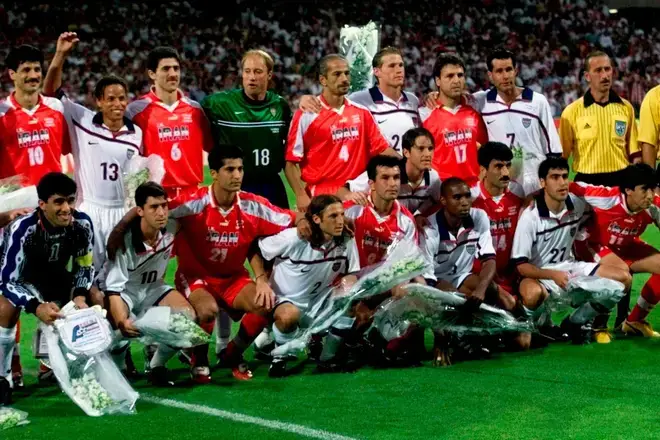
Urs Meier, the Swiss referee, had engineered the break from pre match precedent and coordinated a ceremony where flowers were exchanged between the teams. This gesture led to both teams being given the 1998 Fair Play Award.
Meier would later become infamous among England fans when he controversially disallowed a Sol Campbell goal against Portugal, which saw the Three Lions eliminated from Euro 2004.
Hostility from supporters – attempted pitch invasion foiled
While some banners and balloons bearing slogans were noticed among the supporters, there was not the protests or rioting that some had feared before kick off.
Mehrdad Masoudi, media officer at France 1998, said: “Fifa wanted the game to be about football, to be played in a peaceful manner. It reignited the sense of pride among people.
“There were a lot of rumours and the US was thought to be the target of radical groups and anti-Iranian groups who were wanting to take advantage of the occasion.”
As the game kicked off, Masoudi said he had noticed a group of Iranian fans waving banners and this section then erupted into a clash between football fans and a political group.
The unrest was quelled by armed police surrounding the troublesome group of fans to stop them from invading the pitch.
Iran win 2-1, but Fifa hailed a win for football
On the pitch, the game resulted in a surprise 2-1 victory for Iran, who had taken a lead to nil before Brian McBride, who later played for Fulham and Everton, pulled one back late on.
Khamenei was quick to seize the opportunity, calling it a “beautiful win” over the “Great Satan” but Fifa was more diplomatic in seeing the potential.
Masoudi said: “Looking back, it was a moment in history and it brought people together.
“What happened on the pitch in those two hours was a lesson to the whole world that, despite our differences, we can live peacefully together.
“The two teams exchanged jerseys and became friends.”