

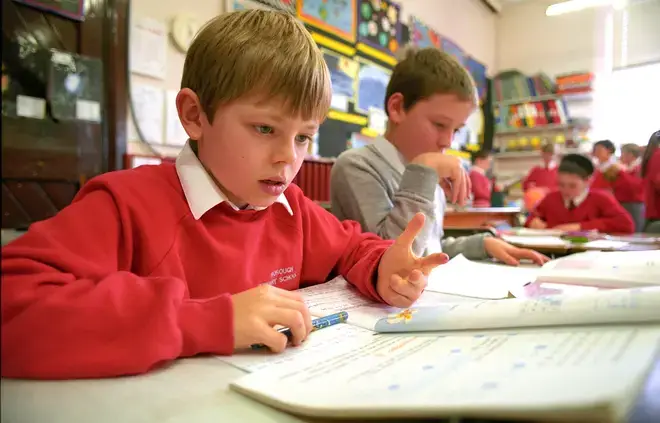

The Schools White Paper will set a target to halve the disadvantage gap by the time children born under this Government finish secondary school.
Share
Private equity firms are “profiteering” from special needs, the Education Secretary has told LBC, as the government sets out a package of reforms.
Bridget Phillipson said local authorities "are in the hands of" private organisations who provide social care and education services.
Ms Phillipson said the government is going to bring in "price bands to make it clearer what those providers can charge and so that local authorities are in a stronger position".
She recognised that while there are a lot of "really fantastic independent specialist schools", many of which are run by charities and others that do a brilliant job, the government is "spending a fortune" and the education quality is variable.

“We see it both here in terms of specialist provision and education, but we also see it in children's social care," she said.
"Where private equity have come in and are seeing this as a convenient revenue stream when we're talking about often some very vulnerable children.
"And it also involves sending children very far away from home, often in taxis, long journeys, where their transition into adulthood isn't good and where on a weekend, they don't have any friends locally because they're being sent far away for their education."
The Education Secretary's comments come ahead of the publication of the Schools White Paper, which will set a target to halve the disadvantage gap by the time children born under this government finish secondary school.
To tackle the achievement gap between pupils from poorer backgrounds compared with their more affluent peers, the government will reform how schools get targeted disadvantaged funding.
The Schools White Paper, set to be published in full on Monday, will also set out two new programmes to tackle the performance of disadvantaged pupils locally in the North East and on the coast.
It comes after details of the special educational needs and disabilities (Send) reforms, also forming part of the white paper, were leaked on Thursday.
In the latest GCSE results, the disadvantage gap index for year 11s stood at 3.92, according to the Department for Education (DfE).
It had previously narrowed from 4.07 in 2011 to a low of 3.66 in 2019/20 with some small fluctuations in between. It then widened again post-pandemic to the highest it had been in a decade at 3.94 in 2022/23.
The government will also set a new target for attendance to recover 20 million school days a year by the end of 2028/29 compared with 2023/24.
Instead of targeting disadvantaged funding based on whether a child is eligible to receive free school meals (FSM), after a consultation, distribution of funding to schools could take into account how low the family income is, how long this has been the case, and the place a child lives.
It would also remove the need for families to choose to take up free school meals to be eligible for deprivation funding, in an attempt to cut admin for schools.