

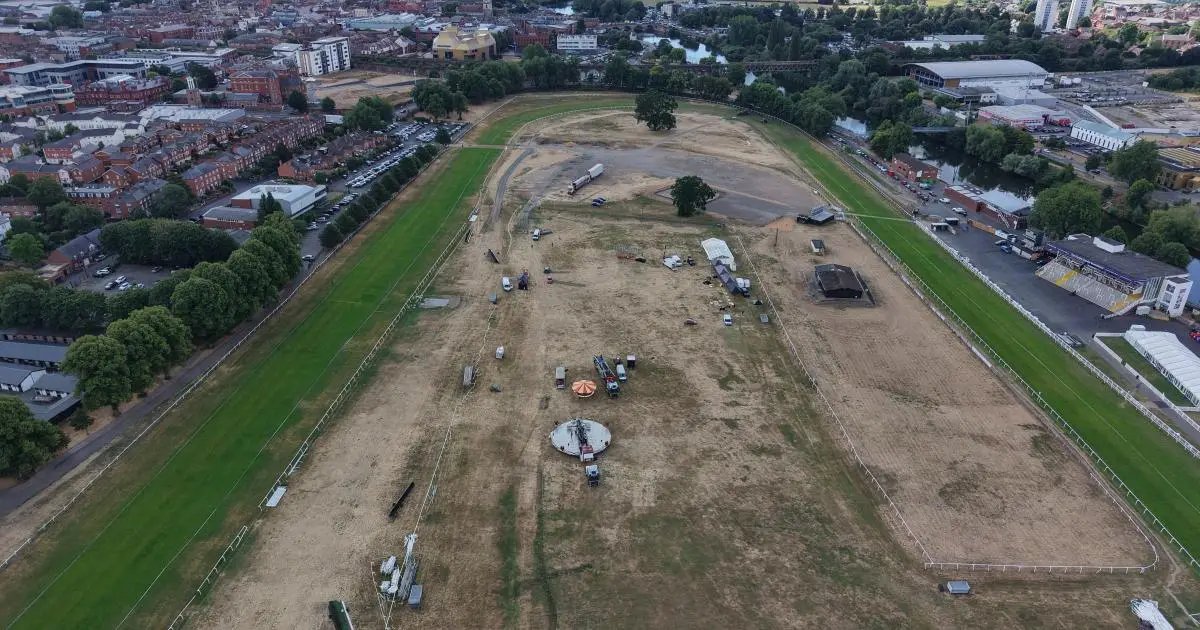

PARCHED fields in Worcester stretching to the horizon are shown after an “exceptional” month of hot weather.
A baked strip at the city’s Racecourse is among the images taken after what is expected to be England’s driest July in 190 years.
Only a fringe around the edges of the track remains from the usually lush field of green in Grand Stand Road.
Other overhead shots of the city show agricultural fields turned a pale yellow colour following four heatwaves which have left half of England and the whole of Wales in drought.
READ MORE: Extreme heat becoming ‘new normal’ as record highs predicted

July 2026 is on course to be England’s hottest since records began (Image: Drone Media, dronemediauk.com)
‘Exceptional July’
The baked land stretches into the distance in the overhead images taken by Drone Media UK.
Only the blue line of the River Severn, and the green trees beside it, show the presence of water in any quantity.
The Met Office has said a “truly exceptional July” is on course to be the driest on record for England once provisional statistics are confirmed.
READ MORE: Crowds cool off at oasis ‘that looks like Devon or Cornwall’
Dr Emily Carlisle, a scientist at the official forecaster, said: “The headline story for July is undoubtedly the rainfall.
“Across parts of England and Wales we’ve seen extraordinarily low totals.”
The fields around Worcester have been turned yellow by the heatwaves (Image: Drone Media, dronemediauk.com)
Worcester is 10th driest city
In separate research, Worcester has been ranked the 10th driest town or city in the UK.
Analysis showed that it received only 122.5mm of rainfall between June and August 2025.
Colchester was the UK’s driest city overall during the timeframe, according to ADI Leak Detection.
READ MORE: Areas of UK on course to go a month without rain as heatwave continues
Worcester has been ranked the 10th driest place in the UK (Image: Drone Media, dronemediauk.com)
‘Summer total has halved’
Peter Jones, director at the leak detection specialist, said: “Worcester stands out in this research as one of the ten driest cities in the UK for summer rainfall, and the change over recent years has been striking.
“The city’s summer total more than halved between 2020 and 2025, falling from 257.3mm to just 122.5mm which is a drop of more than 50 per cent in only six years.
“For a city like Worcester, that matters beyond the garden and the reservoir. Long, dry summers cause the ground to shrink and harden, and that movement puts real strain on the water pipes running beneath homes and streets.
“It’s one of the reasons we tend to see more underground leaks emerge after a prolonged dry spell, not during it.”
The Racecourse before the current spell of heatwaves (Image: NQ staff)
While there is no hosepipe ban in Worcestershire as yet, Severn Trent Water has said restrictions may become necessary if the hot spell continues.
Mr Jones advised householders to watch out for slow leaks that could drain usage and push up bills.
“A sudden jump in your water bill, damp patches that linger in dry weather, or a water meter that keeps ticking when everything’s switched off are all worth taking seriously, ” he said.
“My advice to Worcester homeowners is simple: keep an eye on your usage through these drier summers, and don’t assume a lack of rain means a lack of water problems.
“Catching a leak early saves water, money and a much bigger repair down the line.”