

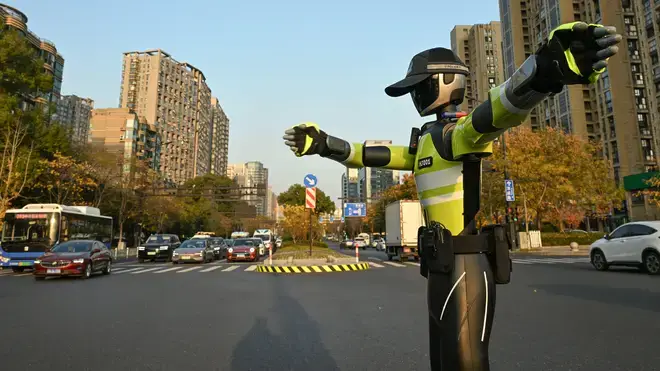

The artificial intelligence-powered robots are being positioned to work alongside officers as “service” droids to assist the public or “crime-fighting” machines that could catch suspects
Share
Humanoid "robocops" could be patrolling Britain's streets within three to five years, a policing expert has said.
The artificial intelligence-powered robots are being positioned to work alongside officers as “service” droids to assist the public or “crime-fighting” machines that could catch suspects.
Up to 1,000 British officers are to be polled on the idea, as well as being asked how supportive they would find military-style “smart” helmets to their work.
The tech helmets, which draw up images of the classic 1980s dystopian sci-fi film RoboCop, could help them track down and identify suspects, record video and share information.
The idea is close to becoming a reality, experts say, as police forces around the world grapple with a shortfall of officers.
Ivan Sun, a professor in the department of sociology and criminal justice at the University of Delaware, presented his predictions at a meeting of the American Association for the Advancement of Science in Phoenix, Arizona.
In his presentation entitled “Robot Cops on Patrol: The Next Generation of Operational Policing”, Mr Sun told the conference: "Engaging in the use of force, engaging in high-speed chases — it’s not in our imagination, it’s coming up … The sky is really the limit.
“In a robbery, for instance, [robots] could really take control of the scene. They could chase you for five miles and they won’t get tired.
"At the same time, while they are chasing the suspect, they can scan the suspect’s bio and characteristics … From 100m away they can know if [the suspect] has a weapon in their possession. A human officer would not be able to do that."
Robotic police officers – that have a human form and walk upright on two legs – have already been tested in China.
Under a project named “Intelligent Police Unit R001”, the humanoid robots have been taken out on patrol with human officers to gauge public reaction.
They have also been formally deployed for traffic control, issuing warnings and fines to drivers who jump red lights and cyclists who ride on pavements.
Mr Sun said it would only take another three to five years for robotic officers to be out on full patrols in China.
He added that Britain and other western countries would soon follow suit.
The policing expert is working with academics at Northumbria University to poll between 500 and 1,000 British officers.
They will be shown two pieces of animated footage, one containing a service droid and the other a “crime-fighting” machine, and asked how acceptable they find the use of robots in those situations.
Sun believes these robots can be used as effectively as the machines used to make initial checks when suspected bombs are found.
He admitted that British officers would “pay more attention to privacy issues and legal issues than the Chinese officers”, who operate in a more authoritarian society, but said he felt they would still back the use of AI and robotics in policing.