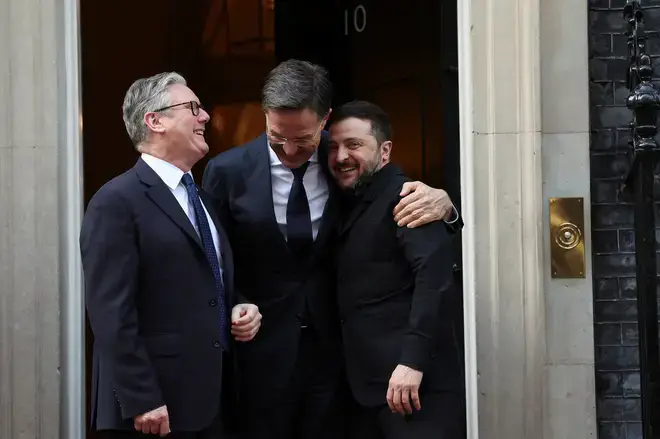

Zelenskyy and Starmer met during the Ukrainian President's UK visit, where he said the Iranian regime and Russia are “brothers in hatred"
Share
Vladimir Putin cannot be allowed to benefit from the Iran war, the Prime Minister told Volodymyr Zelenskyy during his visit to the UK on Tuesday.
Sir Keir Starmer said Russia should not reap the rewards of higher global oil prices and benefit from the easing of sanctions as a result of Middle East instability.
Ukrainian President Zelenskyy, who also met the King during his trip, thanked the UK for support during a “difficult winter” for his country, during which Mr Putin’s forces targeted critical energy infrastructure during freezing conditions.
Sir Keir welcomed Mr Zelenskyy to Downing Street for talks which were also attended by NATO chief Mark Rutte.
The Prime Minister said: “I think it’s really important that we are clear that the focus must remain on Ukraine.
“There’s obviously a conflict in Iran going on, in the Middle East, but we can’t lose focus on what’s going on in Ukraine and the need for our support.”
He added: “Putin can’t be the one who benefits from a conflict in Iran, whether that’s oil prices or the dropping of sanctions.”
The US temporarily loosened some restrictions on Russian oil in a bid to ease pressure on global supplies triggered by the strikes on Iran and Tehran’s retaliation against Gulf states.
During his visit, Volodymyr Zelenskyy told MPs and peers the Iranian regime and Putin’s Russia are “brothers in hatred”.
The Ukrainian president highlighted co-operation between Tehran and Moscow on Shahed kamikaze drones which had targeted Ukraine and countries across the Gulf.
Speaking in a Westminster committee room, Mr Zelenskyy said: “The regimes in Russia and Iran are brothers in hatred and that is why they are brothers in weapons.
“And we want regimes built on hatred, to never, never win in anything. And we want no such regime to threaten Europe or our partners.”
During the visit, Sir Keir and Mr Zelenskyy also agreed a new defence partnership aimed at tackling cheap attack drones.
Downing Street said the partnership with Kyiv would bring together “Ukrainian expertise and the UK’s industrial base” to manufacture and supply drones and other capabilities.
As part of the agreement, the UK will put £500,000 towards a new “AI centre of excellence” in Kyiv, which would be made up of experts working to see how the technology can best be used for a “battlefield advantage”, No 10 said.
Closer co-operation in the defence industries will also be sought with third countries under the partnership as part of efforts to bolster international security.
Sir Keir said: “We must work in lockstep with our partners and allies to deliver security at home and abroad, and this new partnership with Ukraine will do just that.
“Drones, electronic warfare and rapid battlefield innovation are now central to national and economic security, and that has only been further magnified by the conflict in the Middle East.
“By deepening our defence partnerships, we are strengthening Ukraine’s ability to defend itself from Russia’s brutal, ongoing attacks, while ensuring the UK and our allies are better prepared to meet the threats of the future.”
The new declaration will build on the 100-year partnership, which was signed last year by the two leaders and aims to set out a path for continued solidarity with war-torn Kyiv, including financial support.
Mr Zelenskyy added: “Thanks to the UK, you have stood with us all through this difficult winter.”
He met the King at Buckingham Palace, and the men shook hands warmly and stood side by side for a photograph.
The King welcomed Mr Zelenskyy in the first-floor drawing room, and the president was invited to take tea with him in his private study during the 25-minute meeting.
The King, who in January paid tribute to the Ukrainian people’s resilience and the country’s “valiant strength”, and expressed his hopes for a “just and lasting peace”, is said to have re-articulated these sentiments in person to Mr Zelenskyy.
Mr Zelenskyy is currently on a tour of European capitals to drum up support and keep his conflict at the forefront of allies' minds.
In an overnight address on Monday, Mr Zelenskyy said he was working with allies to boost his country's defences, but the ultimate key to peace was putting more pressure on Russia.