

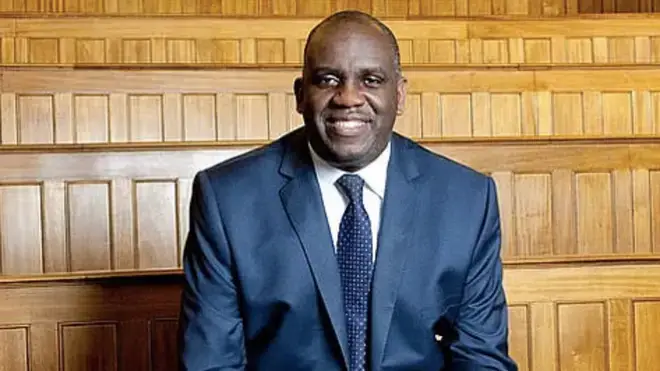

Lord Sewell is set to tell a conference this week that his government is failing to improve education for white working-class boys.
Share
A Tory peer who helmed a landmark race report has likened parental indifference to children who bunk-off school to 'child abuse', insisting the state should act accordingly.
The author of a landmark report into inequality in Britain, Lord Sewell will warn a conference this week that his government has failed to improve education for white working-class boys amid staggering levels of truancy.
Tory peer, Lord Sewell, was the chairman of the Commission on Race and Ethnic Disparities, a group set up following the Black Lives Matter protests in 2021.
Speaking with LBC on Sunday, the Tory peer likened parents' dismissive attitudes to truancy to ‘collusion’ and 'child abuse'.

The Tory peer, who authored the a report, found that on the subjects of race and ethnic disparities, white boys are still stuck at the bottom of the class – despite warnings which have been ignored by successive governments.
The review found children from many ethnic minorities did as well or better at school than white pupils, who often performed the lowest.
Speaking to Ali Miraj on LBC, he said the situation has only “got worse” as time has gone on.
“We’ve got a situation in the country now where half of the students who are from that white, poor background are bunking off school,” he said.
Lord Sewell said around 50% of white pupils from low-income backgrounds are persistently absent, compared with 18% among non-white pupils.
"So basically, we've got a situation in the country now where half of the students who are from that white poor background, the bunking-off school boys."
He explained “low income” as typically measured using eligibility for free school meals, which he described as a “crude” proxy.
The report was set up by Boris Johnson to investigate whether Britain was a racist country.
At the time, the Lord Sewell highlighted how "stuck" these groups were, and urged ministers to consider the needs of the white working class.
"I'm not going to disparage white parents who work hard from poor areas, because that's not what this is about," Lord Sewell told LBC.
"However, it is quite clear that the ethnic minority drive on education and particularly in the family structure, particular family structures where there are two parents, people where there's a concentration of education, high expectations of their own children. This has been the big driver in making that disparity."
The latest figures from the Centre for Social Justice (CSJ) show that little has changed in the interim.
According to the CSJ's Lost Boys report, white working-class boys on free school meals are among those least likely to continue their education beyond age 16.
Lord Sewell is expected to address these findings at Westminster on Tuesday, to mark the anniversary of the Commission on Race and Ethnic Disparities report’s release.
The Centre for Social Justice (CSJ) will host an event in Westminster later this week to mark the fifth anniversary of the report, where Lord Sewell is expected to reiterate his concerns.
He will state: 'Five years ago, we were told by the woke Left and liberal Right that the evidence on class and family was uncomfortable. Since then, this evidence has only hardened.'
'White working-class boys from the poorest homes are still stuck at the bottom of the class. Our warnings were not listened to,' he will add.
'If we are serious about opportunity, we have to stop arguing about language and start delivering change in the places that need it most.'
It comes as the Peer told Ali Miraj: "It's not about the identity politics, it's not about more black teachers, it's not about giving our teachers unconscious bias training. It's not.
"It is really down to this core element."
Asked how he could tackle the issue, Sewell insisted "there are a number of things that can be done on a policy level."
"First of all, this number on school absences. That is the fact that too many of our children from poor white backgrounds are at home playing video games and not going to school with the collusion of their parents.
"Now, I think the state have to come in here and say that it's almost like a child abuse. I hate to say that word but you cannot be colluding with that situation where you're leaving the child at home because they don't feel like going to school.
"We've must be more robust about this."