

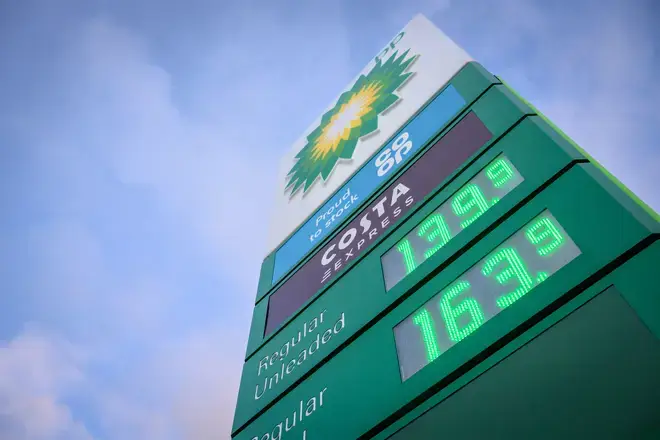

The government has branded these comments 'speculation' and insisted the UK is well stocked for all eventualities.
Share
The UK could face "fuel rationing" if Trump’s war on Iran continues to put pressure on global energy supplies, a former BP chief has claimed.
Sir Keir Starmer today announced a £53 million package of support for “vulnerable” heating oil customers as pressure mounts on global fuel supplies due to Iran’s closure of the Strait of Hormuz.
These measures may not be enough to prevent fuel shortages in the UK, however, Professor Nick Butler, former vice president for policy and strategy at oil giant BP, told LBC.
“It's better than nothing, but I don't think it really deals with the seriousness of the situation, which is developing in the Gulf,” he said.
“Even if we do send minesweepers and clear the Gulf, which I believe we should, because It's in a national interest, I think we're still going to have a period which has already begun, when tankers can't get through, and therefore a fifth of the world's supply of oil is going to be taken off the market, and it's very hard to replace that.
“The only country in the world that can substantially replace part of that is Russia and I don't think we're going to give up on sanctions on Russia just yet.
“I think we have to realise that if this conflict goes on and if Hormuz remains closed, there is going to be a substantial physical shortage here.”
This shortage could lead to panic buying and fuel shortages if left unchecked, he claimed.
Despite this, the Department for Energy Security & Net Zero has insisted the UK is well-positioned for any eventuality and branded Mr Butler's comments "speculation."
“In factories, in food supply, in hospitals, all those things depend on oil and gas.
“Now, Mr. Starmer talks about the long-term energy policy changes towards renewables, and that's fine, but the keyword in that is long term.
“It takes a long time. Oil and gas is still 80% of our daily energy consumption.
“And that is not going to change quickly because it's embedded in all the things that we use in our houses, in our factories, in our cars, that can't be changed overnight.”
He called on the government to lay out a “clear plan” to avoid the worst consequences of a global fuel shortage, panic buying and rationing.
“I think the government, to avoid the risks of panic buying, which wouldn't help anybody, should now lay out a clear plan for what they're going to do
“I think they have to protect the key sectors, the health service, food supply.”
It comes as Sir Keir vowed the UK will “not be drawn into a wider war” in the Middle East, less than 24 hours after Donald Trump demanded the US’ allies aid its war on Iran.
Trump made the demand despite claiming he has “won” the war multiple times and “doesn’t need” the UK’s help.
Keir Starmer insisted the UK will not be drawn into a "wider war" in the Middle East today insisting he wanted to see it end as "quickly as possible".
Knocking back Donald Trump's call for for warships in the Strait of Hormuz, the Prime Minister said Britain is working with its allies and European partners to reopen the vital shipping waterway in the Gulf of Oman after it was blocked by Iran.
Speaking from Downing Street, the Prime Minister said Britain has already acted alongside other countries to release emergency oil stocks at a level that is "completely unprecedented".
He added: "But ultimately we have to reopen the Strait of Hormuz to ensure stability in the market.
"We're working with all of our allies, including our European partners, to bring together a viable collective plan that can restore freedom of navigation in the region as quickly as possible."
It comes after Donald Trump warned Nato faces "very bad future" if it fails to help the US reopen the waterway.
"If there’s no response or if it’s a negative response I think it will be very bad for the future of NATO,” Mr Trump warned on Sunday evening.
“We’ll see if they help us. Because I’ve long said that we’ll be there for them but they won’t be there for us,” he told the Financial Times.
Tehran's blockade of the Strait of Hormuz, a major shipping route used by oil tankers transporting the fuel out of the Middle East, has sparked global price spikes.
Speaking to LBC on Sunday, Energy Secretary Ed Miliband said "the cost of living is the number one priority for this government", as he promised LBC listeners their energy bills will be protected.
He said the Government is still looking at all options of what that support could look like, whether that be targeted or universal.
