


The ban of Palestine Action as a terror group was lawful, judges at the Court of Appeal have ruled.
In a ruling which likely paves the way for hundreds of criminal cases against people accused of supporting the group to go ahead, five Court of Appeal judges said the ban was a “justified and proportionate” interference on freedom of expression rights.
Monday’s decision overturns the judgment of three judges at the High Court, who ruled in February that the then-home secretary Yvette Cooper’s decision to ban Palestine Action was unlawful, following a legal challenge from the group’s co-founder, Huda Ammori.
The ban, which began on July 5 last year, made membership of, or support for, the direct action group a criminal offence punishable by up to 14 years in prison, and has remained in force as the Home Office attempted to challenge the ruling.
In a summary of the decision, the Lady Chief Justice Baroness Carr said comparisons with groups such as the suffragettes were “seriously flawed”.
Baroness Carr, sitting with Sir Geoffrey Vos, Lord Justice Edis, Lord Justice Lewis and Lady Justice Whipple, concluded: “We recognise the proscription of an organisation like Palestine Action is highly controversial.
“We recognise too that Palestine Action is supported by many otherwise lawful citizens. But it is a fundamental mistake to overlook the fact that Palestine Action overtly promotes unlawful violence amounting to terrorism.
“It is not – as claimed – a direct action civil disobedience protest group like the suffragettes, operating transparently in the open.
“It is a covert organisation which operates with secret cells to avoid the detection and prosecution of those using violence to destroy property and cause injury.”
In a 44-page written ruling, the judges said that many people may be subject to a “chilling effect” because of the ban, adding: “The proscription decision will not prevent public expressions of support for the Palestinian cause or opposition to Israel and to the Israeli Defence Force”.
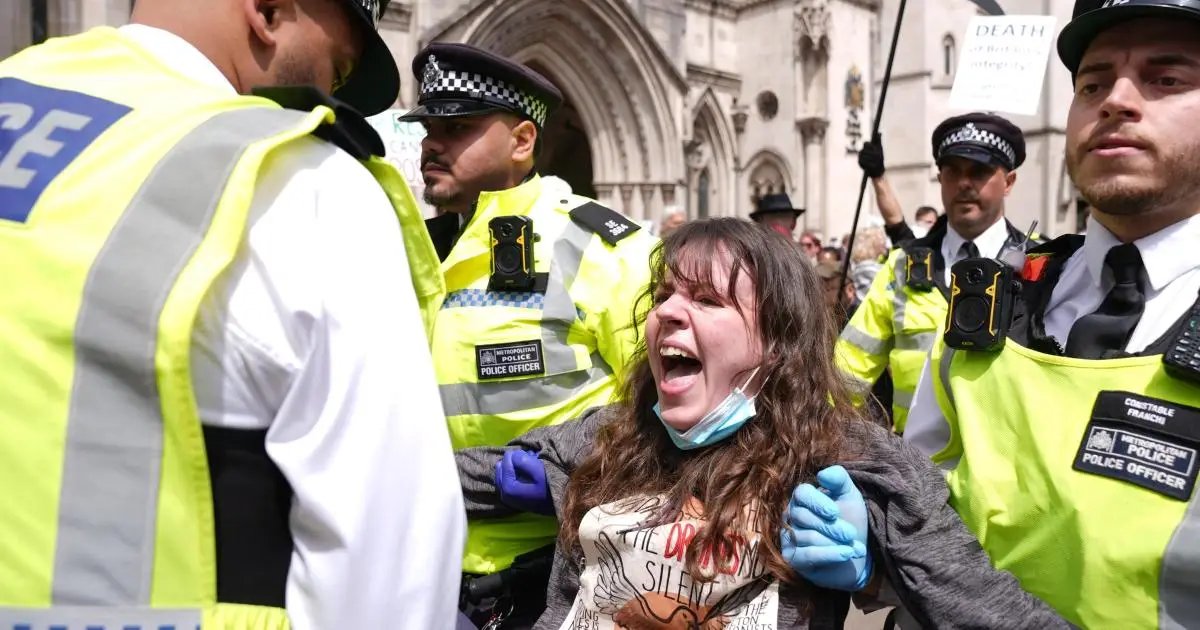
Police have made mass arrests at multiple protests since the decision in June 2025 by Ms Cooper to ban the group, where protesters have typically held up placards, worn T-shirts, and donned badges declaring “I oppose genocide, I support Palestine Action”, leading to their arrests under anti-terrorism legislation.
The Metropolitan Police said 58 people were arrested outside the Royal Courts of Justice following Monday’s ruling, with multiple demonstrators seen being carried away by officers.
The City of London police said two men had been arrested outside the Old Bailey after displaying placards in support of Palestine Action.
More than 700 people have already been charged with supporting a proscribed organisation, with the prosecutions paused after the High Court’s decision and a review due on June 30.
Following the judgment, Ms Ammori said she intended to take the case to the UK Supreme Court, and the European Court of Human Rights if needed.
She continued: “We are confident we will ultimately succeed because criminalising peaceful political protest in this way is a flagrant violation of our fundamental rights and freedoms in Britain, protected in the Human Rights Act, which enshrines the European Convention of Human Rights.”
“We will not stop fighting to overturn one of the most extreme attacks on free speech and the right to protest in modern British history.
“This unprecedented abuse of power has devastated the lives of thousands of people while silencing dissent over Israel’s slaughter of the Palestinian people during the genocide, when that dissent could not be more urgent.”
It is understood the Home Office will “robustly defend” a Supreme Court challenge.
In a statement, Home Secretary Shabana Mahmood said: “The Court of Appeal’s judgment upholds the proscription of Palestine Action.
“The court has found that Palestine Action has carried out acts of terrorism, celebrated those who have taken part in those acts and promoted the use of violence. It is not an ordinary protest or civil disobedience group, and its actions are not consistent with democratic values and the rule of law.
“This decision does not affect lawful protest in support of the Palestinian cause, which remains a fundamental democratic right. There is a difference between supporting Palestine and supporting a proscribed terrorist group.
“We will always take the strongest possible action to protect our national security and keep the public safe.”
The Court of Appeal’s decision comes after four Palestine Action activists who mounted a “terrorist” raid on Israel-based defence firm Elbit Systems’ UK factory were jailed.
Charlotte Head, 30, Samuel Corner, 23, Leona Kamio, 30, and Fatema Rajwani, 21, used sledgehammers and crowbars to destroy computers, drones and other equipment before police and security intervened.
Corner, a former student at Oxford, struck police officer Kate Evans twice on the back with a seven-pound sledgehammer, leaving her with a fractured spine.
Mr Justice Johnson gave the four prison sentences of between seven years and eight months and four years and eight months, with each defendant also spending an extra year on licence.
During the hearing on Friday, the judge ruled that the raid amounted to an “act of terrorism”, having been carried out to try to influence the UK Government and intimidate a section of the public.
