

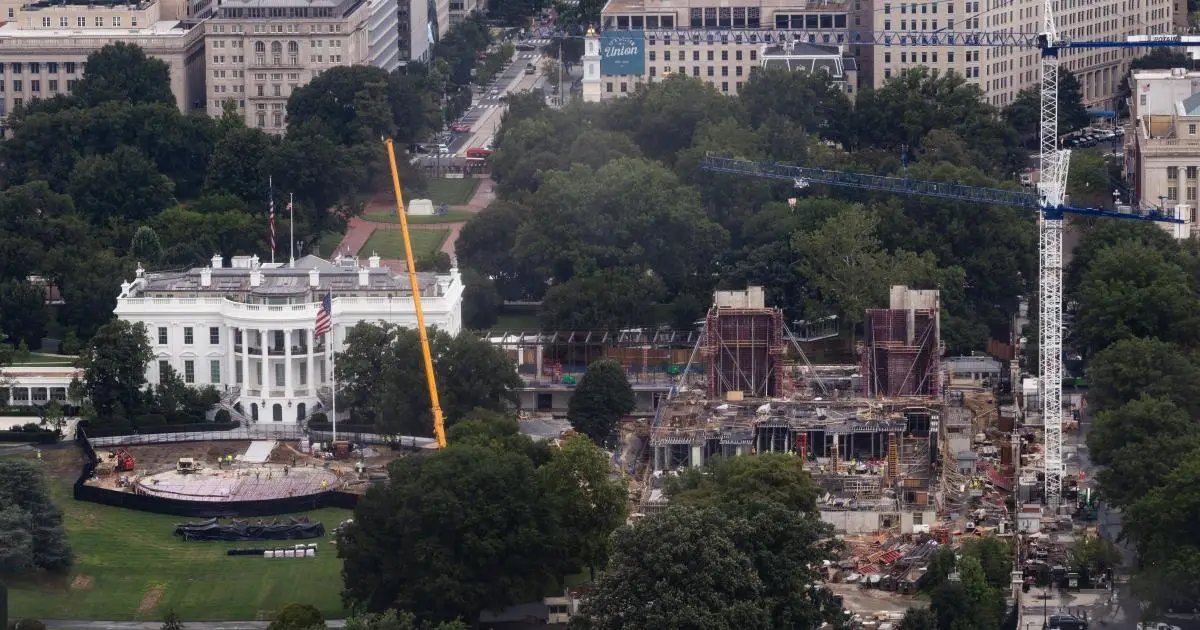

A US appeals court has ordered the Trump administration to halt construction of its 400 million dollar ballroom at the White House without congressional approval.
US President Donald Trump does not have the unilateral authority to construct a 90,000-square-foot (8,400-square-metre) ballroom where the White House’s East Wing stood before he ordered its demolition, according to the decision by a three-judge panel from the US Court of Appeals for the District of Columbia Circuit.
In a 2-1 decision, the US Court of Appeals sided with historic preservationists who sued to stop construction.
The court said it would stay its own ruling for two weeks to allow the administration to appeal to the US Supreme Court.
“Whether or not a massive ballroom should be constructed is for Congress to decide and is not a matter for executive self-help,” the court wrote.

“This holding has nothing at all to do with whether the proposed ballroom is desirable, or not, as a matter of policy.
“This ruling does not even necessarily mean that the defendants may not ultimately construct the ballroom.
“What it does mean,” the court continued, “is that the defendants may not do so during the district court’s expeditious litigation without securing Congress’s authorisation, as the Constitution and laws require.”
There was no immediate comment from the White House or Mr Trump.
After the lower court earlier this year ordered a halt to aboveground construction, the president argued that permission from Congress to build the ballroom was unnecessary because public money was not being used to pay for it.
Mr Trump has said he has raised hundreds of millions of dollars from corporations and wealthy individuals, including himself, to cover the construction costs.
“He’s saying I need congressional approval and he’s so wrong,” Mr Trump said in March after US district judge Richard Leon’s ruling against the ballroom.
“This is being financed privately.”
The National Trust for Historic Preservation, the non-profit organisation that brought the lawsuit against the administration, said Friday’s decision affirmed “the American people’s right to voice their opinions about the historic places they cherish”, including the White House.
“From the beginning, our position has been clear and consistent: the law states that only Congress can authorise the construction of a ballroom at the White House,” Brent Leggs, the group’s president and chief executive said in a statement.
“We are pleased with the DC Circuit Court’s decision to uphold the District Court’s preliminary injunction, which although stayed for 14 days will block any above-ground ballroom construction unless and until Congress takes action.”
The panel upheld an April 16 order from US district judge Richard Leon for the administration to halt above-ground work on the ballroom.
Judge Leon, who was nominated to the bench by former Republican president George W Bush, allowed for construction to continue on below-ground work on a bunker and other “national security facilities” at the site.
Mr Trump, a Republican, railed against Judge Leon’s decision on social media, calling him a “Trump Hating” judge who “has gone out of his way to undermine National Security, and to make sure that this Great Gift to America gets delayed, or doesn’t get built”.
The appeals court case was assigned to judges Patricia Millett, Neomi Rao and Bradley Garcia.
Judge Millett was nominated to the court by former Democratic president Barack Obama.
Mr Trump nominated Judge Rao.
Judge Garcia was nominated by former Democratic president Joe Biden.
Both Judge Millett and Judge Garcia backed the decision, while Judge Rao opposed it.
The National Trust for Historic Preservation sued to challenge the project in December 2025, a week after the White House finished demolishing the East Wing to make way for a ballroom that Mr Trump said would fit 999 people.
Government lawyers have argued that the project — the biggest structural change to the White House in more than 70 years — includes critical security features to guard against a range of threats, such as drones, ballistic missiles and biohazards.
“These upgrades, alterations, and improvements are essential to protecting the president, his family, and his staff, as well as the White House itself, and the entire project flows from them,” government lawyers wrote in a court filing.
Lawyers for the preservation group countered that the lack of a White House ballroom does not constitute a national security emergency.
“That common sense conclusion is not clearly erroneous, and there is no basis to disturb it,” they wrote.
In an initial ruling that the government also appealed, Judge Leon barred above-ground work on the ballroom from proceeding without congressional approval.
In response, the appeals court instructed the judge to reconsider the national security implications of stopping construction.
In his most recent decision, Judge Leon ordered a stop only to the above-ground construction of the planned ballroom.
The judge stressed that the White House is free to proceed with below-ground work, including the construction of any bunkers, military installations and medical facilities.
“Defendants argue that the entire ballroom construction project, from tip to tail, falls within the safety-and-security exception and therefore may proceed unabated,” the judge wrote.
“That is neither a reasonable nor a correct reading of my order.”
On April 2, Mr Trump’s ballroom won final approval from the 12-member National Capital Planning Commission, which is charged with approving construction on federal property in the Washington region.