


Share
The head of the Metropolitan Police said the force will be taking advice from the Crown Prosecution Service after "death, death to the IDF (Israel Defence Forces)" chants led by Bobby Vylan at the Al Quds Day demonstration.
The artist, real name Pascal Robinson-Foster, who is a member of punk duo Bob Vylan, repeated his controversial Glastonbury chant while appearing as a speaker at the protest on Sunday.
Those in the crowd appeared to join in.
The Metropolitan Police said on Sunday: "We are aware of chanting made by a speaker at the Al Quds protest and will be investigating.
"We recognise the concern footage and chanting like this causes, particularly with London's Jewish communities.

"When this language had been used previously we sought advice from the CPS who determined that there would be insufficient evidence to take a case forward."
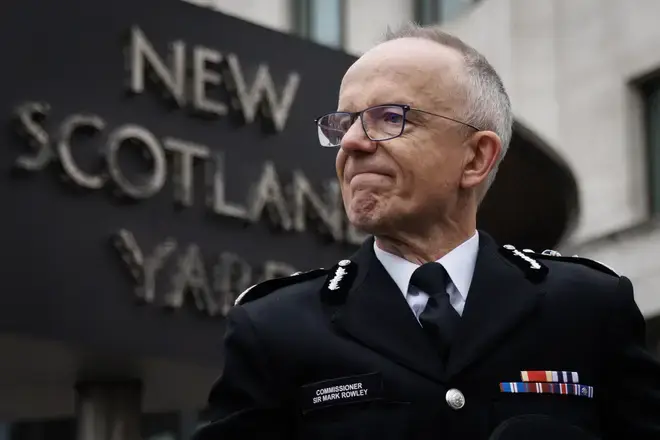
Commissioner Sir Mark Rowley told LBC the demonstrations went "fantastically well".
He said: "Looking back, it went fantastically well.
"I think the assertive use of powers, putting the protest group and the counter protest group opposite sides of the river, restricting the times.
"I think fewer people turned up and there wasn't too much trouble.
"We've seen, haven't we, over protests over the last two-and-a-half years, all sorts of contentious chants.
"We absolutely understand how upsetting those feel to certain communities and everything that's in a legal grey area, we take to the CPS, we say this was the context.
"So, we're going through that same process again for this one, where we'll be taking it to taking CPS and taking their advice. But this is really complex contextual stuff.
"And I know, though, that for communities still leaves quite a heavy feeling with how that lands with Jewish communities in London."
He added: "I think there'll always be a bit of grey at the margins of legislation, but the current public order legislation has far, far too much grey.
"It was designed in the 1980s in a different time. It's had the Human Rights Acts overlaid over the top of it, which creates such complexity for the decision-making of police officers and CPS.
"I don't think it's tenable. And I do think time has come for Parliament to redraw the lines really clearly. It's not for me to say how permissive or restrictive they should be, but as a police officer, me and my colleagues, we just want clarity."
Sir Mark also said he delayed his trip to the US to be in London on Sunday.
He told LBC: "I was actually in London for the march yesterday.
"I delayed my trip because obviously we took the unprecedented step of we came to the conclusion the march ought to be banned and just reduced to a static assembly.
"The Home Secretary agreed and authorised that. Having taken such a dramatic step, I altered my trip because I felt I needed to be in London to see that through. And I was at some of the briefings of officers going out on the ground yesterday morning."
A Crown Prosecution Service spokesperson said on Sunday: "We are aware of chants made at an Al Quds Day march in London today which are currently being investigated by the Metropolitan Police.
"We carefully consider each case referred to us for charging decision or early advice to see whether it can be taken to court.
"Some offences can be context-specific and where the evidence is not sufficient, we will work with police to identify what more can be done to meet the threshold for charging.
"Hateful chanting or waving of offensive flags may constitute an offence and where behaviour goes beyond lawful protest we will not hesitate to prosecute.
"We are already working closely with police and communities to identify, charge and prosecute hate crimes, and we will always look at ways we can do more.
"We stand ready to review any files presented to us in relation to any alleged criminal offence."
Home Secretary Shabana Mahmood granted the police's bid for a month-long ban on the annual march organised by the Islamic Human Rights Commission (IHRC), making it the first time such a restriction on protest had been imposed since 2012.
However, people could still legally assemble and take part in a so-called "static protest".
A Home Office spokesperson said: “The Independent Review of Public Order and Hate Crime Legislation will assess whether legislation adequately protects communities from intimidation and hate and whether it strikes a fair and sustainable balance between the right to freedom of expression and peaceful protest.
“The review will also specifically address whether the existing legislation is effective and proportionate.”
