

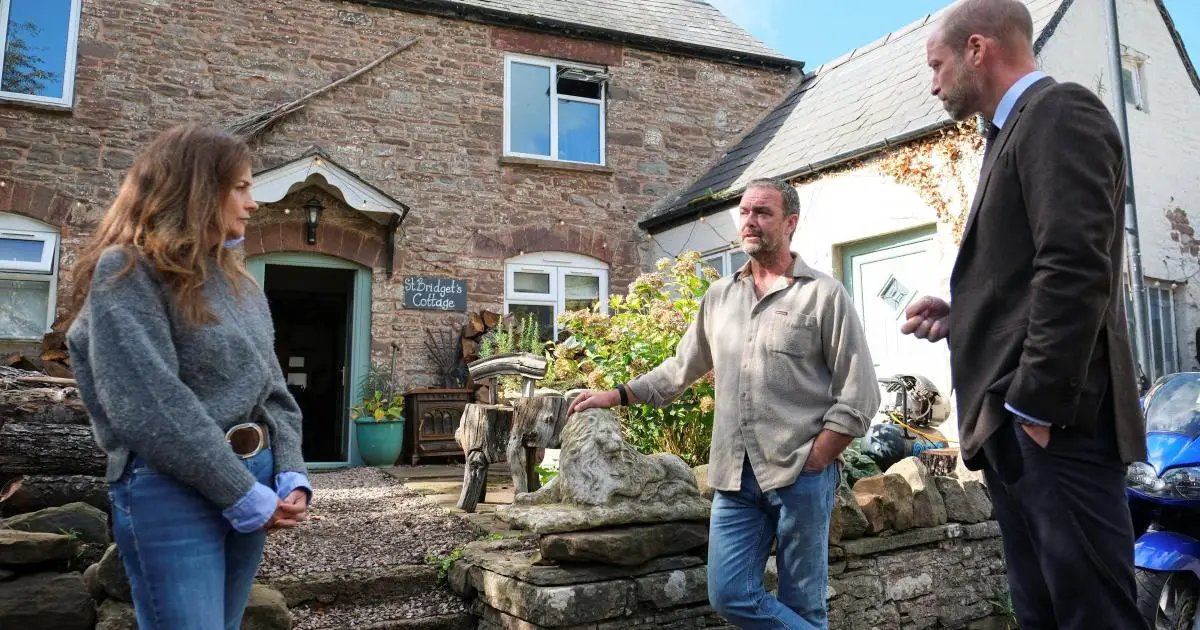

The Prince of Wales has said a “holistic” approach to tackle extreme flooding is needed as he met villagers living with the threat of the upcoming storm season.
William sympathised with residents in the rural Welsh settlement of Skenfrith who might be “anxious” about extreme weather events he said were no longer “one in 50-year” occurrences but seemed to be happening every year.
Skenfrith has faced four major floods in six years but the most recent last winter caused the biggest impact there after the River Monnow swept through the village after Storm Claudia brought a month’s rain in 24 hours to parts of England and Wales.
William was visiting the area to learn about how communities have been affected by recent flooding and what measures are being taken by local authorities and other agencies to mitigate future incidents.
The future king even got behind the wheel of a tractor sowing winter wheat with the aid of satellite navigation, when he visited the Duchy of Cornwall’s first regenerative farm tenant.

In Skenfrith, he chatted to Rod and Helen Wyatt at their garden gate and was told how the water almost topped gravestones in a cemetery opposite and they have now tiled the ground floor of their house and just live with the threat of flooding.
Mr Wyatt, who has lived in his home for 10 years, made light of the experience when he told William at one point “we had to give up really, we got two bottles of Prosecco and went to watch Strictly upstairs”.
William replied: “It must be so demoralising for you now, the worry each year you’ve got to go through that again, potentially, is becoming more frequent.
“They keep talking about a one in 50-year event, it doesn’t make sense anymore.
“It might be in the researching and scientific point of view – it’s happening every year now, it’s mad.
“So, it’s trying to understand how we can do a better holistic view of the whole catchment area, so we’re dealing with the whole problem.”
He listed a number of ideas from “slowing the water down” using farming landscaping remedies, tree planting and better monitoring “so we know when things might be getting worse”.
William discussed the ideas in detail during his next visit on Thursday, meeting representatives from environmental charity Stump Up for Trees at Great Tre-Rhew Farm in Monmouthshire.
The charity, founded in 2020, aims to plant one million native trees across south Wales and the Bannau Brycheiniog, formerly known as the Brecon Beacons.
William joined volunteers harvesting seeds from a field maple tree and planted a sessile oak tree – designated as the national tree of Wales.
To access the trees, William had to climb over a barbed wire fence and used a small step – joking that he did not want to rip his trousers.
As he harvested seeds from the tree, he noted that he was “taller” than others present, adding “I’m going to reach up here and get these higher ones”.
The charity collected 35,000 seeds last year that were used to grow new trees for planting, and hopes to increase this to 60,000 this year.
William planted the sessile oak, praising the compost from the charity’s nursery, and said he hoped it would grow well.
“It’s in a good spot, it has some space, it will be alright,” he added.
The prince spoke to Kate and Jim Beavan, of Great Tre-Rhew Farm, and Jenny Knight, the director of Stump Up for Trees.
After the visit, Dr Knight paid tribute to William for “looking at not just the problems but the solutions as well”.
Representatives from the Duchy of Cornwall also joined the visit to share learning about nature recovery, climate-resilient forestry and to start a long-term partnership.
Dr Knight described how that “knowledge exchange is so valuable” and said working together across different areas would have a greater impact.
At the end of the conversation, William discussed his enjoyment of cider – which is made on the farm.
“He said ‘one pint a day keeps the doctor away’,” Dr Knight added.
William ended his visit by travelling to Monkhall Farm in Herefordshire to meet 25-year-old Harry Davies, the incoming tenant of the Duchy of Cornwall’s first regenerative farm business tenancy.
Regenerative farming aims to restore soil health, increase biodiversity, and improve the water cycle rather than depleting natural resources.
Standing in a field, William, the Duke of Cornwall, told Mr Davies: “We can help other farmers understand this is totally doable.”