

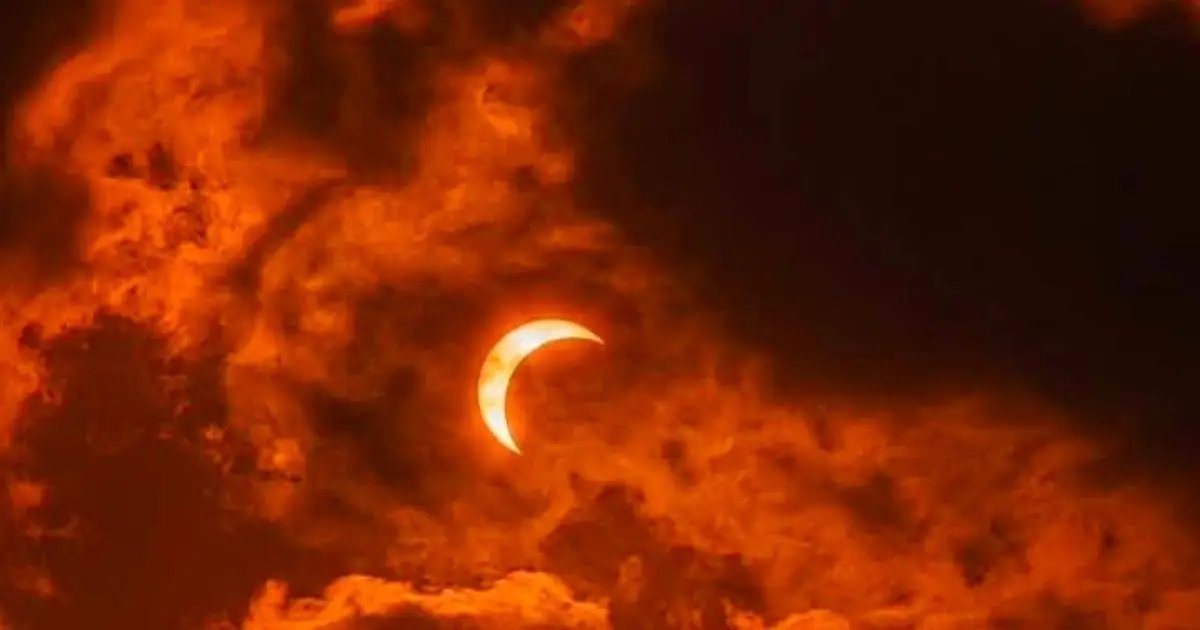

CROWDS braved a climb up the Malvern Hills to catch a glimpse of the once-in-a-generation solar eclipse but some were left less than impressed.
Despite weeks of mostly clear weather across Malvern, clouds passed in front of the sun just as the eclipse was expected to be visible on Wednesday evening (August 12).
Crowds took to various viewpoints in and around the town, with the Malvern Hills proving an especially popular spot for those hoping to catch the rare sight.
READ NEXT: Eye-watering £100 solar eclipse glasses in Worcestershire
Some impressive snaps
The solar eclipse seen from Malvern Link (Image: Sarah Emerysmith)

While parts of Europe were treated to a spectacle of 100 per cent coverage of the Moon over the Sun, Worcestershire was predicted to see approximately 93 per cent coverage.
Even with clouds obscuring their view, plenty of people still managed to capture the eclipse, including from Worcestershire Beacon, Midsummer Hill, Malvern Link, Hanley Swan, Castlemorton and Upton upon Severn.
The eclipse seen in Hanley Swan (Image: Caroline Curtis)
Some disappointed
Meanwhile, others were left disappointed, describing the event as a “waste of time”.
“Promised more than it could deliver,” said Matt Grimes. “Completely underwhelming.”
Wayne Macey said: “Total complete waste of time.”
The last time a total solar eclipse was visible in the UK was in 1999, with some Malvern residents saying that one had been more impressive.
“Nothing compared to 1999,” said Jan Frame. “All went dark and cold and birdsong stopped.”
READ NEXT: Once in a generation solar eclipse will be visible today – what you need to know
When will the next solar eclipse be?
The solar eclipse seen from Wyche (Image: Jessica Chippendale-Hague)
The 2026 solar eclipse was described as a “once-in-a-generation” event, due to its near total coverage, but some may be lucky enough to see it again, or perhaps one even better, in their lifetime.
According to Royal Museums Greenwich, the next partial solar eclipse that will be visible in the UK will be August 2, 2027, with an expected coverage of approximately 45 per cent.
The next total solar eclipse isn’t expected to happen until 2090.
