

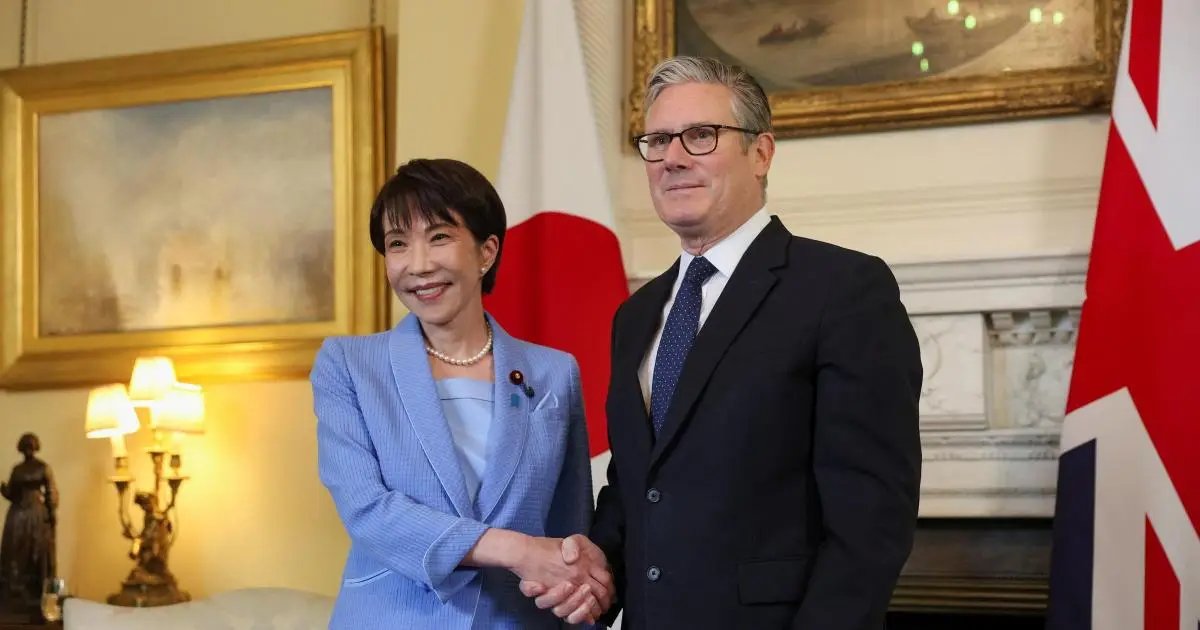

Sir Keir Starmer said the UK and Japan were building a “new era of co-operation” after welcoming his Japanese counterpart to Downing Street ahead of the G7 summit.
The Prime Minister conducted meetings with Sanae Takaichi, the first woman to hold the position of prime minister in Japan, and business leaders in No 10 on Sunday.
It comes as the Department for Science, Innovation and Technology (DSIT) said a “landmark tech partnership” between the UK and Japan had been agreed and backed by businesses in both countries.
Sir Keir said the UK-Japan Frontier Technology Partnership was “combining UK excellence in R&D and software with Japanese advanced manufacturing experience and expertise”.
The Prime Minister said a new offshore wind compact would “unlock up to £9 billion of Japanese investment into the UK’s world-leading offshore industry”.

He added that the UK-Japan Defence Capability and Industrial Council was “hugely important” and the Gcap fighter jet development initiative was at the “heart of the relationship between our two countries”.
Speaking inside No 10, the Prime Minister said: “I’m delighted that we’re building stronger cooperation, a new era of cooperation between our two countries.”
Sir Keir said the UK and Japan were “working more closely” on defence and had “lots of issues to discuss in a volatile world” ahead of the G7 summit next week.
It comes after Sir Keir’s leadership survival plans were rocked by the shock resignation of John Healey as defence secretary over a dispute about long-term funding for the military.
Mr Healey was joined in his exit from Government by armed forces minister Al Carns, as well as two parliamentary aides, heaping pressure on the Prime Minister, who is already facing the threat of a leadership challenge.
Ms Takaichi, leader of Japan’s Liberal Democratic Party, said the UK and Japan are “strengthening” security cooperation and have a “shared strategic recognition”.
Speaking after their meeting, Ms Takaichi said: “Today, Japan and the UK hold a firm determination to contribute together to peace and stability in the international community, and are highly important, like-minded countries.
“I believe that our relationship has reached a level that could even be described as quasi-allies.”
A Downing Street spokesperson said the Prime Minister also welcomed “significant new Japanese investment into the UK, supporting tens of thousands of jobs, including in real estate and financial services”.
The spokesperson added: “The leaders discussed the conflict in the Middle East, Russia’s illegal invasion of Ukraine, stability in the Indo-Pacific region and the importance of resilient global supply chains and free trade.”
DSIT said “for the first time” a formal partnership had been agreed connecting “the UK’s world-class microchip design expertise with Japan’s advanced manufacturing”.
The collaboration between the UK Semiconductor Centre and Rapidus, Japan’s 2nm semiconductor manufacturing facility, will create a “direct pathway for the UK semiconductor sector to manufacture cutting-edge chips”, DSIT added.
Rapidus is backed by £11.6 billion in Japanese government investment and DSIT said the agreement marked a “critical step in strengthening the resilience of the UK semiconductor sector”.
Technology Minister Kanishka Narayan said Japan “is one of our closest tech partners”.
Discussing the UK-Japan Frontier Technology Partnership, the Labour MP added: “This deal will offer our talented innovators driving the future of quantum computers, next-generation chips, and clean energy direct access to vital investment, manufacturing and markets.
“At the same time the UK’s world-class research base, software expertise, and pro-innovation environment makes us the ideal partner for Japanese firms looking to expand and invest.
“By working together we can bolster growth and jobs across our countries and build a stronger, more secure economy that improves lives across the UK.”