

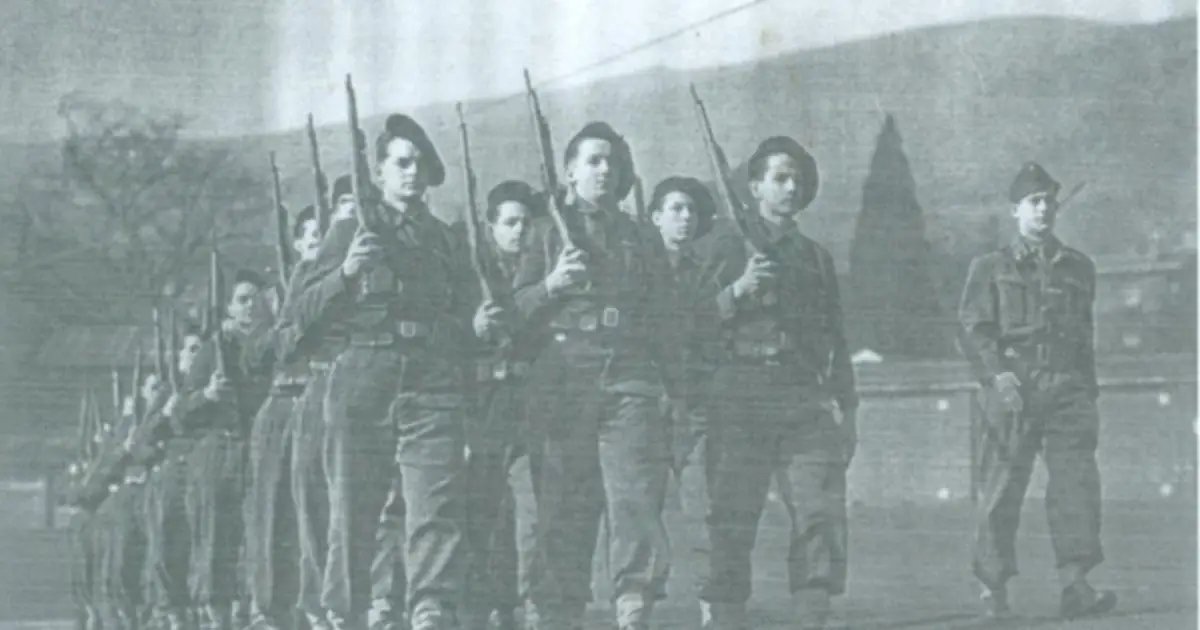

OVER the years there have been many stories written about the American soldiers in Malvern during the Second World War where the US Army built five hospitals to treat those injured on D-Day and after.
In all nearly 80,000 were cared for there.
Rather less has been published about the Free French arriving in the town.
Those were the young men of the French resistance led by General Charles de Gaulle who had escaped their homeland to continue their fight against the Nazis.
A platoon of Free French cadets marches towards Malvern College (Image: This Was Our Malvern Vol 2)
More: Malvern man to drive to Polish-Ukrainian border loaded with aid
Now, thanks to memories collated by Margaret Bramford, a former school administrator at Malvern Girls’ College, today’s Malvern St James Girls’ School, a light can be shone on their time billeted at Malvern College.
In her recently-published book This Was Our Malvern Vol 2, Margaret writes: “Malvern people remembered the Free French as ‘young lads in the capes and berets’. They were in Malvern from 1941 to 42. They wore navy blue capes and navy blue puttee and always seemed to be short men.
“They would walk briskly along with their tricolour flying bravely before them.”
Catherine Moody told Margaret: “They had struggled to England from France across the Channel. Some in fishing boats.
“They were lodged in Malvern Boys’ College in House Number 5 and were having rather rigorous training with their commanding officer.
“We artists painted murals all around the school of France and Paris. But the young men who came were largely Breton fishermen who had probably never been to Paris in their lives. However, we played games together and they sang to us in French.”
Dorothy Jones told Margaret of a secret visit General de Gaulle made to Malvern to encourage his young soldiers.
She said: “We had some lovely classical concerts at the Winter Gardens on Sunday nights and on one occasion Gen de Gaulle was sitting on the next but one chair to me. On the vacant chair between us was his uniform hat. I looked at all the embroidery on it. It was beautiful – gold thread work on pale blue.
“The General looked at me and I looked at him. He stayed at the Abbey Hotel and his visit was a secret.”
As well as the Americans and the French, several other nationalities found themselves in Malvern during the war, including Ukrainians, Dutch, Belgians, Italians, Poles and German Jews.
Joy Van Saesdonk told Margaret: “Towards the end of the war, to be a girl in Malvern was quite good. It didn’t matter if you had a face like the back-end of a bus you could still find plenty of partners. That was because there were so many troops stationed everywhere, of all nationalities.”
Margaret was born in Overbury, south Worcestershire, and spent most of her career teaching French and Spanish before becoming a school administrator in Malvern.
She also enjoyed meeting people and her book is full of nostalgic conversations she had with characters in the town in the 1950s and 60s.
A time when the Second World War was well within many people’s memories and some reminiscing even went back to the early years of the century.
Like the story about the Free Belgian soldier, “a scruffy lot, they were billeted in the Tudor Hotel”, who solved the problem when a chimney sweep couldn’t get his brush up the building’s blocked chimney. The soldier simply fired his gun up the flue and down cascaded piles of soot. Job done.
Margaret’s memories have been published by her nephew Richard Lyntton, a former British Army officer who now lives in America, as part of the Worcestershire and Malvern History series.
Richard Lyntton with a copy of the newly released book This Was Our Malvern Vol 2 (Image: This Was Our Malvern Vol 2)
He explained: “I made a promise to my aunt to publish her books for a wider audience. There is a whole generation of local people who find her stories quite fascinating.”
To end here’s a lovely tale from Kath Hill who was 10 years old in the 1920s when her family lived in Severn Stoke.
Their big day out was to visit Madresfield Show on August Bank Holiday.
This entailed starting off at 8am to walk five miles across fields to Upton where they would catch the train to Great Malvern.
From there they walked via Barnards Green to Madresfield, a distance of about three miles.
Kath recalled: “For the show, our mother brought a picnic with plain water. No fizzy pop in those days.
“After we had viewed the flowers, fruit and vegetables and some animals it was time to walk back to Great Malvern Station to catch the 6pm train. Then we still had to walk home from Upton to Severn Stoke.
“I still remember one year I was so tired that night I forgot to say my prayers!”
Different days, in many ways.
Legendary Malvern blacksmith Dennis Morgan at work in his forge at Barnards Green (Image: This Was Our Malvern Vol 2)
George ‘Divvy’ Davis, well-known beekeeper of Lower Wyche, Malvern (Image: This Was Our Malvern Vol 2)
The Worcestershire Ladies Golf Club team in 1906 when they won the Midland Counties Ladies Championship. Note the display of hats (Image: This Was Our Malvern Vol 2)
A 1912 prototype four-seater Morgan car with HFS Morgan at the wheel (Image: Malvern Motor Company)
Sir Edward Elgar and George Bernard Shaw having a chin-wag at Malvern Festival in the early 1930s (Image: This Was Our Malvern Vol 2)
Arthur Russell (left), the Malvern funeral director who also had a cinema organ studio, welcomes radio star Reginal Dixon to play on his Compton organ in 1972 (Image: This Was Our Malvern Vol 2)
