

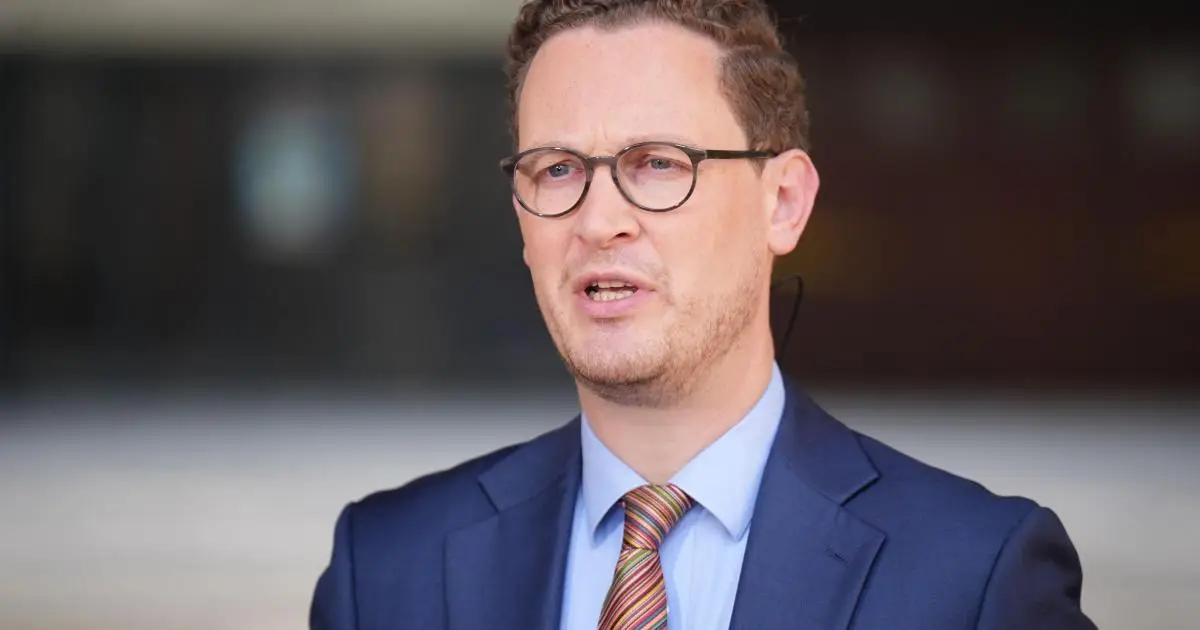

Westminster and Whitehall must get better at using the tools they have to govern artificial intelligence (AI), Sir Keir Starmer’s Chief Secretary has said.
Speaking on the BBC’s Question Time, Darren Jones said: “We do have the tools but we have to modernise and adapt the way in which Government and Parliament works in order to keep up with the pace of technology.”
He described a “challenge of speed” which lawmakers are grappling with.
But Mr Jones also said: “I feel perfectly able to use legislation and regulation in a way that is pro-innovation, great for the economy and public services, whilst also protecting the interests of British people.”
Parliament earlier this year passed the Crime and Policing Act.

In it, the Government took on a new, flexible power to amend the Online Safety Act 2023 to help it deal with AI bots producing potentially illegal content.
Conservative shadow Home Office minister Lord Davies of Gower labelled this “the mother of all Henry VIII powers” – referring to a mechanism allowing ministers to change parts of the law without the need for a fresh bill.
He said it has “wide-ranging constitutional implications” and added: “Ministers will now be able to amend the entire Online Safety Act 2023 as they wish”.
The Act also included a ban on making, modifying or supplying nudification tools, which can generate so-called deepfake intimate images of real people without their consent.
Mr Jones said: “The technology develops very quickly and the way in which our democracy creates legislation is very slow.”
The Crime and Policing Act was introduced to the Commons towards the end of February 2025, but did not become law until the end of April this year – a 14-month process.
“The last government got the first real piece of legislation through on the Online Safety Act, but it took eight years to get done,” Mr Jones continued.
He later said: “One of the things we’ve had to do now is we’ve had to give the Technology Secretary (Liz Kendall) legal powers in advance of consulting on the things we might want to change in the future, so that she can then legislate more quickly without having to wait eight years to be able to do this again with new legislation.”
Mr Jones earlier said the UK should take a “big bet” on novel and emerging technologies to improve “jobs, pay, and public services in the years ahead”.
He also said: “In the United States, you basically allow the harm to happen and then you sue someone and the law figures it out.
“In the European Union, they try to predict the outcome, regulate it actually in this space quite badly, and then stop the innovation from happening at all.
“What we’re really good at in the UK is legislating for outcomes and good regulation – ‘these things should not cause harm to children’.
“If you’re providing a healthcare service, it should be based on clear evidence that you’re not causing harm to the patient.”
Conservative shadow technology secretary Julia Lopez, who was also on the programme, warned that “Labour is increasing the cost of employing people, it’s increasing the cost of energy, so that these tech companies can’t base themselves here”.
She continued: “It’s creating regulatory uncertainty.
“It’s doing a very bad job at applying AI within Government, so the cost of Government is increasing – there’ve been 8,000 more civil servants under Labour than previously”.
Ms Lopez also said: “You can’t wish away this technology but you can try and build a really strong ecosystem in this country.
“And I think on those basic fundamentals, Labour’s getting a lot of things wrong.”
On Thursday, Prime Minister Sir Keir defended his approach towards AI.
In a Substack post, he wrote: “Far from being left behind on AI, Britain is at the front of the pack.
“This isn’t rhetoric. Britain is widely recognised by the leading lights of that sector as being a growing and sovereign AI player.”
He pointed to investment into datacentres in Loughton, Essex, and Blyth, Northumberland, as evidence of a nationwide investment into tech.
“It is improving our public services, particularly the NHS,” he said.
“And as we build this future, we are taking measures that strengthen our sovereignty, making sure we are an AI rule-maker, not a rule-taker.
“It is our principles in action, once again. Not just passively accepting our economic fate, but actively shaping the future. Taking control. Unlocking the potential of the whole country.”