

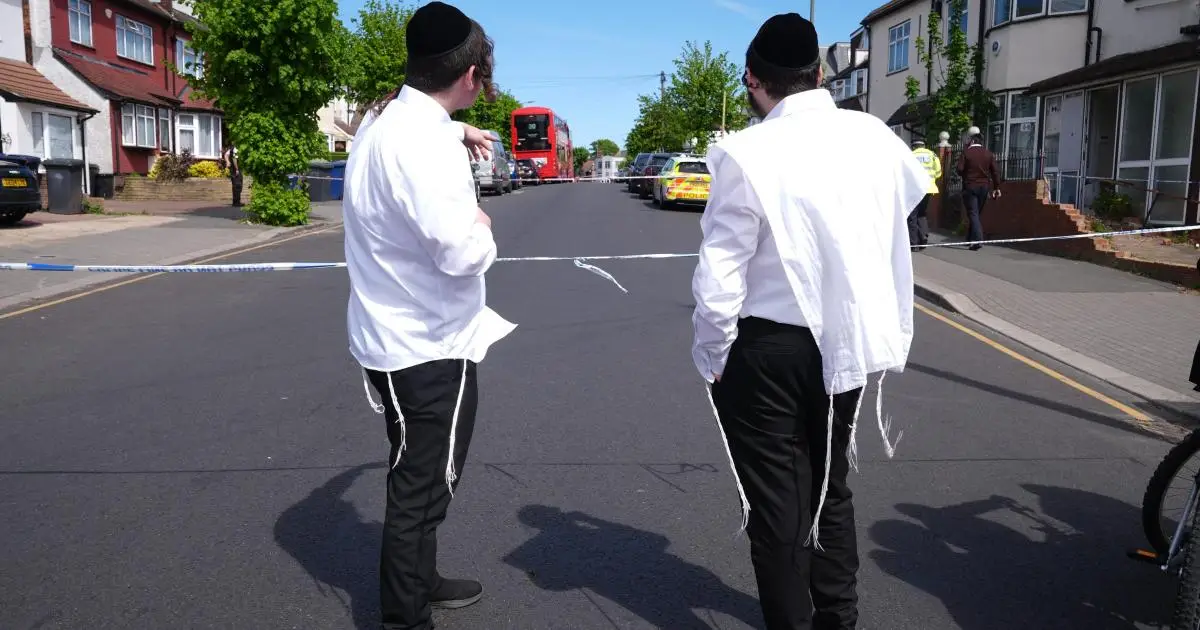

Ministers are under pressure to ban pro-Palestine marches in the wake of Wednesday’s suspected terror attack in north London amid claims they contribute to “a tone of antisemitism”.
Police across the country have stepped up patrols in response to the attack that saw two Jewish men – 34-year-old Shilome Rand and 76-year-old Moshe Ben Baila, named locally as Moshe Shine – taken to hospital after being stabbed in the Golders Green.
A 45-year-old man, said by police to be a Somali-born British national, was arrested following the incident.
The stabbings are the latest in a series of attacks on Jewish sites over recent weeks and have prompted calls for urgent action and accusations the Government has not done enough to tackle antisemitism.
Mr Rand, the younger victim of Wednesday’s attack, told ITV: “People are really afraid, people are uncomfortable walking in the streets.

“People are blaming obviously the Government. You know they aren’t doing anything about what’s going on for the past few months.”
Chief Rabbi Sir Ephraim Mirvis called for “meaningful action” to tackle the “root causes” of antisemitism, while the Board of Deputies of British Jews said antisemitism must be “confronted, punished and deterred with the full force of the state”.
Witness Isaac Cohen told the Daily Mail he saw the attacker chasing two men and raised the alarm after following him.
“We said, ‘what are you doing?’, and we understood something was wrong,” he said. “So we turned the car and we went after him, we tried to save the people. We screamed ‘be careful’.”
Fellow witness Moishe Geller said the assailant “lunged” at Mr Rand.
“Mr Rand didn’t seem to know what had happened at first. He went back inside the shul and called the Jewish police,” he told the Mail.
“Only when he put his hand to his chest, and saw blood, did he realise that he had been stabbed in the chest. He then called the ambulance.”
Responding to the attack, Sir Keir Starmer vowed that the Government would address the causes of antisemitism, provide more funding for security at Jewish sites and tackle “malign state actors” linked to recent violence.
He is also expected to meet criminal justice agencies on Thursday to discuss the attack, and said he would visit Golders Green “as soon as possible”.
But the Prime Minister will face pressure to go further, including calls to ban pro-Palestinian marches.
Jonathan Hall, the former independent reviewer of terrorism legislation, said it was currently “impossible” for such marches not to “incubate” antisemitism.
Describing recent attacks on Jews as a “massive national security emergency”, he called for a “moratorium” on pro-Palestinian marches.
His comments were echoed by the chief rabbi, who said “hate marches” together with “purposeful anti-Israel demonisation” had contributed to “a tone of antisemitism” in the UK.
Opposition politicians have also joined calls to ban the marches, with Conservative leader Kemi Badenoch saying it was “quite clear they are used as a cover for violence and intimidation against Jews”.
Meanwhile, police forces across the country said they would step up patrols in Jewish areas in response to Wednesday’s attack.
Greater Manchester Police said it had deployed extra officers around the city, with a “high-visibility presence within our Jewish communities in north Manchester, Bury and Salford”.
West Yorkshire Police and Thames Valley Police both said they would increase patrols to “provide additional reassurance”.
In London, counter-terrorism officers investigating the attack said they were also searching an address in the south-east of the city after it was reported the suspect had been involved in a prior “altercation” with another person.
A joint statement from Detective chief superintendent Luke Williams, the regional basic command unit commander, and Barnet Council chief executive Cath Shaw said “significant number of officers” would be in the area to support the investigation.
“This gives police officers temporary powers to stop and search people in the area without needing specific suspicion, where there is a risk of serious violence,” the statement said.
“This is a preventative measure designed to deter further criminality. We were already deploying an increased number of Counter Terrorism Response Vehicles to respond to suspicious activity.”
They said there would be an “increased policing presence in and around schools, transport hubs, high footfall areas and faith venues”.