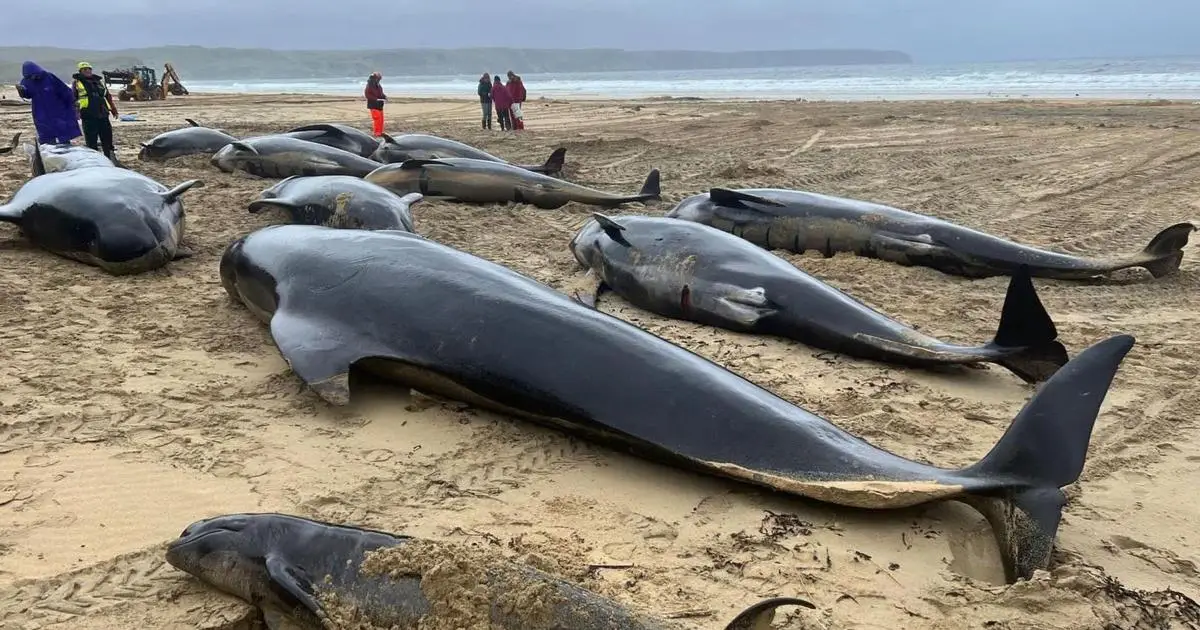

Changes in the feeding grounds of pilot whales may increase the risk of mass strandings, a study has found.
Researchers studying the deaths of 55 long-finned pilot whales that stranded on the Isle of Lewis in 2023 found the animals had been feeding in deep offshore waters close to steep coastal drops.
The incident is one of the largest mass stranding events in Scottish history.
The study, led by the Scottish Marine Animal Stranding Scheme (Smass) at the University of Glasgow and published in the journal PLOS One, used stable isotope analysis to reconstruct the whales’ feeding patterns in the weeks before the stranding.
The findings have shed light on the animals’ movements and foraging behaviour in the weeks prior to the event and on the broader factors that may contribute to mass strandings.
Post-mortem examinations previously undertaken by Smass confirmed that the animals were in good health.
Another report, later published by the Scottish Government’s Marine Directorate, found a combination of biological, behavioural, and environmental factors had contributed to the event.
It found that the pilot whales, a highly social species, appeared to have followed a female experiencing a difficult birth (dystocia) into dangerously shallow water.
While the likely cause of the stranding has been established, the Glasgow researchers said the latest study provides new evidence on the period leading up to the incident.
The team said deep water pelagic cetaceans, such as long-finned pilot whales, are “notoriously” difficult to study in the wild, and their feeding behaviour and movements before stranding are rarely documented.
But stable isotope analysis reconstructs feeding history from chemical signatures preserved in skin tissue, and offers a means of recovering dietary information, revealing where the animals have been and what they have been eating in the weeks before they come ashore.
The isotopic data from the 2023 stranding indicated the pod had been feeding primarily along the continental shelf edge and slope, deeper offshore waters believed to support substantial fish and squid populations during spring and early summer.
Although the animals were in good nutritional condition at the time of death, their stomachs were empty, raising questions about their foraging activity in the immediate period before stranding.
The study is the first direct evidence that long-finned pilot whales use shelf-slope habitats as important seasonal feeding grounds, the research team said.
Their study found the proximity of these habitats to rapidly shallowing coastal zones may represent a risk factor, placing foraging animals closer to conditions where they are likely to experience stranding.
The scientists say that understanding where these animals feed – and how those patterns may be shifting in response to environmental change – is essential to assessing the impact of human activity on the species, and to work out how to minimise the risk of further events.
Anna Kebke, PhD researcher at the University of Glasgow and lead author of the study, said: “Understanding the feeding habits of large marine predators such as long-finned pilot whales is critical for the development of conservation strategies.
“However, dietary data are often lacking.
“Our findings demonstrate the importance of deep-water food sources to long-finned pilot whales, providing valuable insights into their early spring-summer feeding habits.
“These results highlight the value of stable isotope analysis in advancing our understanding of cetacean trophic ecology and better informing marine mammal conservation management.”
Dr Andrew Brownlow, director of Smass, added: “Post-mortem examination tells us about the animals’ condition at the moment of stranding; stable isotope analysis tells us where they had been and what they had been eating in the weeks before.
“Together, they allow us to move from asking what happened at the moment of stranding to asking what set these animals on a course towards it.”