


Share
Want LBC stories before everyone else? Set us as your Preferred Source on Google
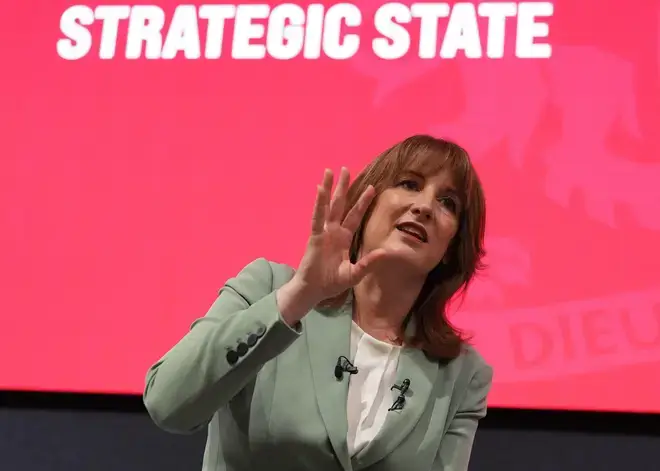
Chancellor Rachel Reeves has laid out the steps she will take tomorrow to protect working people from “unfair price rises” caused by the US’ war on Iran in a meeting with ministers today.
The Prime Minister chaired the meeting on Monday afternoon, during which the Chancellor spoke about steps she will set out in a statement to Parliament tomorrow.
Ms Reeves, Governor of the Bank of England Andrew Bailey and Energy Secretary Ed Miliband gave updates on the situation and stressed that de-escalation and ending the Iran conflict was “the best thing we can do for the economy”, Downing Street said in a readout.
“The Chancellor set out the steps she will take tomorrow – in a statement to Parliament – that will help protect working people from unfair price rises.

“She spoke about a plan to detect and crack down on companies if they exploit the crisis in the Middle East. This will take the form of a new anti-profiteering framework which will help regulators like the CMA to root out price gouging.”
Sir Keir earlier said he was looking at giving the Competition and Markets Authority “further teeth” so it can better protect customers.
As part of that, Downing Street said the Government will not hesitate to give the CMA and other regulators “time-limited, targeted powers” if needed.
The Treasury, Department for Business and Trade and regulators are working “at pace” on what those powers could be.
A Government spokesperson said: "We are fighting your corner to keep the cost of living down in these uncertain times. We will not allow companies to exploit this crisis to hike their prices to unjustifiable levels.
"Whether at the fuel pump filling up your car or at the till paying for your groceries, we are working with regulators to make sure the price you pay is a fair one."
It comes as Sir Keir Starmer warned against "false comfort" over the war on Iran after Donald Trump claimed peace talks were taking place.
Asked how long he thought the crisis would last, the Prime Minister told the Liaison Committee: “It’s hard to answer that question, if I’m honest about it.
“I think all our focus and energy has to be in the swift de-escalation, but we’ve got to plan on the basis that it could go on for some time, and that’s the way in which we’ll plan this afternoon.
“Since the conflict started, I’ve been really clear with the team that we mustn’t fall into the sort of false comfort of thinking that there will necessarily be a quick and early end to this.
“We have to plan on the basis there may not be.”
He added: “On energy supplies, I can reassure the committee that we haven’t any meaningful concern about energy supplies. Obviously the price fluctuates daily.”
The PM went on to say he “welcomes” reports of peace talks.
He said: “To that end, I welcome the talks reported between the US and Iran.
“And to be clear with the committee, we the UK were aware that that was happening, and the immediate priority has to be a swift resolution of the conflict and delivering a negotiated agreement which puts tough conditions on Iran, particularly in relation to nuclear weapons.”
Sir Keir also rubbished suggestions Iran could hit the UK with long-range missiles after it struck Cyprus last week.
Britain has “very effective ways of defending ourselves”, the Prime Minister has insisted amid questions about whether the UK could intercept long distance missiles shot at Britain by Iran.
The Prime Minister said: “We constantly assess this, and we do have very effective ways of defending ourselves.
“I don’t want to raise levels of public anxiety. They are anxious about what they’re already seeing on their television screens. They’re anxious about the impact it will have on them, particularly economically, in their households. And I don’t want to raise their levels of anxiety.
“I can tell you our military personnel, our security and intelligence services, are working literally 24/7 to keep us safe and doing a very good job in that regard.”