

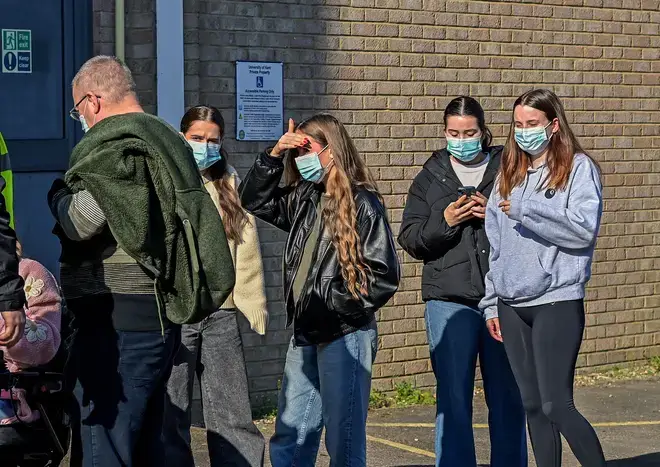

It comes as meningitis vaccination centres opened across Kent today after more than 100 students were turned away while trying to get the jab.
Share
Want LBC stories before everyone else? Set us as your Preferred Source on Google
A student at the University of Kent who survived a meningitis infection has told of her pain and fear when she lost the ability to see and talk.
Annabelle Mackay, 21, said she feels grateful to be alive after she was rushed to hospital with an infection which caused her “so much pain”.
Ms Mackay said she believed she may have contracted meningitis while on a night out at Club Chemistry in Canterbury on March 5, or at a different venue the evening before.

The law student said she initially thought she was suffering from Covid-19 symptoms and took a test, which came back negative.
“Then I started to be quite delirious, and I wasn’t really making any sense and I was also really sensitive to light, so then that’s when I thought something was really, really wrong,” Ms Mackay told the BBC.
Ms Mackay said she lost the ability to talk and does not remember being taken to hospital in an ambulance.
She said: “I was still in quite a state of delirium, and at that time I lost my sight as well, which was really scary, especially for my friends and family.
“I wasn’t paying as much attention to it because I was just in so much pain in my body that I didn’t have time to process that I couldn’t see, but it was definitely really scary for my family and my friends.”
She added: “I feel so grateful to be alive and be here. I’m still dealing with the after-effects now, but I think I just need to focus on my recovery and getting better and back to myself.”
It comes as the number of cases of meningitis linked to the outbreak in Kent rose to 29 on Friday, health chiefs confirmed.
The UK Health Security Agency (UKHSA) said the number, up from 27 previously, includes both confirmed and suspected cases.
It comes as meningitis vaccination centres opened across Kent today after more than 100 students were turned away while trying to get the jab.
The University of Kent stopped the vaccine queue on its Canterbury campus yesterday afternoon because of capacity issues, despite efforts to widen access.
Its clinic is due to reopen today from 09:00 until 17:00, with people advised to join the queue by 14:00.
Other sites expected to open include Faversham Health Centre and Vicarage Lane Clinic in Ashford.
The Gate Clinic at Kent and Canterbury Hospital is also due to offer walk-in appointments across the weekend.
So far, more than 8,500 courses of antibiotics and 1,600 vaccines have been given to eligible people in Kent.
Health Secretary Wes Streeting said the vaccine would be offered to anyone who attended Club Chemistry between 5 March and 15 March, as well as sixth-form pupils at four schools, other university students in Canterbury, and close contacts of confirmed and suspected cases.
Anyone in England who is eligible for antibiotics can also ask their local GP for a vaccination.
Two students have died during the outbreak, including 18-year-old Juliette Kenny, who died on Saturday, one day after first developing symptoms.
Her father, Michael Kenny, said she had been vomiting and had discolouration in her cheeks. He said she had been “fit, healthy and strong” and that the illness “took her from us so quickly”.
He told PA news agency: “The devastation of her loss to us, her family and friends is immeasurable.
“Sharing stories of the empathy, warmth and fun that she created is helping her family and friends through at this time.
“Her energy continues to make the people who love her find a way.”
The MenB vaccine was added to the NHS routine schedule for babies in 2015, meaning most young people born before then will not have been protected unless they were vaccinated privately.
A student who went to Club Chemistry on March 12 was turned away from the vaccine queue on Thursday.
Hayden Taylor, 19, a radiography student at Canterbury Christ Church, arrived at the campus vaccine clinic at around 3pm on Thursday.
He said: "I had the antibiotics already. We already knew it was going to be busy."
Isobel, 21, an English literature student at the University of Kent, was turned away after her mother drove them 80 minutes to the centre.
Mr Streeting has urged young people should be cautious about sharing vapes, but added he is not the "fun police".
He said that as a "rule of thumb" it is "not hygienic to share things like vapes around your mates".
Mr Streeting added: "It's absolutely fine for people to go about living their lives in a normal way and there is no reason for me to be the fun police today and tell students across the country that they shouldn't be going out this weekend and doing the things that they would normally do in a nightclub."
Morrisons confirmed an employee at its Sittingbourne distribution centre who attended Club Chemistry has contracted meningitis while three members of the cheerleading society at the University of Kent are in hospital after catching the virus.
The UKHSA said four schools in Kent have confirmed cases of meningitis, while the London animation and games school Escape Studios said one if its students with links to the county had contracted meningitis.
UKHSA also said 20,000 vaccines from the NHS supply will be made available to the private market to ease the demand at pharmacies from people who want to pay for a jab.
Louise Jones-Roberts, who owns Club Chemistry, said: "I'm really pleased, I'm over the moon there are more vaccines. I'd like to see it given to all under-25s though. It needs to be looked at right across the country. As for reopening the club, there will come a time when it feels OK to open and we will know when the time is right, but it's definitely not going to be this weekend."
Professor Robin May, UKHSA chief scientific officer, said on Thursday "this is a very unusual outbreak", adding experts were looking at why meningitis in these cases may have become more transmissible between people.
He added: "What is particularly remarkable about this case, and unexpected about this case, is the large number of cases all originating from what seems to be a single event.
"There are two possible reasons for that. One is that there might be something about the kind of behaviours that individual people are doing.
"The other possibility is the bacteria itself may have evolved to be better at transmitting."
Prof May said the bacteria which can cause meningitis can be transmitted by sharing utensils, cups and vapes.
