

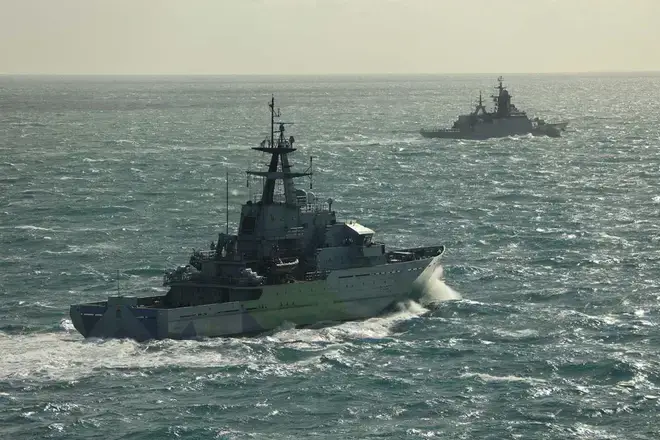

Portsmouth-based HMS Mersey and a Wildcat helicopter were scrambled to monitor the Russian Steregushchiy-class frigate RFN Soobrazitelny and tanker MV Anatoly Kolodkin
Share
Want LBC stories before everyone else? Set us as your Preferred Source on Google
A Royal Navy warship and helicopter have spent 48 hours shadowing a Russian warship and a sanctioned oil tanker in the English Channel.
Portsmouth-based HMS Mersey and a Wildcat helicopter were scrambled to monitor the Russian Steregushchiy-class frigate RFN Soobrazitelny and tanker MV Anatoly Kolodkin.
A Royal Navy spokesman said the operation was co-ordinated with Nato and added: “Patrol ship Mersey and the Yeovilton-based Wildcat kept close watch, utilising powerful radars and sensors to gather valuable intelligence, as the two Russian vessels sailed westward through the English Channel.

“The two Russian ships separated at the western end of the Channel, with the Royal Navy tracking Soobrazitelny back eastwards through the Channel as the Anatoly Kolodkin continued to sail into the Atlantic.”
Lieutenant Commander Dan Wardle, commanding officer of HMS Mersey, said: “This operation provides a clear example of Mersey’s readiness and operational capability in monitoring Russian vessel movements through our waters.
“Our co-ordination with allied forces further amplifies our situational awareness and response capacity, ensuring we are able to safeguard the integrity of our maritime environment.”
Fleet commander Vice-Admiral Steve Moorhouse said: “In an increasingly contested and uncertain world, the work of HMS Mersey and 815 Naval Air Squadron is another example of the Royal Navy’s enduring commitment to protecting UK home waters.”
The monitoring operation comes two weeks after the Royal Navy shadowed two sanctioned Russian cargo ships and their escorting warships in UK waters from the Mediterranean to the North Sea.
Portsmouth-based HMS Tyne and a Wildcat helicopter from 815 Naval Air Squadron were tasked with monitoring Russian Navy Ropucha-class landing ship Aleksandr Otrakovsky and merchant vessel Sparta IV.
The ships were first monitored by HMS Cutlass of the Royal Navy’s Gibraltar Squadron as they sailed through the Strait of Gibraltar’s Traffic Separation Scheme, before an allied warship tracked the journey north, before HMS Tyne took over the monitoring.
And 48 hours later, Tyne and a Wildcat were scrambled again to track another Russian Ropucha-class warship, Aleksandr Shabalin, and cargo vessel MV Sabetta as they sailed westward through the English Channel.
