


It comes after the BOE announced it would hold interest rates at 3.75% amid fears the US-Israel war on Iran could see inflation rise
Share
Want LBC stories before everyone else? Set us as your Preferred Source on Google
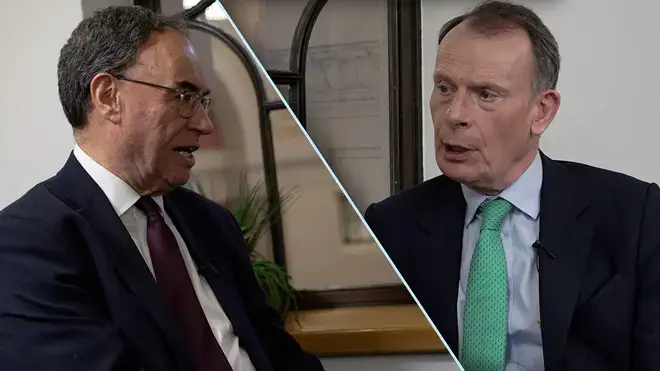
The Governor of the Bank of England (BOE) has called on Donald Trump to get the Strait of Hormuz back open as soon as possible, as he warned interest rates may not be cut in the near future.
Speaking exclusively to LBC’s Andrew Marr, Andrew Bailey warned the economy will continue to falter as long as the US and Israel continue their war on Iran.
It comes after the BOE announced it would hold interest rates at 3.75% amid fears the US-Israel war on Iran could see inflation rise.

The pivot reflects the changing outlook for energy costs on the back of soaring oil and gas prices in recent weeks, and the potential for this to weigh on UK inflation.
Mr Bailey backed the BOE’s decision and suggested it is unlikely rates will be cut as long as the geopolitical situation remains so unstable.
He told LBC: “Our view on the committee is that we've held rates today. I think that's the appropriate thing to do.
“That, of course, is a change from where we were because I thought that over the course of the next few meetings we would probably be able to cut.
“So the message has changed there.
“I'm not going to go beyond that because the situation is so uncertain and so prone to change.
“But I'm not making any predictions about what happens beyond that.”
Calling on Donald Trump to resolve his conflict and reopen the Strait of Hormuz as quickly as possible, he added: “I will come back to the point that the best thing we can do actually for the world economy, for the UK economy and people in the world, is to sort out the problem in terms of reopening the energy supply lines, because that is in the best interest of people in the world.”
In a stark warning, Mr Bailey said things are likely to get worse if war in the Middle East continues.
He said: “Well, the longer it goes on, I'm afraid to say the effect will be larger.
“So I think that's why it's imperative that the government is doing everything that can be done to alleviate this effect. That's the critical thing.”
In an earlier statement announcing the decision to freeze interest rates, he said: “War in the Middle East has pushed up global energy prices.“You can already see that at the petrol pump and, if it lasts, it will feed into higher household energy bills later in the year.
“The best way to tackle this is at the source by reopening energy supply lines.”
He said he would be monitoring developments “extremely closely” and that the Bank “stands ready to act” to make sure inflation returns to the 2% target level.
Consumer Prices Index (CPI) inflation fell to 3% in January, and MPC forecasts in February showed the rate falling toward 2% from April, largely due to Government efforts to cut household energy bills.
But, on Thursday, the MPC said recent increases in wholesale energy costs would delay the return of CPI inflation to target, as it was already leading to higher fuel prices.
It was now expecting inflation to be around 3% in the second quarter of 2026, up from the 2.1% that had been forecast in February.
Higher wholesale gas prices could then feed through into a higher Ofgem energy price cap from July, which could add around 0.75 percentage points to inflation over the third quarter.
This, combined with firms potentially passing on higher energy costs to consumers, could mean CPI inflation increases to up to 3.5% in the third quarter, up from the previous 2% forecast, the MPC said.