

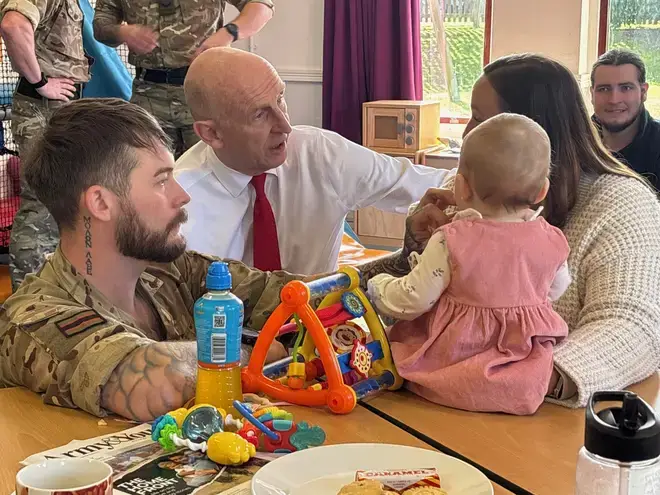

It is hoped the scheme will close the “big gap” in childcare provision between England and Scotland
Share
Want LBC stories before everyone else? Set us as your Preferred Source on Google
Military families in Scotland are to receive additional childcare support worth up to £6,000 per year under a UK Government scheme designed to close the “big gap” in childcare provision between England and Scotland.
The initiative, which will begin in September 2026, will see UK armed forces families in Scotland reimbursed for up to 30 hours of childcare per week for children aged between nine months and three years.
The Ministry of Defence (MoD) said the scheme will save eligible military families in Scotland up to £6,000 per child per year, and ensure they get the same Government-funded childcare support as forces families in England.

Announcing the scheme during a visit to Dreghorn Barracks in Edinburgh on Thursday, UK Defence Secretary John Healey said “it is right” military families get the childcare support they need wherever they are posted.
“I don’t want forces families paying a penalty for serving in Scotland, and there’s a big gap in the help for childcare costs for those serving in England to the big gap that the Scottish Government leaves in Scotland,” he said.
“So, I’m here to confirm that we will match the support in England.
“That means we’ll cover the cost of 30 hours of childcare for children of working parents between the age of nine months until they hit their third birthday.
“It gives them extra options. It means parents can have a choice of serving and living in Scotland and bringing up their family here, which for some is made so much harder at the moment by the Scottish Government’s failure.”
He said in England all working families with children aged between nine months and three years get 30 hours per week free childcare – but that north of the border “this Scottish nationalist government does not do that”.
“We can’t solve the problem for all Scots families, but I can solve the problem for those forces families that support those who serve in uniform, and that’s what I’m announcing today,” he said.
“So, from September, the start of the new academic year, that support will be in place just as it is for England, for any families that are serving here in Scotland.”
As well as matching childcare support in England, the MoD also said the scheme is a “major step” in the delivery of its pledge to renew the UK’s contract with its armed forces.
It added that childcare is cited as one of several factors affecting Armed Forces retention and morale, and that addressing it is part of the government’s “mission” to fix the recruitment crisis.
Scottish Secretary Douglas Alexander said: “The UK Government is renewing the country’s contract with our military personnel, and this latest scheme will be transformative in helping tackle the cost of living for hundreds of Armed Forces families in Scotland.
“It is vital that those who serve – and have served – in the military and their families receive fair treatment.
“In addition to this latest measure – saving up to £6,000 per year in childcare costs for each child – we have introduced a new housing strategy which will make homes fit for heroes, delivered the biggest pay rise for personnel in 20 years and put the Armed Forces Covenant into law.
“Scotland plays such a vital role in the UK’s defence and I am appreciative, and deeply proud of, our service personnel.
“Their professionalism and bravery are rightly respected worldwide, and it is our duty to back them.”
A Scottish Government spokesperson said: “It is for the MoD, as an employer, to decide what childcare benefits it provides for those who serve.
“Scotland remains the only part of the UK to offer 1,140 hours a year of funded early learning and childcare to all three and four-year-olds and eligible two-year-olds, backed by £1 billion annual investment.
“If families paid for their full entitlement themselves, it would cost them more than £6,000 per eligible child per year.”
