


Doctors hope the change will help reduce the record high transplant waiting list
Share
Hundreds more organs could be saved for transplant every year thanks to preservation techniques being trialled by NHS doctors.
Several major hospitals in England are running a pilot to keep donor organs preserved for longer so checks can be carried out to see whether they are suitable for transplant.
At present, there is not always enough time to carry out tests on organs before they need to be used.
This means doctors are not always confident about accepting them for operations.

If successful, the pilot would lead to the first full national network in the world for reconditioning organs.
Under the scheme, up to 750 more organ transplants could be carried out every year – a 19% rise on current figures.
This could include up to 202 more liver transplants being carried out, up to 202 more lung transplants and up to 345 additional kidney transplants.
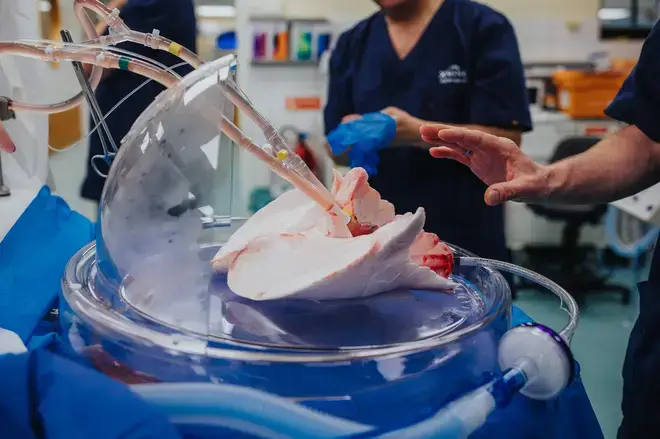
Perfusion is a technique for circulating oxygenated blood or nutrient-rich fluids through organs, preserving their function and enabling more time for them to be assessed.
The first lung pilot centre has opened at Royal Papworth Hospital in Cambridge, and will be followed by lung pilot sites at the Freeman Hospital in Newcastle and Harefield Hospital in London.
Some 12 liver and kidney pilot centres will also open in the coming months.
NHS Blood and Transplant (NHSBT) says changes are needed to save more organs owing to the record high transplant waiting list, which is consistently over 8,000 people.
The potential donor pool is also falling as people live longer and have long-term health conditions.
Derek Manas, medical director for organ and tissue donation and transplantation at NHSBT, said the aim is to create “centres of excellence” that benefit patients across the country.
Some trusts already have perfusion techniques but the aim is to standardise practice and create a network.
He said: “There are two aims of perfusion. One is to extend the preservation time – the standard currently is to put all organs in a box of ice.
“What the perfusion machines will do is give us more time to keep the organs viable. So you can keep organs on a machine until the theatre is available, until surgeons are available, until anaesthetic staff are available and so on.
“The heart probably has the least extended time. At the moment, in a box of ice, you’ve got about three hours at the most, but with machine perfusion you’ve got eight hours and probably longer.
“For livers, you can probably extend the time to 12 to 24 hours."
Manas continued: "The other value of perfusion is assessing the functionality of the organs.
“Most organ donors now are older […] so putting organs on a machine allows you to assess their function.”
With perfusion, organs are connected to a device by tubes going into the arteries.
Organs are then fed blood or an oxygenated substance, plus nutrients. Waste products such as bile are removed.
With a full reconditioning network, organs could also receive additional reconditioning treatments, such as surgical repairs, medications, blood group changing or cell therapies.
Anthony Clarkson, NHSBT director of organ and tissue donation and transplantation, said: “There is an urgent need to innovate in organ utilisation.
“Survival on the transplant waitlist is a daily struggle, and hundreds of patients will die this year before they can receive a life-saving transplant.
“Donation alone cannot close the gap. This programme will help us preserve donor organs so we can assess them and make the best use of the gift of donation.”
Dr Zubir Ahmed, the Government’s health innovation and safety minister, said: “Every person waiting for a transplant deserves the best possible chance of receiving one.
“We are committed to funding this crucial programme because, as part of our plans to build an NHS fit for the future, we want to use the latest technology to give clinicians more time and better tools to assess organs safely, honouring the extraordinary generosity of donors and their families.
“This programme could mean saving and transforming hundreds of lives that might otherwise have been lost.
“As a transplant surgeon, I know first-hand what that can mean for patients and families, and I am proud that the UK is leading the world in this approach.”
The transplant centres acting as pilot sites for kidneys are Cambridge, Newcastle, Oxford, Edinburgh, Royal Free, Manchester and Hammersmith.
Liver sites are Cambridge, Royal Free, Kings College, Edinburgh, Newcastle, while lung sites are Cambridge, Newcastle and Harefield.