

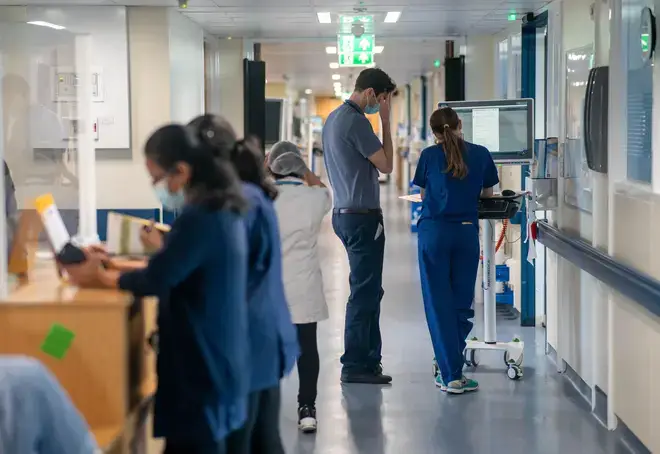

Half of emergency care doctors feel their department is “unsafe” for patients.
Share
NHS staff are avoiding eye contact with patients because they are “embarrassed” about how they are being treated in A&E departments, MPs have heard.
It comes as a new poll found that half of emergency care doctors feel their department is “unsafe” for patients.
MPs on the Health and Social Care Committee heard how one senior emergency care doctor is reported to have said: “I don’t think I can go back and do another shift, because I am embarrassed at the care we are delivering.”
Meanwhile, health experts warned that NHS data can be “gamed” to say “whatever you want”, so action needs to be taken to tackle the culture in hospitals.

Giving evidence to the Committee of MPs, Dr Ian Higginson, president of the Royal College of Emergency Medicine (RCEM), revealed data from a new poll from emergency medicine clinical leaders from 80 of England’s emergency departments, which found:
– Half (51%) said their emergency department was fairly or very unsafe.
– Almost nine in 10 (88%) said A&E “overcrowding” was a daily occurrence.
– Nearly three in five (59%) said their department was moderately understaffed, while 30% said that it was severely or dangerously understaffed.
– Some 30% of new starters in emergency medicine are showing active evidence of burnout.
– Medics responding to the survey described “inhumane” working conditions with “non-existent” staff morale, with others highlighting “increased numbers of nurses crying after shifts”.
Staff feel 'unheard and unsupported'
Dr Higginson said: “Often our staff feel that they’re left to fend for themselves, with poor engagement throughout the system, and they often feel unheard and unsupported because it has been going on for so long with little apparent mitigation.
“And we agree with the reported increase in violence and aggression towards staff, which is now being related to corridor care.
“So why does this matter? Well there is a human cost – staff reduce hours, retire early or leave.
“I was around to dinner with a friend of mine the other day, a very experienced consultant. We started talking about retirement, and he said: ‘I love my job, I feel I’ve got so much to offer, I love emergency medicine, (but) I don’t think I can go back and do another shift, because I am embarrassed (about what) we are delivering’.
“And on a personal level, the phenomenon of avoiding eye contact is something I have experienced.”
Professor Nicola Ranger, chief executive and general secretary of the Royal College of Nursing, said the scenario of patients being cared for on corridors in A&E had “spilled out to wards”.
“For many (nurses) that’s what they feel very ashamed about – when they know that someone is stuck by a nurse’s station, and there’s someone needs to toilet, or they’re dying and they need a quiet space, and so that real sense of anger, shame,” she told MPs.
“They’re losing hope. That’s why there’s got to be a sense of urgency on this, because they’re just feeling this is just the way it is.”
Asked if there is a sense of embarrassment among nursing staff, she added: “I think there is, and I think people are genuinely trying.
“I was talking to a patient last week who said they (nurses) feel embarrassed, so there’s a lack of eye contact.
“Now those are symptoms of people just almost ‘head down’ because they feel upset with what they’re seeing.
“And when patients are struggling for a nurse to give them eye contact. That’s not a good place… I think that’s a real symptom of many nurses not feeling proud of what they are doing.”
Prof Ranger said capturing data is “only going to be part” of resolving the issue of corridor care.
Conservative MP Joe Robertson asked: “Will someone waiting in an ambulance count as waiting in a corridor care setting?
“Because if they don’t, then clearly a hospital or a Government looking to improve the corridor care figures will simply leave people in ambulances, and you create another massive problem.”
Pressed on whether corridor care data could be improved by leaving patients in ambulances, Prof Ranger raised concerns that organisations are already “playing off” the data.
She said: “People can game it now. I’ve been to a hospital where they were telling me the 45 minute handover delay ambulance was brilliant.
“What they didn’t tell me was there were five extra patients stuck on the ward in order to achieve that.
“You can play all of the system off each other, which is why it will come down to culture.
“The data can be played off to say whatever you want, but we’ve got to make this about people and patients, and that requires culture and leadership.”