

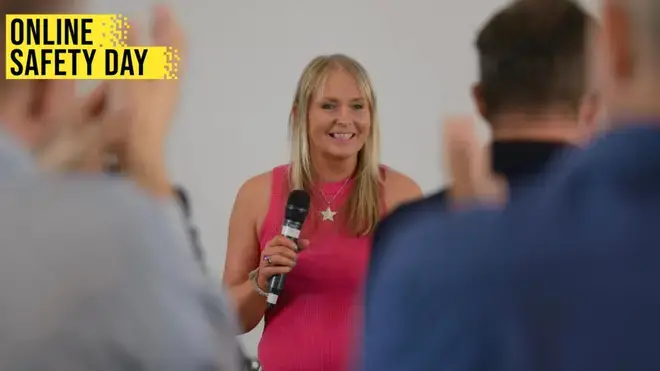

“Young people are seeing it online and then acting it out themselves”
Share
A sex educator who delivers talks to empower teachers, parents and young adults has warned that "sex is broken" – and knows exactly where the blame lies: pornography.
Larissa Astara Gray is on a mission to transform sex education and get people talking about sex in an honest and upfront way. Her message is blunt: avoidance isn’t protecting anyone.
“Sex is a taboo subject,” she told LBC. “It’s still an elephant in the room.”
Too often, she argues, adults don’t feel equipped to lead those conversations.

“Parents don’t want to talk about it, and teachers also don’t know what to do”.
In that silence, young people are left to learn from what’s loudest, easiest to access and most pervasive online.
In her work, she’s witnessed a shift in expectations, pressure and what some young people come to think is “standard” due to pornography.
The problem, she says, isn’t just that porn exists, it’s what it can normalise when it becomes a main source of “sex education”.
Larissa warned the usually violent nature of porn has led to an increase in strangulations.
“So much of this behaviour – such as choking – is now the norm”, she said.
Larissa warned that porn hides a dark reality from its audience from the wellbeing of performers to the expectations it can set for viewers.
She spoke of a worrying trend of young people buying sexual performance-enhancement drugs from high-street retailers. These products are typically marketed at older men which shows a growing pressure to “perform” rather than connect through intimacy.
She also reported more and more young women saying sex now feels painful and performative, rather than pleasurable.
'Addictive'
Additionally, she has warned of the impact of young people bypassing the Online Safety Act and using VPNs to access more extreme porn on the dark web.
“Young people are tech savvy, they’re not going to want to step away from watching porn once the tentacles are in, especially as it’s so addictive.”
Beyond the impact on expectations, Larissa has raised concerns that a lot of online porn may be linked to exploitation and trafficking, and that on-screen pleasure is acted out. The result, she warns, is a pipeline from what’s seen online to what’s acted out in person: “Young people are seeing it online and then acting it out themselves”.
She believes young people need to be taught how to separate fantasy from reality and understand what safe, healthy sex looks like. “Education is what we need. We need to take the power back from porn.”
Last August, a report by the children’s commissioner was titled ‘Sex is kind of broken now’.
“I completely agree with that title and it drove my determination even more seeing some of the statistics in there. This includes the fact 44% of young people had watched porn depicting rape.
Porn isn’t the only influence. Larissa said now social media can act as almost a gateway to access porn, where young people are seeing “highly sexualised images” online all the time.
She believes this can intensify pressure on body image and warp how young people view themselves and others. In her words, it “normalises objectification”.
“When young people see these images their sexual energy is activated.” Without guidance, she argues, it can distort what young people think sexuality is for: “They think sexuality is just all about objectifying people”.
Larissa also warned that young people are taking and sending nude images of themselves, creating serious risks for parents as well as children; images involving under-18s may be treated as illegal child sexual abuse material, even when shared between peers if on a phone that is owned by a parent.
Larissa is also worried about the rise of lad culture on social media and the emerging trend of boys thinking girls can be pushed into giving consent through manipulation and persistence.
“The idea that girls can be persuaded or talked into saying yes is becoming increasingly normal”. She added this type of thinking is creating a “rape culture”.
Through consent workshops, Larissa aims to normalise discussing consent beforehand and disagrees with the idea that to do so can “kill the mood”.
She insists that “it’s not going to put people off” and that normalising these conversations is essential for safer, healthier sex and more realistic expectations. She also teaches the impact of non-consensual sexual experiences and the importance of making conscious decisions in these workshops.
“I teach people the impact of non-consensual experiences. You can’t commit these crimes so easily once you’ve learned that”. She believes people nowadays are now so desensitised to rape and sexual assault. “I want to resensitise these crimes, these crimes destroy lives.”
She explained: “Being raped at the age of 13 took my voice away and shut me down. My life turned from what it should have been and filled with shame. I hated myself and toxic relationships became the norm. I don’t want young people to suffer the way I did”.
Ultimately, Larissa is confident the power of porn can be challenged, but only if education catches up with reality. She compared it to the way the government cracked down on smoking, arguing that meaningful progress can come when the government intervenes with public education and clear health warnings.
Online pornography showing strangulation or suffocation is to be made illegal, as part of government plans to crack down on violence against women and girls.
Any material depicting strangulation or suffocation will be criminalised after a review found the harmful images were rife on websites.
Non-fatal strangulation is already an offence in its own right but it is not currently illegal to show it online.
A government spokesperson said: "Violent pornography is not only deeply distressing, it is dangerous – especially for young people.
"Those who post or promote such content are contributing to a culture of violence and abuse that has no place in our society.
“We made the depiction of strangulation and suffocation in pornography a priority offence under the Online Safety Act, meaning platforms will have to take active steps to stop this content reaching users, or face robust enforcement action from Ofcom.”